
Why did Krishna run to embrace a poor brahmin in rags? Read the Sudama story from the Bhagavatam and learn how a...
Latest posts
-
 Krishna and Sudama: The Poor Brahmin Who Became Wealthy in LoveRead more
 -
 Vamana Avatar: How Three Steps Humbled Bali MaharajaRead more
Why did a powerful king give away three worlds to a boy asking for three steps? Learn the Vamana avatar story from...
-
 The Bhagavatam on Marriage: Duty, Love and Spiritual PartnershipRead more
What does the Bhagavatam say about marriage? Through the stories of Kardama and Devahuti, Rukmini's secret letter and...
-
 What Is Prema? The Bhagavatam's Highest Stage of Love for GodRead more
Prema is love for God with no "because" attached. Learn how the Bhagavatam describes it, the nine steps from faith to...
-
 Is Shiva Parvati Kalyana Mentioned in Srimad Bhagavatam? What the Scripture Really SaysRead more
Looking for Shiva and Parvati's wedding in the Srimad Bhagavatam? Find out what the scripture actually describes,...
-
 How Many Modes of Devotion Are Mentioned in Bhagavatam?Read more
A young boy named Prahlada listed nine ways to serve God, and the Bhagavatam keeps them as its answer. Learn what the...
-
 What Is Bhagavatam and Why Has It Been Read for 5,000 Years?Read more
A dying king asked one question, and the answer became the Bhagavatam. Learn what this Sanskrit scripture contains,...
-
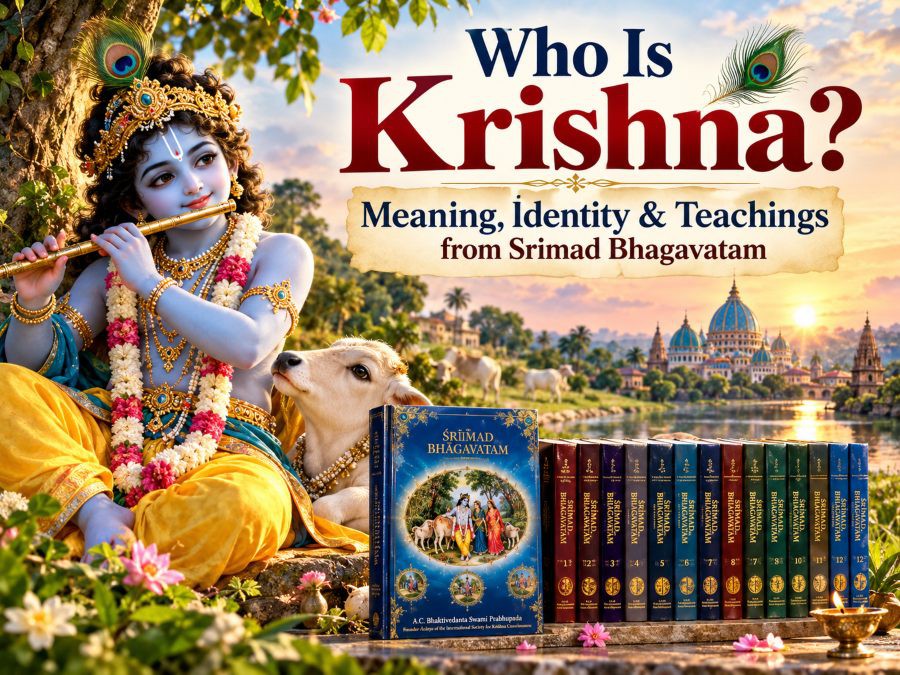 Who Is Lord Krishna? His Meaning, Teachings and Pastimes ExplainedRead more
Discover who Krishna is according to Srimad Bhagavatam, including His divine identity, childhood pastimes, teachings,...
-
 Incense in Islam: Bakhoor, Agarbatti and What Tradition SaysRead more
Is burning fragrance part of Muslim tradition? Explore incense in Islam, from the Prophetic practice of fumigating...
-
 History of Agarbatti: From Vedic Dhupa to Modern Incense SticksRead more
Where did agarbatti really come from? Follow the history of agarbatti from Vedic fire rituals and temple dhupa to...
Blog categories
- Default category (0)
- MUSICAL INSTRUMENT (1)
- BOOK (5)
- DEVOTIONAL GIFT (0)
- Blog (30) click
- CHANDAN (12)
- Bhagavatam Wisdom Series (68)
- Krishna Consciousness (14)
- Mridangam Musical Instrument (6)
- Bhagavad Gita for Beginners (13)
- Bhagavad Gita As It Is (37) click
- Bhagavad Gita As It Is Telugu (0)
- Bhagavad Gita As It Is Marathi (0)
- Bhagavad Gita As It Is In Hindi (0)
- Bhagavad Gita As It Is In English (0)
- Bhagavad Gita As It Is In Bengali (8)
- Bhagavad Gita As It Is In Kannada (0)
- Bhagavad Gita As It Is In Gujarati (0)
- Bhagavad Gita As It Is In Panjabi (0)
- Bhagavad Gita As It Is In Tamil (0)
- Bhagavad Gita As It Is Odia (0)
- BHAGAVAD GITA As It Is GERMAN (0)
- Bhagavad Gita As It Is In French (0)
- Bhagavad Gita As It Is In Nepali (0)
- Bhagavad Gita As It Is In Assamese (0)
- Incense or Agarbatti (38)
- Lord Chaitanya Mahaprabhu (3)
- Vedic Temple Mayapur (14)
- kalki (15)
- Mahabharata – Dharma & Destiny (27)
- Vaishnava Scriptures (4)
- healthy product (4)
- chaitanya mahaprabhu (5)
- Tulsi Mala Guide (17)
Search in blog
The Story of Ajamila Reconsidered: What “Narayana” Really Saved
The Story of Ajamila Reconsidered: What “Narayana” Really Saved
What if a single word spoken at the very edge of death could change the direction of an entire life? The story of Ajamila in the Srimad Bhagavatam is often remembered as a dramatic example of the power of the holy name, but there is much more happening beneath the surface. His story becomes even more fascinating when we place it against the spiritual framework of the four yugas, the nature of karma, and the transforming power of devotion.
Ajamila was not a saint when death came for him. He had fallen deeply into immoral living and had spent years attached to worldly pleasures. Yet, at the decisive moment, he called out the name Narayana. That one utterance stopped the servants of Yamaraja and opened the door to a second chance.
But what exactly did “Narayana” save him from?
And did Ajamila's story mean that anyone could live recklessly and simply chant God's name at the last moment?
The Srimad Bhagavatam gives a much deeper answer.
Ajamila Was Once a Respectable Brahmana
Ajamila's story appears in the Sixth Canto of the Srimad Bhagavatam. His early life was very different from the person he eventually became.
He was born into a respectable brahmana family and was trained in religious principles. He followed the expected duties of his position and had developed habits of discipline and spiritual practice.
Then everything changed.
One day, Ajamila encountered a woman whose behavior deeply disturbed his mind. Instead of turning away from the temptation, he became increasingly attached to her. His attraction eventually overwhelmed his previous values.
The fall was gradual.
That detail matters.
Ajamila did not wake up one morning and decide to destroy his life. His transformation happened through repeated attachment, desire, and indulgence. He abandoned his previous responsibilities, left his virtuous path, and became absorbed in activities condemned by the spiritual culture in which he had been raised.
His story therefore begins as a warning about the power of uncontrolled attachment.
How One Attachment Changed Everything
Ajamila eventually had several children with the woman he had chosen as his companion. His youngest son was named Narayana.
That name would become the turning point of the entire story.
Ajamila became extremely attached to the child. He constantly called him, played with him, watched him, and worried about him.
“Narayana.”
He repeated the name again and again.
But there is an interesting irony here.
Ajamila was not consciously worshiping the Supreme Lord every time he called his son. His affection was directed toward his child.
Yet the sacred name he pronounced was still Narayana, a name of the Supreme Lord.
The Bhagavatam uses this situation to reveal something extraordinary about the nature of the holy name.
Death Arrives Without Asking Permission
Eventually, Ajamila reached the end of his life.
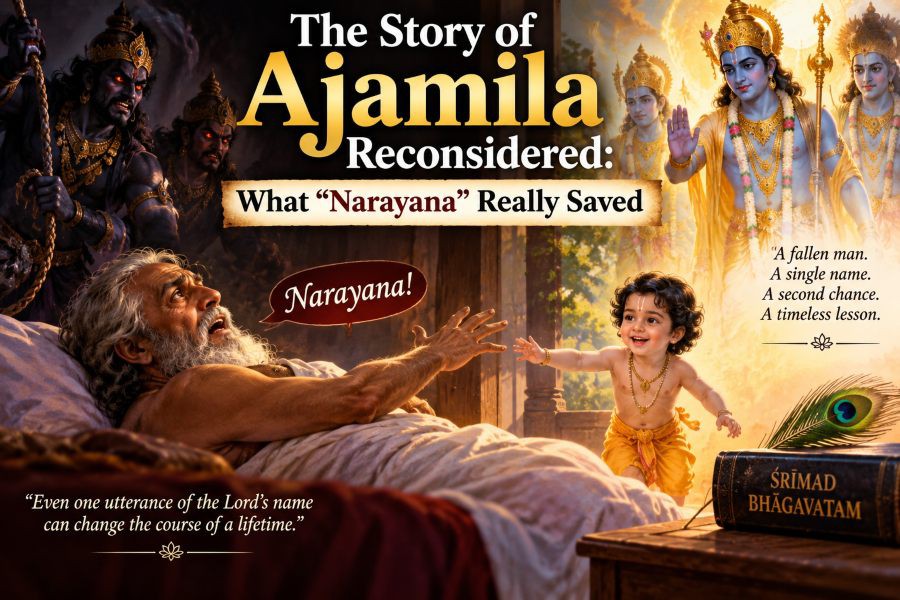
The years of sinful conduct had caught up with him. As he lay on his deathbed, terrifying figures appeared before him.
These were the Yamadutas, the servants of Yamaraja.
Seeing them, Ajamila became frightened.
His mind immediately turned toward his youngest son. In desperation, he cried out:
“Narayana!”
He was calling for his child.
But the spiritual consequences of that sound were far greater than Ajamila understood.
The Yamadutas were about to take him away when another group appeared: the Vishnudutas, servants of Lord Vishnu.
They stopped the Yamadutas.
Ajamila had unknowingly invoked the holy name of the Lord.
That is the dramatic heart of the story.
What Did “Narayana” Actually Save?
This is where the story is often simplified.
A popular interpretation says, “Ajamila sinned throughout his life, said Narayana once, and immediately went to heaven.”
That is not what the Bhagavatam actually presents.
Ajamila was saved from immediate punishment by the Yamadutas, but he still had spiritual work to do.
The Vishnudutas explain the power of chanting the Lord's name and challenge the understanding of karma held by the Yamadutas. Their discussion reveals that the holy name has a purifying power that ordinary karmic calculations cannot fully measure.
Ajamila had committed serious offenses.
Yet his utterance of the Lord's name created a remarkable spiritual turning point.
The immediate result was not final liberation.
It was another opportunity.
That distinction changes the entire meaning of the story.
The Difference Between Being Saved and Being Finished
Imagine someone receiving a second chance after narrowly escaping disaster.
Being rescued does not mean the person has already completed the journey.
The same principle applies to Ajamila.
After the Vishnudutas disappeared, Ajamila realized how dangerously he had lived. He understood that his attachment to temporary pleasure had taken him far away from his original spiritual purpose.
This realization changed him.
He left his previous life and went to Haridwar, where he devoted himself to spiritual practice and remembrance of the Supreme Lord.
Now the story takes a second turn.
Ajamila did not use the mercy he had received as an excuse to continue living carelessly.
He responded to it by changing his life.
That is one of the most important lessons hidden inside his story.
The Holy Name Is Not a License for Sin
The story of Ajamila should never be reduced to the idea that people can deliberately commit wrongdoing and then use God's name as an emergency escape plan.
That attitude completely misses the transformation that follows his rescue.
The Bhagavatam repeatedly emphasizes the power of the holy name, but it also describes the danger of sinning on the strength of chanting.
There is a huge difference between:
· accidentally or unintentionally invoking the holy name, and
· deliberately committing wrongdoing while planning to depend on chanting afterward.
Ajamila belonged to the first category.
He did not name his son Narayana because he wanted a spiritual loophole. He had no such plan.
His chanting became the beginning of his awakening.
Why the Story Is About Mercy as Much as Karma
Ajamila's life raises a fascinating question.
If karma alone determined everything, how could one utterance of a divine name interrupt the consequences of so many actions?
The Bhagavatam's answer points toward divine mercy.
Karma describes the consequences of actions. But bhakti introduces another dimension: the conscious relationship between the individual and the Supreme Lord.
The holy name is not treated as an ordinary sound.
When the name of the Lord enters Ajamila's life, even unintentionally, it begins to break the chain that had bound him to his previous behavior.
The message is not that actions have no consequences.
It is that divine grace can create a path beyond the mechanical cycle of reaction and consequence.
Ajamila's Second Life Is the Part We Should Remember
The most inspiring part of Ajamila's story may actually come after the famous moment at his deathbed.
He had been given time.
What did he do with it?
He practiced devotion.
He remembered the Lord.
He purified his consciousness.
He seriously engaged in spiritual life.
Eventually, the Vishnudutas returned for him. This time, Ajamila was prepared.
The story ends with his departure from the material world and his attainment of the spiritual destination.
So the complete sequence looks like this:
Fall → attachment → sinful life → death → chanting Narayana → rescue → realization → devotional practice → final liberation.
That sequence is far more meaningful than the simplified version.
A Lesson About the Name We Repeat Every Day
Ajamila's story also makes us think about language itself.
We constantly repeat names, slogans, phrases, and ideas. Some words deepen our awareness; others reinforce material desires.
Ajamila spent years calling “Narayana” because of his son. The repetition eventually became connected with the holy name of the Lord.
The Bhagavatam therefore presents chanting as a powerful spiritual practice because sound can shape consciousness.
What we repeatedly speak about begins to occupy our minds.
What occupies our minds influences what we desire.
And what we desire eventually influences how we live.
This is why bhakti traditions place such emphasis on hearing and chanting.
Ajamila's Story Is Really About the Direction of a Life
It would be easy to focus only on the spectacular moment when the Vishnudutas appear.
But the deeper lesson is quieter.
Ajamila shows how quickly a life can move in the wrong direction—and how quickly sincere spiritual awakening can change its direction.
His story contains both warning and hope.
The warning is that uncontrolled attraction can pull even a trained person away from his principles.
The hope is that spiritual recovery is still possible.
Even someone who has fallen deeply is not beyond redemption.
But redemption requires more than a dramatic moment.
It requires transformation.
What the Srimad Bhagavatam Wants Us to Understand
The story of Ajamila does not tell us to wait until death before remembering God.
It tells us almost the opposite.
Do not gamble with the final moment.
Do not assume that you will suddenly become spiritually focused when the body is failing and fear has taken over the mind.
Ajamila was extraordinarily fortunate.
His final utterance became the doorway to another opportunity.
Most importantly, he recognized that opportunity and acted upon it.
The Srimad Bhagavatam therefore presents his story as both a warning against sinful attachment and a powerful demonstration of the mercy associated with the Lord's holy name.
The Real Miracle Was Not Only the Word “Narayana”
The most remarkable part of Ajamila's story is not simply that he spoke the name Narayana.
It is what happened afterward.
The name interrupted his downward journey.
The realization awakened his conscience.
The rescue gave him another chance.
And that second chance became a life of genuine devotion.
That is why Ajamila's story remains so compelling. It does not promise an easy escape from responsibility. Instead, it shows that divine mercy can reach a person even in the darkest moment—and that genuine gratitude for that mercy should lead to a changed life.
Ajamila called for his son.
He received something far greater than he expected.
His story reminds us that the spiritual path may begin in an unexpected moment, with an unexpected word, but it becomes meaningful when that moment leads us toward sincere remembrance, devotion, and transformation.
The question, then, is not simply whether we can call out “Narayana” at the end.
The deeper question is:
What are we training our minds to remember long before that final moment arrives?
That is the question Ajamila leaves behind—and one of the enduring lessons of the Srimad Bhagavatam.
Posted in: Bhagavatam Wisdom Series
Related posts
-
 Why to read srimad bhagavatamReading the Srimad Bhagavatam fosters deep spiritual growth by narrating the life and teachings of Lord Krishna,...Read more
 -
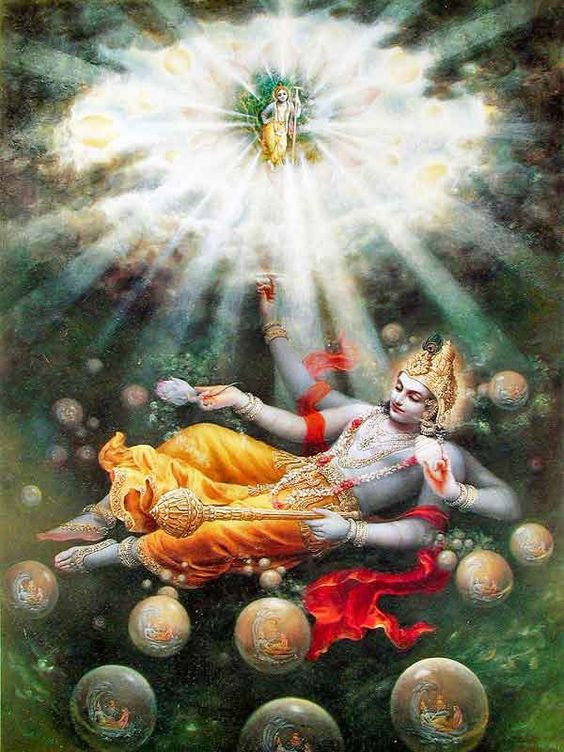 When was srimad bhagavatam written?The Srimad Bhagavatam is believed to have been written around 9th-10th century CE, though its oral traditions date...Read more
 -
 How many chapters are there in srimad bhagavatam?The Srimad Bhagavatam consists of 12 cantos (books) containing 335 chapters in total. Each canto covers various...Read more
 -
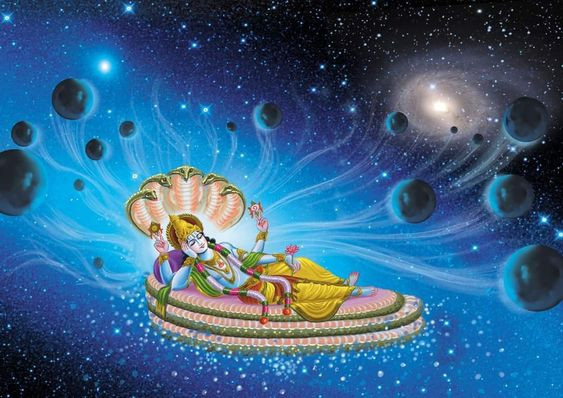 How many skandhas are there in srimad bhagavatamThe Srimad Bhagavatam is divided into 12 skandhas (cantos or books). Each skandha explores different themes,...Read more
 -
 How many slokas in srimad bhagavatamThe Srimad Bhagavatam contains approximately 18,000 shlokas (verses). These verses are spread across its 12 skandhas...Read more
Leave a comment