
Why did Krishna run to embrace a poor brahmin in rags? Read the Sudama story from the Bhagavatam and learn how a...
Latest posts
-
 Krishna and Sudama: The Poor Brahmin Who Became Wealthy in LoveRead more
 -
 Vamana Avatar: How Three Steps Humbled Bali MaharajaRead more
Why did a powerful king give away three worlds to a boy asking for three steps? Learn the Vamana avatar story from...
-
 The Bhagavatam on Marriage: Duty, Love and Spiritual PartnershipRead more
What does the Bhagavatam say about marriage? Through the stories of Kardama and Devahuti, Rukmini's secret letter and...
-
 What Is Prema? The Bhagavatam's Highest Stage of Love for GodRead more
Prema is love for God with no "because" attached. Learn how the Bhagavatam describes it, the nine steps from faith to...
-
 Is Shiva Parvati Kalyana Mentioned in Srimad Bhagavatam? What the Scripture Really SaysRead more
Looking for Shiva and Parvati's wedding in the Srimad Bhagavatam? Find out what the scripture actually describes,...
-
 How Many Modes of Devotion Are Mentioned in Bhagavatam?Read more
A young boy named Prahlada listed nine ways to serve God, and the Bhagavatam keeps them as its answer. Learn what the...
-
 What Is Bhagavatam and Why Has It Been Read for 5,000 Years?Read more
A dying king asked one question, and the answer became the Bhagavatam. Learn what this Sanskrit scripture contains,...
-
 Who Is Lord Krishna? His Meaning, Teachings and Pastimes ExplainedRead more
Discover who Krishna is according to Srimad Bhagavatam, including His divine identity, childhood pastimes, teachings,...
-
 Incense in Islam: Bakhoor, Agarbatti and What Tradition SaysRead more
Is burning fragrance part of Muslim tradition? Explore incense in Islam, from the Prophetic practice of fumigating...
-
 History of Agarbatti: From Vedic Dhupa to Modern Incense SticksRead more
Where did agarbatti really come from? Follow the history of agarbatti from Vedic fire rituals and temple dhupa to...
Blog categories
- Default category (0)
- MUSICAL INSTRUMENT (1)
- BOOK (5)
- DEVOTIONAL GIFT (0)
- Blog (30) click
- CHANDAN (12)
- Bhagavatam Wisdom Series (68)
- Krishna Consciousness (14)
- Mridangam Musical Instrument (6)
- Bhagavad Gita for Beginners (13)
- Bhagavad Gita As It Is (37) click
- Bhagavad Gita As It Is Telugu (0)
- Bhagavad Gita As It Is Marathi (0)
- Bhagavad Gita As It Is In Hindi (0)
- Bhagavad Gita As It Is In English (0)
- Bhagavad Gita As It Is In Bengali (8)
- Bhagavad Gita As It Is In Kannada (0)
- Bhagavad Gita As It Is In Gujarati (0)
- Bhagavad Gita As It Is In Panjabi (0)
- Bhagavad Gita As It Is In Tamil (0)
- Bhagavad Gita As It Is Odia (0)
- BHAGAVAD GITA As It Is GERMAN (0)
- Bhagavad Gita As It Is In French (0)
- Bhagavad Gita As It Is In Nepali (0)
- Bhagavad Gita As It Is In Assamese (0)
- Incense or Agarbatti (38)
- Lord Chaitanya Mahaprabhu (3)
- Vedic Temple Mayapur (14)
- kalki (15)
- Mahabharata – Dharma & Destiny (27)
- Vaishnava Scriptures (4)
- healthy product (4)
- chaitanya mahaprabhu (5)
- Tulsi Mala Guide (17)
Search in blog
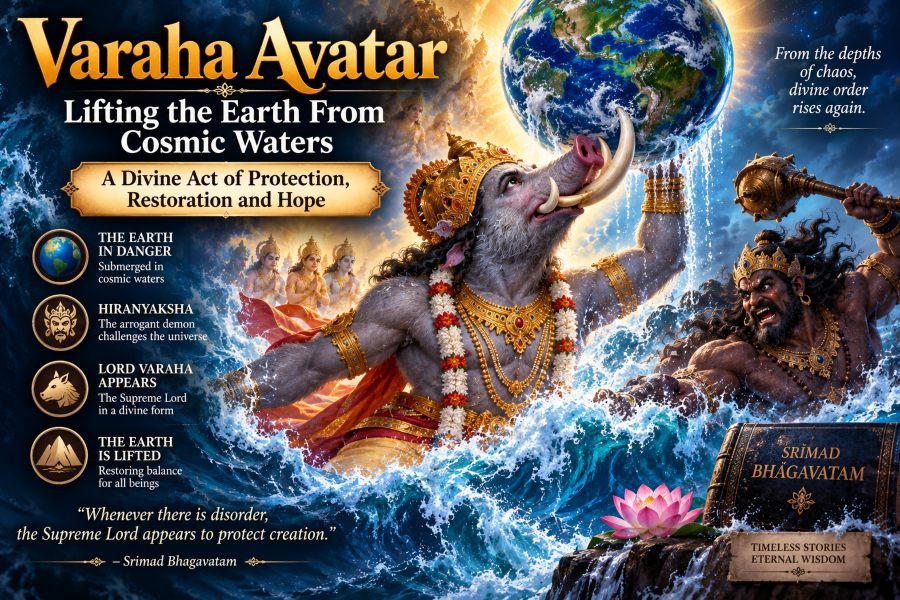
Varaha Avatar: Lifting the Earth From Cosmic Waters
Varaha Avatar: Lifting the Earth From Cosmic Waters
What would it take to rescue an entire world from the bottom of a cosmic ocean? The story of Varaha Avatar, one of the most striking incarnations of Lord Vishnu, answers that question with an image that is both immense and intimate: the Supreme Lord appearing as a divine boar, entering the cosmic waters, defeating the powerful demon Hiranyaksha, and raising the Earth from the depths. For readers exploring the concept of maya, the story offers another important idea: the visible universe may appear unstable and temporary, yet behind its changing forms stands a divine intelligence that sustains and protects creation. The Srimad Bhagavatam presents Varaha not merely as a mythological hero, but as a powerful expression of divine protection.
When the Earth Disappeared Beneath the Waters
The story begins with a world thrown into disorder.
According to the Srimad Bhagavatam, the Earth had been submerged beneath the cosmic waters. The devas and other divine beings were unable to restore the Earth by their own strength. The situation demanded intervention from the Supreme Lord.
Then something extraordinary happened.
Lord Vishnu assumed the form of Varaha, the divine boar.
At first, the form may seem surprising. Why a boar?
The answer lies partly in the nature of the mission. Varaha needed to enter deep waters and recover the Earth from a place where an ordinary divine form would not be suited to the task. The incarnation demonstrates a recurring principle in Vaishnava theology:
The Supreme Lord appears in whatever form is required to protect creation and restore spiritual order.
Varaha's form is not a limitation on Vishnu. It is an expression of His unlimited freedom.
Why a Boar?
A boar naturally searches through earth and water, using its strength and powerful snout to uncover what lies beneath the surface.
That makes Varaha an especially fitting form for this particular divine act.
The imagery is striking. The Lord does not remain distant while the Earth is trapped below the waters. He enters the environment Himself.
He goes where the danger is.
This is one of the reasons the Varaha story has remained so powerful within the Hindu tradition. Divine protection is presented as active rather than abstract.
The Lord does not merely give instructions.
He descends.
Hiranyaksha: The Force Behind the Crisis
Varaha's appearance is closely connected with the demon Hiranyaksha, a powerful asura whose strength and arrogance had become a threat to the cosmic order.
Hiranyaksha was not simply a physically powerful opponent. His character represents a particular kind of consciousness—one that becomes intoxicated with strength and increasingly hostile toward divine authority.
His confidence was enormous.
He challenged powerful beings.
He searched for an opponent capable of matching him.
Eventually, he encountered Varaha.
What follows is one of the great cosmic battles described in the Srimad Bhagavatam.
A Battle That Shook the Cosmic Order
The confrontation between Varaha and Hiranyaksha was not a small fight between two ordinary warriors.
The battle represented a conflict between divine order and destructive pride.
Hiranyaksha had tremendous physical power and fought fiercely. Varaha, however, remained unstoppable.
The descriptions in the Bhagavatam emphasize the extraordinary scale of the encounter. The two opponents fought with weapons, strength, speed, and determination.
Yet there was never any real doubt about the final outcome.
Hiranyaksha's power had a limit.
Varaha's power did not.
Eventually, Lord Varaha defeated the demon.
The danger was removed.
But the greater purpose of the incarnation remained.
The Earth still had to be rescued.
Varaha Lifts the Earth
After entering the cosmic waters, Varaha located the submerged Earth.
He lifted her upon His tusks.
This is the image most closely associated with Varaha Avatar: the mighty divine boar emerging from the cosmic ocean with the Earth raised safely above the waters.
It is difficult to imagine a more dramatic visual representation of protection.
The Earth is vulnerable.
The Lord is powerful.
And between them stands the divine act of rescue.
The image also changes the way we think about Vishnu's role as the preserver.
Preservation is not always passive.
Sometimes preservation means entering chaos, confronting danger, and restoring what has been displaced.
The Earth as Bhudevi
In Vaishnava traditions, the Earth is often personified as Bhudevi, the goddess associated with the Earth.
This gives the Varaha story another layer of meaning.
The Earth is not treated merely as an inert object floating through space. She is presented as something worthy of divine care and protection.
Varaha's relationship with Bhudevi is therefore deeply connected with the idea of divine guardianship.
The Lord protects the world because the world is part of His cosmic arrangement.
For devotees, this makes the story personal.
The same Supreme Being who restores the Earth is understood as the protector of individual living beings.
The Deeper Meaning of Varaha Avatar
It is easy to read the story only as a supernatural rescue tale.
But the Srimad Bhagavatam invites a deeper reading.
The Earth disappears beneath the waters.
The forces of disorder gain influence.
Divine intervention becomes necessary.
The Lord appears.
The demon is defeated.
The Earth is restored.
This sequence can be understood as a recurring spiritual pattern.
When consciousness becomes overwhelmed by ignorance and destructive desire, the original sense of order can seem buried.
Spiritual knowledge then acts like a force that lifts consciousness upward.
The symbolism should not replace the traditional account, but it can help modern readers connect with the story.
Varaha and the Problem of Pride
Hiranyaksha's downfall is especially interesting because he possesses something many people desire: enormous power.
Yet power does not save him.
His problem is not simply strength. It is strength without humility.
This distinction matters.
Strength can protect.
Strength can build.
Strength can serve others.
But when strength becomes an excuse for domination, it turns against its owner.
Hiranyaksha sees the universe as something to conquer.
Varaha sees the Earth as something to protect.
That contrast gives the story much of its emotional force.
Why Vishnu's Avatars Take Different Forms
The Varaha Avatar also helps explain the broader idea of avatara.
In Vaishnava philosophy, the Supreme Lord appears in different forms according to the needs of the world and His devotees.
The form is therefore connected with the purpose.
As Varaha, Vishnu rescues the Earth.
As Narasimha, He protects Prahlada and destroys Hiranyakashipu.
As Vamana, He humbles the proud Bali and restores cosmic balance.
As Krishna, He reveals an extensive range of divine qualities through His teachings and pastimes.
These forms are different, but they point toward the same Supreme Reality.
The form changes; divine purpose remains.
What the Cosmic Waters Represent
Water in sacred narratives often carries several meanings.
In the Varaha story, the cosmic waters form the environment from which the Earth must be rescued.
For a modern reader, the image can also suggest what happens when stability disappears.
Imagine losing the ground beneath your feet.
That simple expression describes more than physical danger. It can describe confusion, fear, moral uncertainty, or spiritual disorientation.
Varaha restores the ground.
That is why the story continues to resonate.
Human beings regularly experience periods when life feels unstable. The circumstances may be different from those described in ancient scripture, but the emotional experience is familiar.
We want something solid to stand on.
The Varaha story says that divine protection can restore that foundation.
A Lesson About Divine Action
One of the most appealing features of Varaha Avatar is that the Lord's action is direct.
There is no elaborate negotiation.
No attempt to persuade Hiranyaksha to return the Earth voluntarily.
The situation has reached a point where intervention is necessary.
Varaha enters the waters, confronts the threat, defeats the demon, and completes His mission.
This gives the story a practical spiritual lesson:
Sometimes protecting what is right requires courage, not merely good intentions.
A person may know what should be done but hesitate because the challenge looks too large.
Varaha's example presents another attitude.
Face the difficulty.
Do the work.
Protect what has been entrusted to you.
Why Varaha's Story Still Matters
The story of Varaha Avatar is ancient, but its central questions remain surprisingly familiar.
What happens when power becomes arrogant?
What happens when the foundations of order are threatened?
Can something lost be restored?
What does genuine protection look like?
The Srimad Bhagavatam answers these questions through a dramatic divine appearance.
Varaha is not portrayed as an ordinary creature that somehow becomes powerful. He is Vishnu Himself, voluntarily accepting a form suited to His purpose.
That point is essential.
The story is ultimately about divine adaptability.
The Supreme Lord is not restricted by human expectations about how divinity should appear.
The Earth Is Lifted, But the Lesson Goes Deeper
The most memorable image is simple: Varaha rising from the cosmic waters with the Earth resting upon His tusks.
But behind that image is a profound spiritual message.
The world can fall into disorder.
Power can become corrupted.
Pride can become destructive.
Yet none of these conditions are beyond divine restoration.
Varaha's victory over Hiranyaksha shows that destructive strength has an ending. His rescue of the Earth shows that preservation may require entering the very depths of danger.
For devotees of the Srimad Bhagavatam, the story is therefore not merely about an extraordinary incarnation from the distant past. It is a reminder of the character of the Supreme Lord: He protects, restores, confronts evil, and appears in whatever form is needed to fulfill His purpose.
The Earth emerges from the waters.
The demon falls.
Order returns.
And Varaha stands as one of the most unforgettable symbols of divine protection in Vaishnava tradition.
Posted in: Bhagavatam Wisdom Series
Related posts
-
 Why to read srimad bhagavatamReading the Srimad Bhagavatam fosters deep spiritual growth by narrating the life and teachings of Lord Krishna,...Read more
 -
 When was srimad bhagavatam written?The Srimad Bhagavatam is believed to have been written around 9th-10th century CE, though its oral traditions date...Read more
 -
 How many chapters are there in srimad bhagavatam?The Srimad Bhagavatam consists of 12 cantos (books) containing 335 chapters in total. Each canto covers various...Read more
 -
 How many skandhas are there in srimad bhagavatamThe Srimad Bhagavatam is divided into 12 skandhas (cantos or books). Each skandha explores different themes,...Read more
 -
 How many slokas in srimad bhagavatamThe Srimad Bhagavatam contains approximately 18,000 shlokas (verses). These verses are spread across its 12 skandhas...Read more
Leave a comment