
Why did Krishna run to embrace a poor brahmin in rags? Read the Sudama story from the Bhagavatam and learn how a...
Latest posts
-
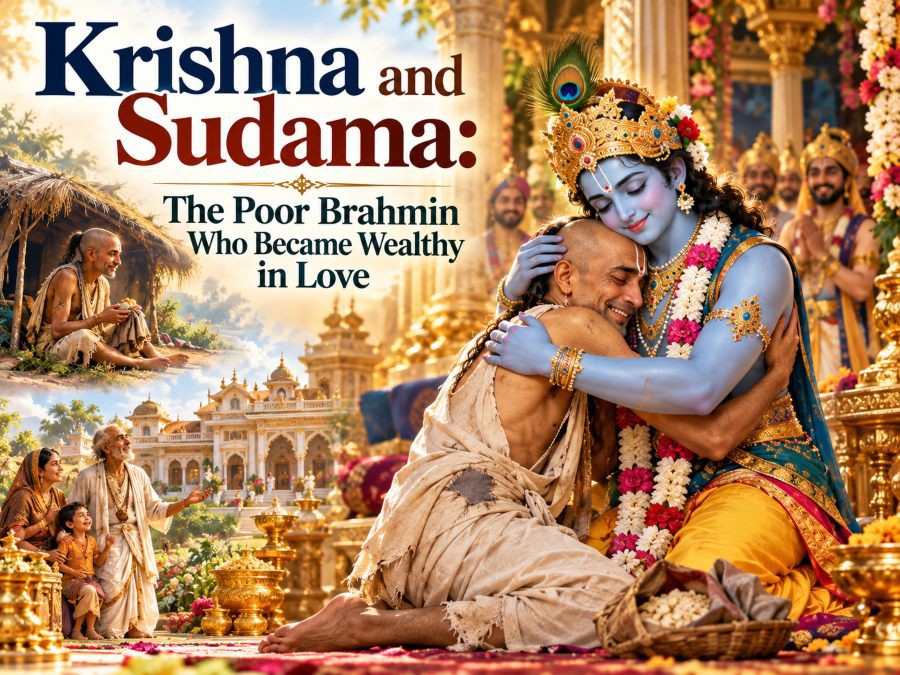 Krishna and Sudama: The Poor Brahmin Who Became Wealthy in LoveRead more
 -
 Vamana Avatar: How Three Steps Humbled Bali MaharajaRead more
Why did a powerful king give away three worlds to a boy asking for three steps? Learn the Vamana avatar story from...
-
 The Bhagavatam on Marriage: Duty, Love and Spiritual PartnershipRead more
What does the Bhagavatam say about marriage? Through the stories of Kardama and Devahuti, Rukmini's secret letter and...
-
 What Is Prema? The Bhagavatam's Highest Stage of Love for GodRead more
Prema is love for God with no "because" attached. Learn how the Bhagavatam describes it, the nine steps from faith to...
-
 Is Shiva Parvati Kalyana Mentioned in Srimad Bhagavatam? What the Scripture Really SaysRead more
Looking for Shiva and Parvati's wedding in the Srimad Bhagavatam? Find out what the scripture actually describes,...
-
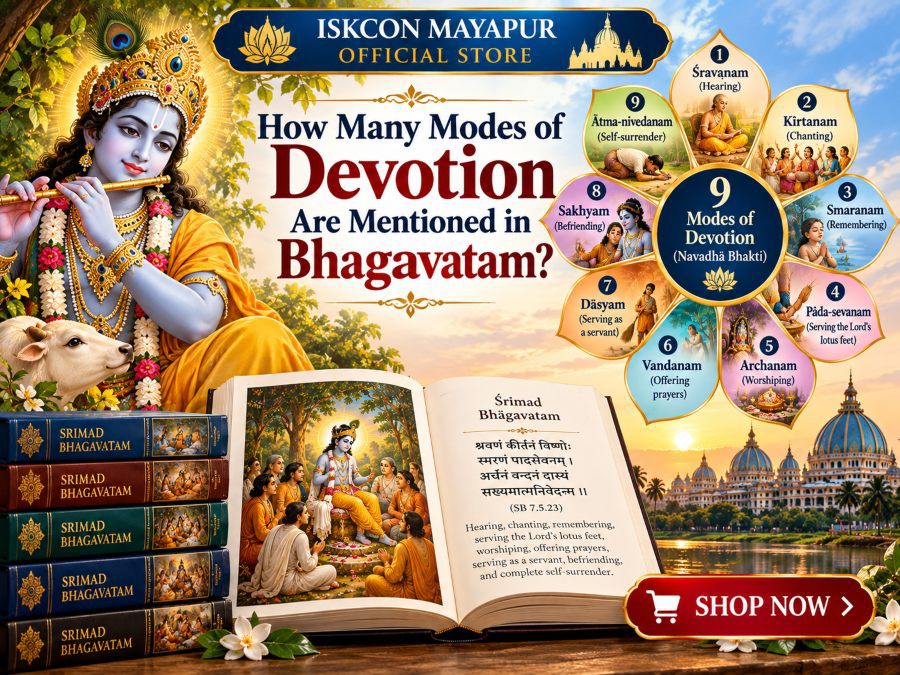 How Many Modes of Devotion Are Mentioned in Bhagavatam?Read more
A young boy named Prahlada listed nine ways to serve God, and the Bhagavatam keeps them as its answer. Learn what the...
-
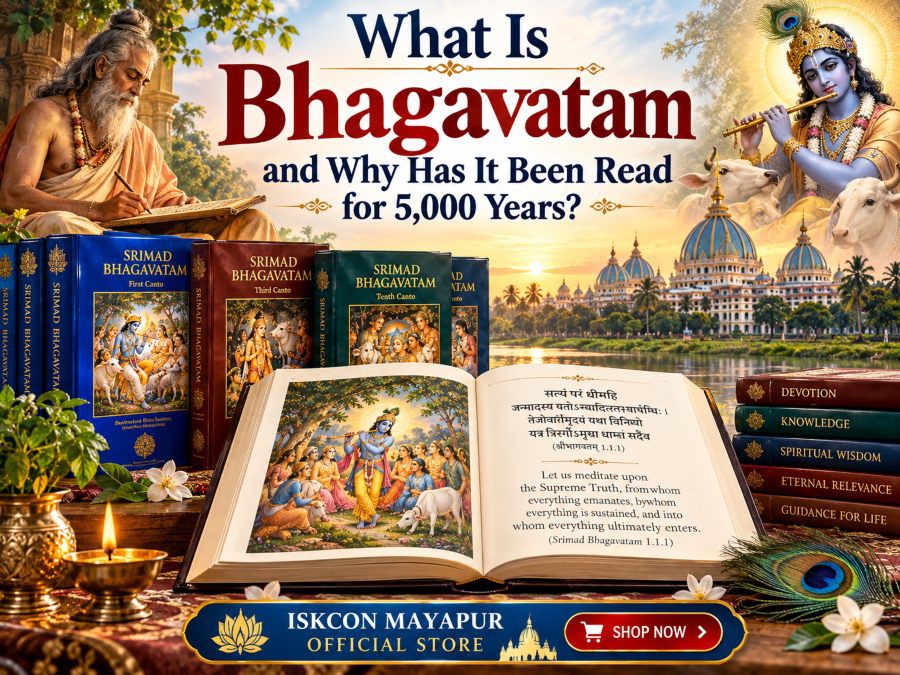 What Is Bhagavatam and Why Has It Been Read for 5,000 Years?Read more
A dying king asked one question, and the answer became the Bhagavatam. Learn what this Sanskrit scripture contains,...
-
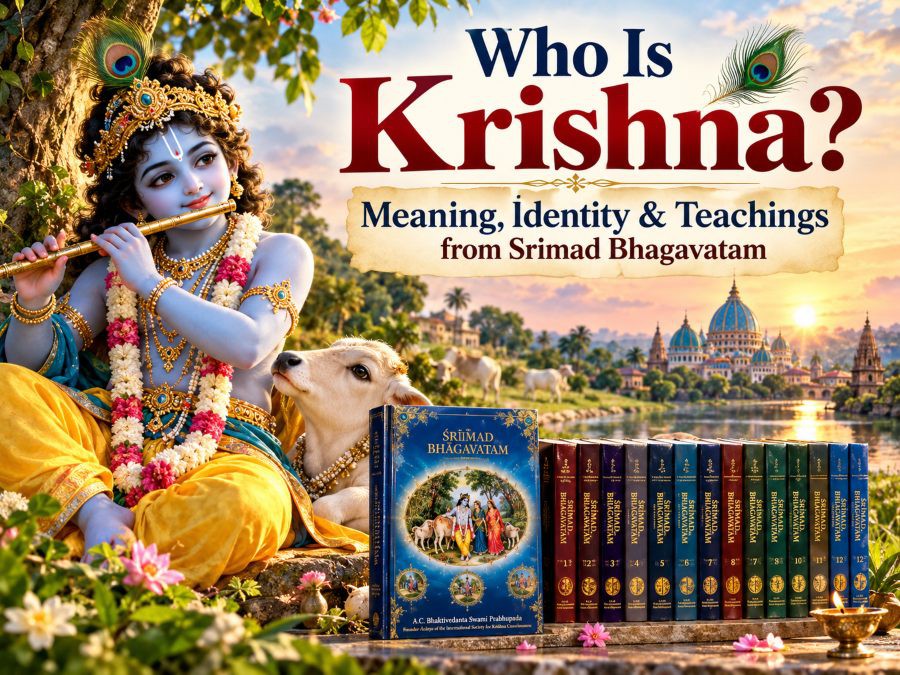 Who Is Lord Krishna? His Meaning, Teachings and Pastimes ExplainedRead more
Discover who Krishna is according to Srimad Bhagavatam, including His divine identity, childhood pastimes, teachings,...
-
 Incense in Islam: Bakhoor, Agarbatti and What Tradition SaysRead more
Is burning fragrance part of Muslim tradition? Explore incense in Islam, from the Prophetic practice of fumigating...
-
 History of Agarbatti: From Vedic Dhupa to Modern Incense SticksRead more
Where did agarbatti really come from? Follow the history of agarbatti from Vedic fire rituals and temple dhupa to...
Blog categories
- Default category (0)
- MUSICAL INSTRUMENT (1)
- BOOK (5)
- DEVOTIONAL GIFT (0)
- Blog (30) click
- CHANDAN (12)
- Bhagavatam Wisdom Series (68)
- Krishna Consciousness (14)
- Mridangam Musical Instrument (6)
- Bhagavad Gita for Beginners (13)
- Bhagavad Gita As It Is (37) click
- Bhagavad Gita As It Is Telugu (0)
- Bhagavad Gita As It Is Marathi (0)
- Bhagavad Gita As It Is In Hindi (0)
- Bhagavad Gita As It Is In English (0)
- Bhagavad Gita As It Is In Bengali (8)
- Bhagavad Gita As It Is In Kannada (0)
- Bhagavad Gita As It Is In Gujarati (0)
- Bhagavad Gita As It Is In Panjabi (0)
- Bhagavad Gita As It Is In Tamil (0)
- Bhagavad Gita As It Is Odia (0)
- BHAGAVAD GITA As It Is GERMAN (0)
- Bhagavad Gita As It Is In French (0)
- Bhagavad Gita As It Is In Nepali (0)
- Bhagavad Gita As It Is In Assamese (0)
- Incense or Agarbatti (38)
- Lord Chaitanya Mahaprabhu (3)
- Vedic Temple Mayapur (14)
- kalki (15)
- Mahabharata – Dharma & Destiny (27)
- Vaishnava Scriptures (4)
- healthy product (4)
- chaitanya mahaprabhu (5)
- Tulsi Mala Guide (17)
Search in blog
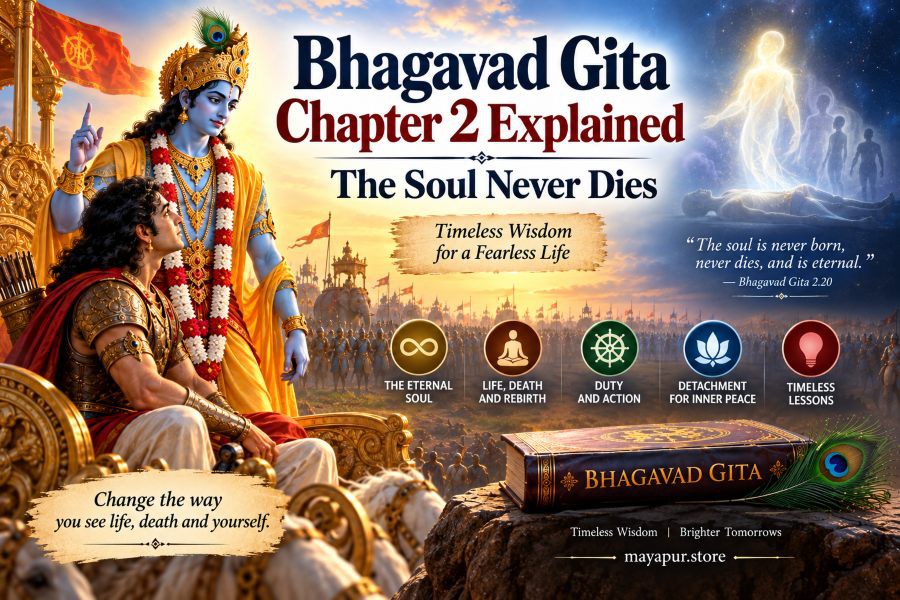
Bhagavad Gita Chapter 2 Explained: The Soul Never Dies
Bhagavad Gita Chapter 2 Explained: The Soul Never Dies
What if the person you fear losing can never truly be destroyed?
That question sits at the heart of Bhagavad Gita Chapter 2, where Krishna begins answering Arjuna's devastating grief on the battlefield of Kurukshetra. After seeing his relatives, teachers, and friends standing before him, Arjuna has lost the confidence to fight. Krishna responds by challenging the way Arjuna understands life, death, identity, and the self. Bhagavad Gita Chapter 2
Chapter 2 is one of the most important sections of the Bhagavad Gita because Krishna moves the conversation from emotional confusion toward spiritual understanding. His central teaching is strikingly simple yet profound: the eternal self, or soul, is not destroyed when the physical body dies.
For Arjuna, this changes the entire way he sees the battlefield.
For us, it raises a much bigger question: If the body changes and eventually dies, then what exactly is the “I” that remains?
Why Krishna Begins With the Nature of the Self
Arjuna's grief is understandable.
He sees people he loves and imagines their deaths. His mind is focused almost entirely on the destruction of physical bodies.
Krishna does not dismiss his emotions as meaningless. Instead, he addresses the deeper assumption behind his grief.
Arjuna is treating bodily death as though it represents the complete destruction of the person.
Krishna challenges that idea.
According to the Bhagavad Gita, the body is temporary, while the self within the body is eternal.
This distinction becomes the foundation for much of Krishna's teaching.
Think about the body you had as a child.
It is not the same body you have today.
Your appearance has changed. Your cells have changed. Your abilities have changed. Your thoughts and personality have developed.
Yet there is a continuing sense of “I” throughout those changes.
The Gita asks us to take that observation much further.
If the body changes continuously while our sense of personal identity persists, could the self be something deeper than the physical body?
That is the question Krishna wants Arjuna to consider.
The Body Changes, But the Self Remains
One of Krishna's most memorable teachings in Chapter 2 compares the changing body to moving through different stages of life.
A person experiences childhood, youth, adulthood, and old age.
The body changes at every stage.
Yet the conscious self experiences all those changes.
Krishna uses this reasoning to explain why death should not be understood as the annihilation of the self.
The physical body is temporary.
The soul is not.
This does not mean that death becomes emotionally meaningless.
The Gita does not ask people to stop caring about those they love.
Rather, it introduces a deeper perspective on what death actually means.
The body can be destroyed, but the eternal self cannot be destroyed.
That distinction becomes one of the central philosophical ideas of the text.
What Does “The Soul Never Dies” Actually Mean?
The phrase sounds simple, but it deserves careful thought.
When Krishna speaks about the eternal self, he is not describing the personality, appearance, social status, or physical body.
Those things change.
The soul is presented as something fundamentally different from the temporary body.
Krishna explains that the self cannot be destroyed by ordinary physical forces.
It is not something that can simply be cut apart, burned, drowned, or blown away.
The point is not merely poetic.
It represents a completely different understanding of human identity.
Modern culture often encourages us to define ourselves through external characteristics:
· Our profession
· Our appearance
· Our possessions
· Our achievements
· Our relationships
· Our social position
The Bhagavad Gita asks us to look underneath all of these.
Who are you when all temporary labels are removed?
Chapter 2 begins exploring that question.
Why This Teaching Matters When We Face Loss
Grief can make the world feel smaller.
When someone we love dies, their physical presence disappears. We can no longer speak to them in the same way, see their face, or share ordinary moments.
The pain is real.
Krishna's teaching does not require us to deny that pain.
Instead, it offers another way to understand what has happened.
If the soul is eternal, then physical death marks a transformation of the body's condition rather than the destruction of the self.
This idea has offered spiritual comfort to generations of people.
It also changes the way we think about our own lives.
If our true identity is not the temporary body, then perhaps life is not simply a race to accumulate possessions, recognition, or physical pleasure.
There may be a deeper purpose.
The Soul and the Problem of Fear
Arjuna's fear is connected to death.
He fears losing people he loves.
He fears causing suffering.
He fears the consequences of his actions.
Krishna responds by placing death inside a much larger understanding of existence.
This does not mean that physical life has no value.
Quite the opposite.
The body is the vehicle through which a person acts, learns, serves, and grows.
But the body is temporary.
The soul is eternal.
Once Arjuna begins to understand this distinction, his fear of physical destruction can be placed into a broader spiritual framework.
That is an important lesson for anyone who struggles with fear.
Fear often becomes overwhelming when we see one event as the whole story.
Spiritual wisdom can sometimes help us step back and see a larger picture.
The Gita's Famous Clothing Analogy
One of the most accessible ideas in Chapter 2 compares changing bodies to changing clothes.
A person wears one set of clothes, eventually removes them, and puts on another.
The clothes change.
The person wearing them remains.
Krishna uses this kind of comparison to help Arjuna understand the relationship between the soul and the body.
The analogy is powerful because everyone understands what it means to change clothes.
We do not normally think that our identity disappears when we remove a shirt or replace an old garment.
The Gita asks us to imagine the body in a similar way.
The body is temporary.
The conscious self is deeper.
This idea becomes the foundation for understanding reincarnation as it is presented in the text.
Why the Soul Teaching Is Connected to Duty
At first, the teaching about the eternal soul might seem separate from Arjuna's responsibility to fight.
It is not.
Krishna is gradually helping Arjuna separate two different questions:
What happens to the eternal self?
and
What is my responsibility in this particular situation?
Arjuna has allowed grief and attachment to overwhelm his sense of duty.
Krishna wants him to regain clarity.
This does not mean blindly performing an action.
It means understanding one's responsibility without allowing fear, attachment, or personal gain to distort judgment.
That becomes the foundation for Krishna's later teachings about karma yoga, disciplined action, and acting without selfish attachment to results.
Chapter 2 Is Also About Action
The soul's immortality is only one part of Chapter 2.
Krishna also begins teaching Arjuna how to act.
One of the most famous teachings of the Bhagavad Gita is the principle that a person should focus on performing their duty without becoming attached to the results.
This is often misunderstood.
It does not mean:
“Results do not matter.”
Instead, it means that we should not allow anxiety about results to control our actions.
You can prepare carefully.
You can work sincerely.
You can make thoughtful decisions.
But you cannot control every consequence.
That distinction is incredibly practical.
A student can study hard but cannot completely control the exam result.
An entrepreneur can build a business carefully but cannot control every market reaction.
A person can communicate honestly but cannot control how another person responds.
The Gita teaches us to focus on what belongs to us: our intention, effort, discipline, and action.
Why Detachment Does Not Mean Indifference
The word “detachment” can sound cold.
But Krishna's teaching is not asking Arjuna to stop caring.
It is asking him not to become psychologically dependent on a particular outcome.
There is a major difference.
Indifference says: “I don't care what happens.”
Detachment says: “I care deeply, but I will not let the outcome control my sense of self.”
That is a much healthier way to approach action.
You can love your work without believing your worth depends entirely on success.
You can care about someone without trying to control every aspect of their life.
You can pursue a goal without becoming destroyed by the possibility of failure.
This is one of the most practical ideas in Chapter 2.
The Steady Mind: What Krishna Wants Arjuna to Become
Krishna introduces the idea of a person whose mind remains steady despite life's changing conditions.
Such a person is not emotionless.
They simply do not allow every external event to throw them completely off balance.
Success comes.
Failure comes.
Praise comes.
Criticism comes.
Pleasure comes.
Pain comes.
The steady person learns not to build their entire identity around these temporary experiences.
This is difficult.
But it is also deeply relevant.
Imagine how different life would feel if your confidence did not rise and fall completely according to other people's opinions.
Imagine working sincerely without constantly checking whether everyone approves.
Imagine experiencing failure without immediately deciding that you are a failure.
The Bhagavad Gita's idea of mental steadiness offers a powerful alternative.
What Bhagavad Gita Chapter 2 Teaches About Modern Life
Although Krishna's conversation with Arjuna takes place on an ancient battlefield, its central ideas can be applied to everyday challenges.
When you fear failure
Remember that one result does not define your entire identity.
When you experience loss
Allow yourself to grieve, while remembering that the Gita understands the self as more than the physical body.
When success becomes an obsession
Enjoy achievement without making it the foundation of your worth.
When uncertainty creates anxiety
Focus on the action available to you now rather than trying to control every future outcome.
When criticism hurts
Ask whether the criticism is useful instead of allowing someone else's opinion to define who you are.
When circumstances change
Remember that temporary conditions do not necessarily determine your deepest identity.
The Soul Teaching Changes the Meaning of Life
If we accept the Gita's understanding of the soul, life becomes more than a temporary physical existence.
The body has a beginning and an end.
The soul does not.
That means our priorities can change.
Instead of living only for temporary pleasures and achievements, we can begin asking deeper questions:
What is my real purpose?
What kind of person am I becoming?
What is truly permanent?
How should I use this life?
What does spiritual growth actually mean?
These questions move the reader from simply surviving life toward understanding it.
And that is one reason Chapter 2 is such an important turning point in the Bhagavad Gita.
The Most Powerful Lesson: You Are More Than Your Body
Perhaps the simplest way to understand Krishna's teaching is this:
Your body is part of your experience, but it is not the complete definition of who you are.
The body changes.
The mind changes.
Circumstances change.
Relationships change.
Possessions come and go.
Even our ideas about ourselves can change.
The Gita points toward something deeper—the eternal conscious self.
For Arjuna, this knowledge is meant to free him from paralyzing grief and help him understand his responsibility.
For a modern reader, it can provide a completely different way of looking at identity, loss, success, failure, and death.
Final Thoughts: Chapter 2 Turns Grief Into Understanding
Arjuna begins Chapter 2 overwhelmed by the possibility of losing people he loves.
Krishna does not merely tell him to suppress his emotions.
He gives him a deeper understanding of life.
The body is temporary.
The soul is eternal.
Death does not destroy the self.
And while living in this temporary body, a person should learn to perform their responsibilities with wisdom rather than becoming consumed by attachment to results.
That is why Bhagavad Gita Chapter 2 is much more than a discussion about death.
It is a chapter about identity.
It asks us to look beyond the temporary things we usually use to define ourselves and consider what may lie beneath them.
Arjuna's grief begins with the belief that death means complete destruction.
Krishna challenges that belief.
Once Arjuna begins seeing the self as eternal, his entire understanding of the battlefield starts to change.
And perhaps that is the deepest lesson of Chapter 2:
When our understanding of who we are becomes deeper, the things we fear can begin to look very different.
The soul, according to Krishna, does not die.
The body changes.
Life moves through different stages.
But the eternal self remains beyond those temporary transformations.
For Arjuna, that knowledge becomes the first step toward courage.
For anyone studying the Bhagavad Gita today, it can become an invitation to ask one of life's oldest and most personal questions:
Who am I, really?
Posted in: Bhagavad Gita As It Is
Related posts
-
 Why the Bhagavad Gita Feels Like a Personal Conversation with KrishnaThe Bhagavad Gita feels like a personal conversation with Krishna because its timeless wisdom directly addresses our...Read more
 -
 Shrimad Bhagwat Geeta: The Forgotten Life Manual for Modern StressShrimad Bhagwat Geeta is more than a sacred scripture—it’s a forgotten life manual that offers timeless solutions for...Read more
 -
 Who Wrote the Bhagavad Gita? Discover the true authorship of the Bhagavad Gita—exploring Ved Vyasa’s role as the compiler, Lord Krishna’s divine...Read more
 -
 How Many Shlokas in Bhagavad Gita? Complete Chapter-Wise Breakdown & MeaningDiscover how many shlokas are in the Bhagavad Gita, with a complete chapter-wise breakdown, variations in verse...Read more
 -
 How to Read Bhagavad Gita: A Complete Step-by-Step Guide for BeginnersDiscover how to read the Bhagavad Gita step by step—learn the right mindset, chapter order, and tips to understand...Read more
Leave a comment