
Why did Krishna run to embrace a poor brahmin in rags? Read the Sudama story from the Bhagavatam and learn how a...
Latest posts
-
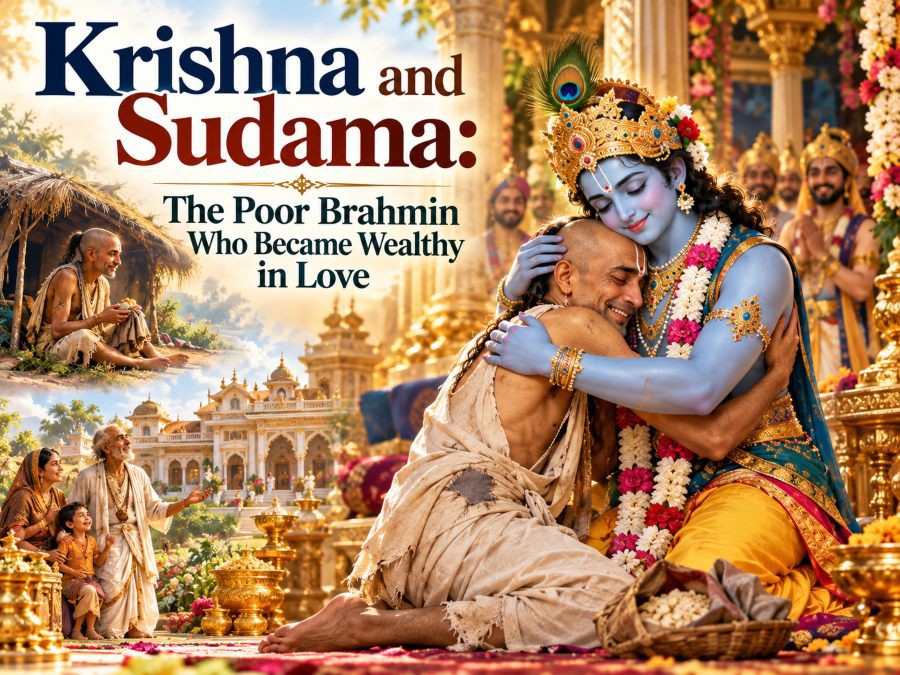 Krishna and Sudama: The Poor Brahmin Who Became Wealthy in LoveRead more
 -
 Vamana Avatar: How Three Steps Humbled Bali MaharajaRead more
Why did a powerful king give away three worlds to a boy asking for three steps? Learn the Vamana avatar story from...
-
 The Bhagavatam on Marriage: Duty, Love and Spiritual PartnershipRead more
What does the Bhagavatam say about marriage? Through the stories of Kardama and Devahuti, Rukmini's secret letter and...
-
 What Is Prema? The Bhagavatam's Highest Stage of Love for GodRead more
Prema is love for God with no "because" attached. Learn how the Bhagavatam describes it, the nine steps from faith to...
-
 Is Shiva Parvati Kalyana Mentioned in Srimad Bhagavatam? What the Scripture Really SaysRead more
Looking for Shiva and Parvati's wedding in the Srimad Bhagavatam? Find out what the scripture actually describes,...
-
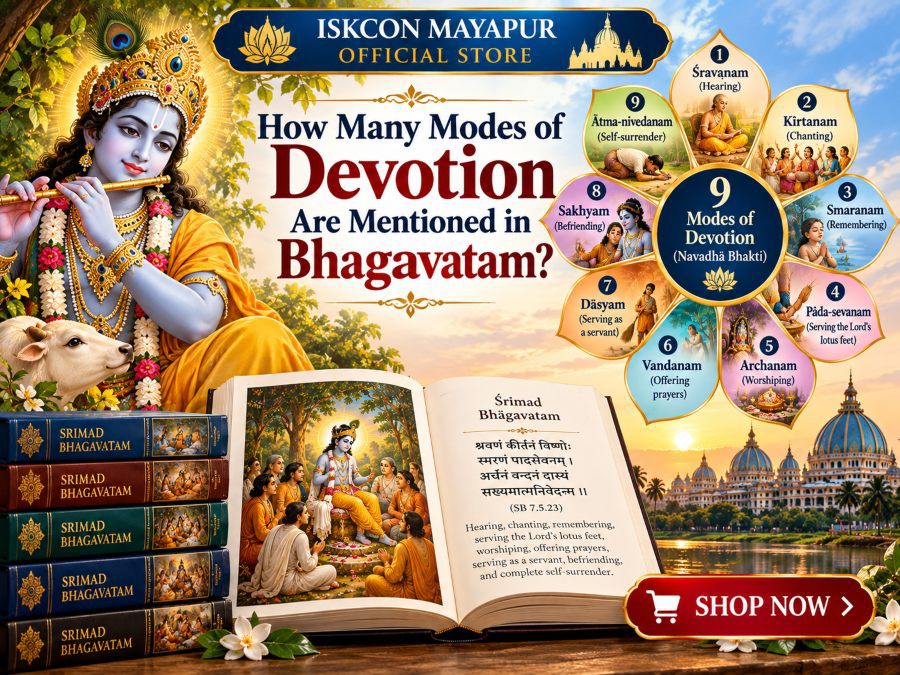 How Many Modes of Devotion Are Mentioned in Bhagavatam?Read more
A young boy named Prahlada listed nine ways to serve God, and the Bhagavatam keeps them as its answer. Learn what the...
-
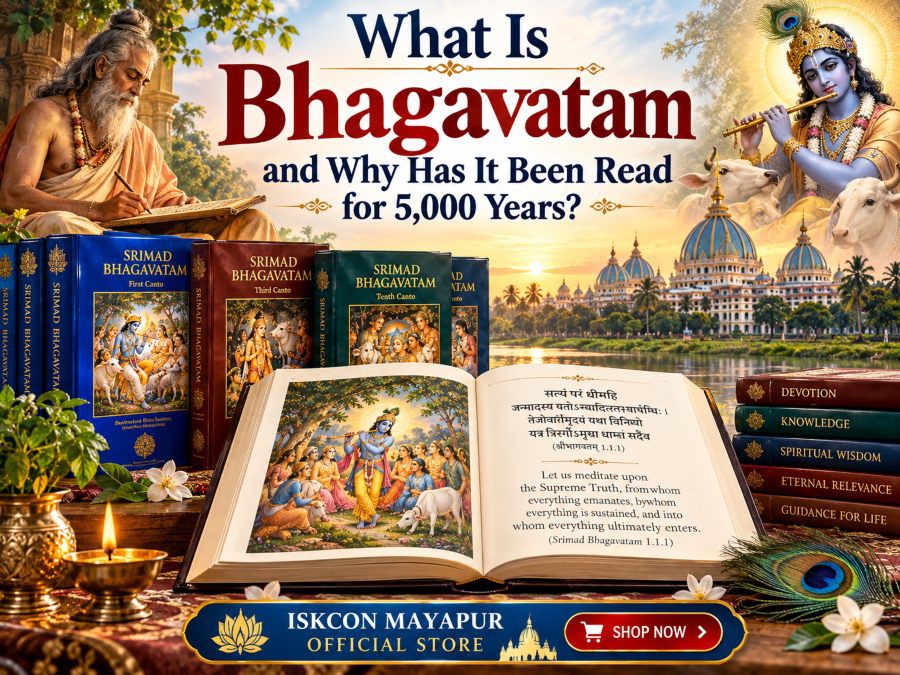 What Is Bhagavatam and Why Has It Been Read for 5,000 Years?Read more
A dying king asked one question, and the answer became the Bhagavatam. Learn what this Sanskrit scripture contains,...
-
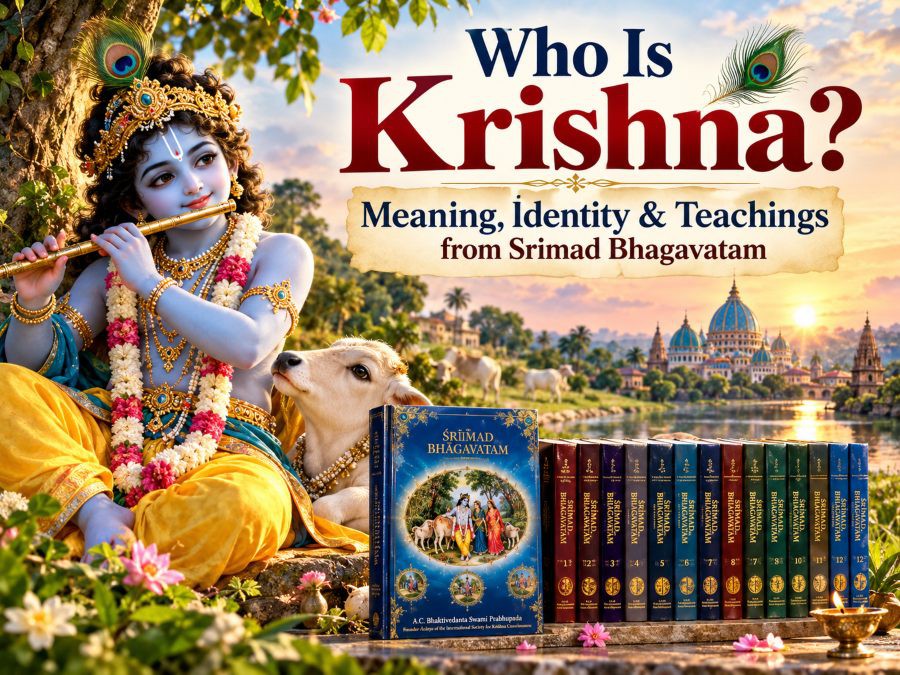 Who Is Lord Krishna? His Meaning, Teachings and Pastimes ExplainedRead more
Discover who Krishna is according to Srimad Bhagavatam, including His divine identity, childhood pastimes, teachings,...
-
 Incense in Islam: Bakhoor, Agarbatti and What Tradition SaysRead more
Is burning fragrance part of Muslim tradition? Explore incense in Islam, from the Prophetic practice of fumigating...
-
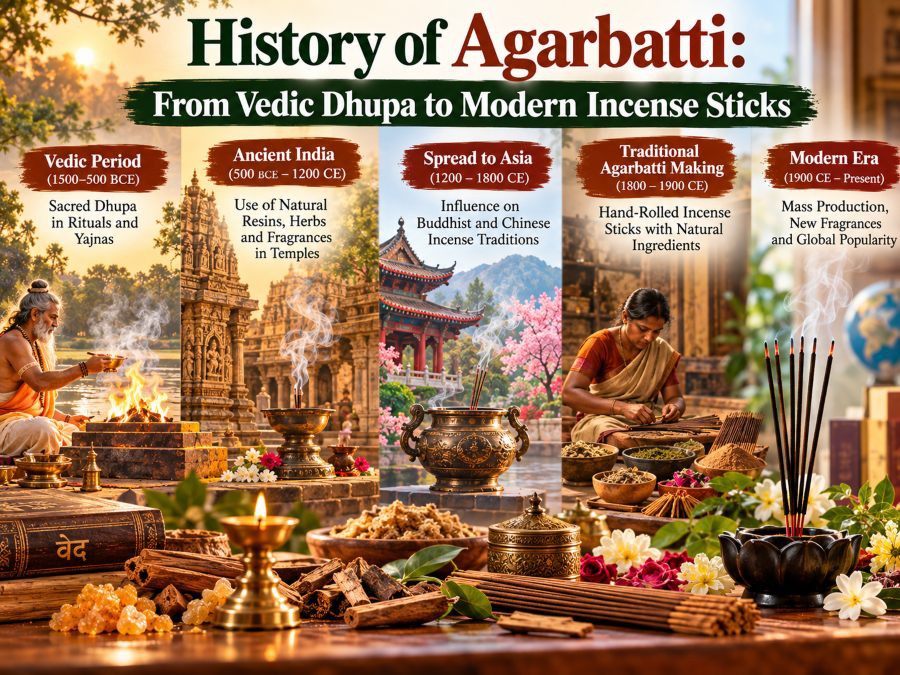 History of Agarbatti: From Vedic Dhupa to Modern Incense SticksRead more
Where did agarbatti really come from? Follow the history of agarbatti from Vedic fire rituals and temple dhupa to...
Blog categories
- Default category (0)
- MUSICAL INSTRUMENT (1)
- BOOK (5)
- DEVOTIONAL GIFT (0)
- Blog (30) click
- CHANDAN (12)
- Bhagavatam Wisdom Series (68)
- Krishna Consciousness (14)
- Mridangam Musical Instrument (6)
- Bhagavad Gita for Beginners (13)
- Bhagavad Gita As It Is (37) click
- Bhagavad Gita As It Is Telugu (0)
- Bhagavad Gita As It Is Marathi (0)
- Bhagavad Gita As It Is In Hindi (0)
- Bhagavad Gita As It Is In English (0)
- Bhagavad Gita As It Is In Bengali (8)
- Bhagavad Gita As It Is In Kannada (0)
- Bhagavad Gita As It Is In Gujarati (0)
- Bhagavad Gita As It Is In Panjabi (0)
- Bhagavad Gita As It Is In Tamil (0)
- Bhagavad Gita As It Is Odia (0)
- BHAGAVAD GITA As It Is GERMAN (0)
- Bhagavad Gita As It Is In French (0)
- Bhagavad Gita As It Is In Nepali (0)
- Bhagavad Gita As It Is In Assamese (0)
- Incense or Agarbatti (38)
- Lord Chaitanya Mahaprabhu (3)
- Vedic Temple Mayapur (14)
- kalki (15)
- Mahabharata – Dharma & Destiny (27)
- Vaishnava Scriptures (4)
- healthy product (4)
- chaitanya mahaprabhu (5)
- Tulsi Mala Guide (17)
Search in blog
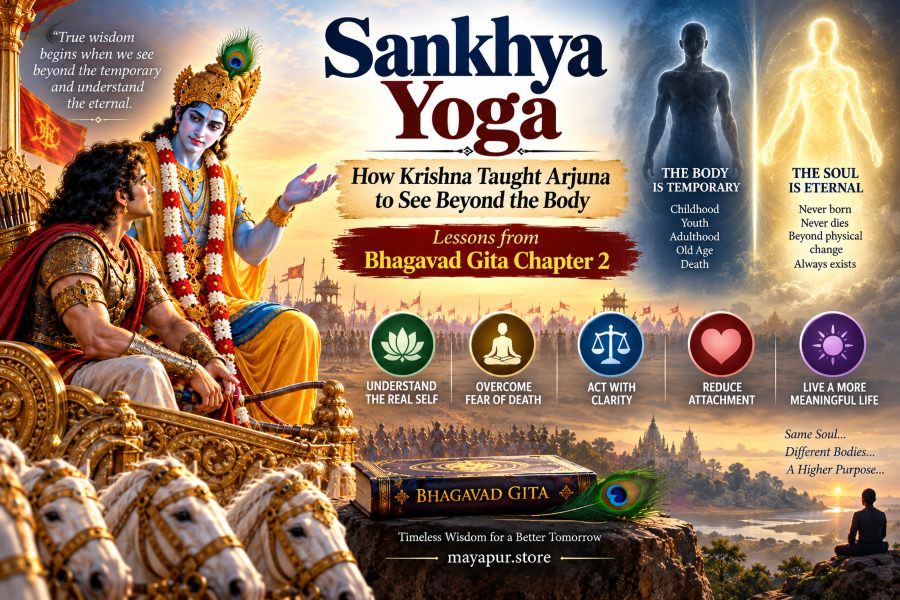
Sankhya Yoga: How Krishna Taught Arjuna to See Beyond the Body
Sankhya Yoga: How Krishna Taught Arjuna to See Beyond the Body
What if everything you use to define yourself—your appearance, age, relationships, achievements, and even your body—is temporary? That is the startling question at the heart of Bhagavad Gita Chapter 2, where Krishna begins guiding Arjuna away from overwhelming grief and toward a deeper understanding of the self. Known as Sankhya Yoga, this chapter asks Arjuna to look beyond the physical body and recognize the eternal soul within.
Arjuna's crisis began when he looked across the battlefield of Kurukshetra and saw his teachers, relatives, friends, and elders standing against him. He could imagine their deaths, but he could not accept what he believed those deaths would mean. Krishna responds by challenging his understanding of life itself.
The teaching is not simply, “Don't be afraid of death.”
It goes much deeper.
Krishna asks Arjuna to reconsider who he really is.
What Is Sankhya Yoga?
The word Sankhya is associated with analytical knowledge or a systematic way of understanding reality. In Bhagavad Gita Chapter 2, Krishna uses spiritual reasoning to help Arjuna distinguish between the temporary body and the eternal self.
This distinction becomes the foundation for everything that follows.
Arjuna is looking at physical bodies on a battlefield and thinking about their destruction. Krishna asks him to look deeper.
The body changes.
The soul does not.
That may sound straightforward, but its implications are enormous.
If our true identity is not the temporary body, then many of the things we normally fear or chase have to be reconsidered.
Our physical appearance changes.
Our social position changes.
Our possessions disappear.
Our relationships change.
Even our thoughts and emotions constantly move.
Yet there remains a sense of continuity—a conscious “I” that experiences these changes.
Sankhya Yoga asks us to investigate that “I.”
Arjuna Was Looking at Bodies; Krishna Wanted Him to See the Self
Arjuna's grief is understandable because he sees people he loves.
Bhishma is there.
Dronacharya is there.
His relatives and friends are there.
He sees the possibility of their physical destruction.
Krishna does not deny that bodies can be destroyed. Instead, he introduces a distinction between the body and the person within the body.
This is the central shift in Arjuna's perspective.
Imagine looking at a house.
If the house is destroyed, something physical has certainly been lost. But the house itself is not the person who lived there.
In a similar way, Krishna teaches that the physical body is not the complete identity of the living being.
The body is temporary.
The soul is eternal.
This teaching allows Arjuna to consider death from an entirely different perspective.
The Body Changes From Childhood to Old Age
Krishna points Arjuna toward something that everyone can observe.
A person passes through childhood, youth, and old age.
The body changes dramatically during those stages.
A child becomes an adult.
The adult becomes elderly.
Yet the individual experiences these stages as one continuous existence.
You can look at a childhood photograph and say:
“That was me.”
But the body in the photograph is obviously different from your present body.
Your height has changed.
Your face has changed.
Your physical abilities have changed.
Yet your sense of being the same person continues.
Krishna uses this observation as a stepping stone toward a deeper spiritual conclusion.
If the body can change while the conscious self remains continuous, then physical transformation may not mean the destruction of the self.
Death, from the Gita's perspective, becomes another transformation of the body's condition rather than the annihilation of the soul.
The Soul Is Not Destroyed by Physical Forces
Krishna describes the soul as beyond ordinary material destruction.
Weapons cannot cut it.
Fire cannot burn it.
Water cannot wet it.
Wind cannot dry it.
These descriptions are not meant as a lesson in physics. They communicate a philosophical point: the soul does not belong to the same category as the temporary physical body.
A sword can damage flesh.
Fire can consume physical matter.
Water can affect the body.
But none of these material forces can destroy the eternal self described by Krishna.
This changes the way Arjuna must understand the battlefield.
He is no longer being asked to think only about bodies appearing and disappearing.
He is being asked to understand the deeper identity of the living being.
Why We Identify So Strongly With the Body
This teaching can feel challenging because nearly everything in ordinary life encourages bodily identification.
We say:
· “This is my body.”
· “I am young.”
· “I am old.”
· “I am attractive.”
· “I am sick.”
· “I am successful.”
· “I am strong.”
The Gita asks whether these descriptions capture the whole person.
The body certainly matters. We need it to live, work, communicate, serve others, and pursue responsibilities.
But the body is constantly changing.
If we build our entire identity around something temporary, insecurity naturally follows.
Physical appearance changes.
Health changes.
Age changes.
Circumstances change.
When identity depends completely on these things, every change can feel like a personal threat.
Sankhya Yoga offers another foundation.
You are not merely the temporary body you inhabit.
Seeing Beyond the Body Does Not Mean Rejecting the Body
This point is easy to misunderstand.
Krishna is not telling Arjuna that the physical world does not matter.
The body has a purpose.
It allows the soul to act within the material world.
The issue is not caring for the body.
The issue is believing that the body is the complete definition of the self.
There is a big difference between:
“I have a body.”
and
“I am nothing more than this body.”
The first recognizes the body's importance.
The second reduces the entire person to something temporary.
Sankhya Yoga encourages Arjuna to recognize a deeper identity without ignoring his practical responsibilities.
What This Means for Fear of Death
Death is one of humanity's oldest fears.
Even people who rarely think about mortality can become deeply shaken when someone close to them dies.
Arjuna's reaction is an extreme example of that fear.
He cannot imagine accepting the destruction of those he loves.
Krishna's teaching does not make grief disappear through a comforting slogan. Instead, it changes the philosophical framework through which death is understood.
If the soul is eternal, then physical death is not the end of existence.
The body passes through transformation.
The soul continues.
This understanding does not mean that separation is painless.
It means that grief can exist alongside spiritual knowledge.
You can miss someone's physical presence while still believing that the soul is not destroyed.
That is a much more nuanced approach to loss.
Sankhya Yoga and the Fear of Change
Death is only the most dramatic example of a broader truth: everything material changes.
Your body changes.
Your career changes.
Your relationships change.
Your financial circumstances change.
Your opinions change.
Your surroundings change.
Even the things you once believed would make you happy can eventually lose their appeal.
Why does this matter?
Because suffering often increases when we expect temporary things to remain permanent.
We want a successful period to last forever.
We want our youth to remain unchanged.
We want loved ones to always be physically present.
We want our circumstances to stay comfortable.
But change is unavoidable.
Sankhya Yoga asks us to develop a deeper identity that is not completely dependent on changing external conditions.
Krishna's Teaching Is Also About Mental Stability
Once Arjuna begins understanding the difference between the temporary and the eternal, Krishna moves toward another important idea: steadiness of mind.
A person who is constantly controlled by pleasure and pain will naturally experience emotional instability.
Good news arrives, and the mind rises.
Bad news arrives, and the mind collapses.
Praise creates confidence.
Criticism destroys it.
Success produces excitement.
Failure produces despair.
The Gita does not ask us to become emotionless.
It asks us to become less dependent on external circumstances for our inner stability.
That is a very different goal.
Sankhya Yoga Connects Knowledge With Action
Arjuna is not sitting in a quiet meditation room.
He is standing on a battlefield.
That matters.
Krishna's spiritual teaching is not disconnected from responsibility.
Arjuna still has to act.
The question is how he should act.
Sankhya Yoga gives him knowledge about the self. That knowledge is meant to change his relationship with action.
If Arjuna understands that the soul is eternal, that the body is temporary, and that his duty must be considered through a clearer understanding of reality, then he can begin acting without being completely controlled by fear and attachment.
This leads naturally toward one of the Gita's central teachings:
Perform your responsibility without becoming enslaved by the result.
Why Attachment Makes Difficult Decisions Harder
Arjuna's attachment is understandable.
He loves his relatives.
But that love makes it extremely difficult for him to evaluate his responsibility clearly.
Attachment can work the same way in modern life.
Suppose you have invested ten years in a career that no longer suits you.
You may continue simply because leaving feels like admitting that those ten years were wasted.
Or perhaps you are holding onto a failing project because you have already invested so much money and effort.
Or you avoid an honest conversation because you fear losing someone's approval.
In each case, attachment can make the past control the present.
Sankhya Yoga encourages a broader perspective.
Respect what has happened without allowing it to imprison your future decisions.
The Practical Side of Seeing Beyond the Body
The Gita's teaching about the soul can sound abstract until we connect it with everyday life.
Here are a few ways its perspective can influence our thinking.
When your appearance changes
Remember that physical appearance is temporary. Your deeper identity is not exhausted by how you look.
When you experience failure
A failed project does not mean that your entire self has failed.
When circumstances change
Temporary conditions should not become the sole foundation of your identity.
When you face loss
Grief is natural, but spiritual knowledge can provide another way of understanding what death means.
When you feel pressured by society
Your worth does not have to depend entirely on status, wealth, popularity, or recognition.
These ideas do not eliminate life's problems.
They change the place from which we face them.
What Sankhya Yoga Says About Who You Really Are
Perhaps the most important question raised in Chapter 2 is not about death at all.
It is about identity.
Who am I?
Am I merely my body?
Am I my job?
Am I my family role?
Am I my memories?
Am I my successes and failures?
Am I the opinions other people have about me?
Krishna's answer points toward the eternal soul as the deeper identity of the living being.
That idea changes everything.
If the self is eternal, then temporary success cannot completely define you.
Temporary failure cannot completely destroy you.
Physical change cannot erase your spiritual identity.
And death cannot annihilate the soul.
For Arjuna, this knowledge becomes the foundation for overcoming his paralysis.
Why Sankhya Yoga Still Speaks to Modern Readers
The world has changed enormously since the time of Krishna and Arjuna.
Yet human beings still struggle with the same fundamental questions.
Who am I?
What happens when I lose someone?
Why do I fear change?
How should I act when every option has consequences?
What makes a meaningful life?
What remains when temporary achievements disappear?
The Bhagavad Gita does not avoid these questions.
Chapter 2 confronts them directly.
Sankhya Yoga offers a perspective in which the physical body is temporary, while the conscious self is eternal.
Whether a reader approaches the teaching as spiritual philosophy, devotional wisdom, or a subject for personal reflection, its central challenge is clear:
Look deeper than the surface of your temporary identity.
Final Thoughts: The Body Changes, but the Self Is Deeper
Arjuna begins Chapter 2 overwhelmed by the thought of death.
Krishna responds by asking him to see beyond the physical bodies standing before him.
The body is temporary.
The soul is eternal.
The self passes through bodily changes but is not destroyed by them.
From this foundation, Krishna begins teaching Arjuna how to act with greater clarity, steadiness, and freedom from attachment.
That is the heart of Sankhya Yoga.
It is not simply a theory about the soul.
It is a different way of seeing yourself.
When you believe you are only the body, every physical change can threaten your identity. When you understand yourself as an eternal soul inhabiting a temporary body, those changes can be placed within a much larger perspective.
This does not make life meaningless.
It gives life a deeper dimension.
The question Krishna places before Arjuna is one we can still ask ourselves:
If the body is temporary, then what is the deeper self that experiences all these changes?
For the Bhagavad Gita, the answer is the eternal soul.
And learning to see that soul beyond the changing body is where Arjuna's journey from grief toward wisdom truly begins.
Posted in: Bhagavad Gita As It Is
Related posts
-
 Why the Bhagavad Gita Feels Like a Personal Conversation with KrishnaThe Bhagavad Gita feels like a personal conversation with Krishna because its timeless wisdom directly addresses our...Read more
 -
 Shrimad Bhagwat Geeta: The Forgotten Life Manual for Modern StressShrimad Bhagwat Geeta is more than a sacred scripture—it’s a forgotten life manual that offers timeless solutions for...Read more
 -
 Who Wrote the Bhagavad Gita? Discover the true authorship of the Bhagavad Gita—exploring Ved Vyasa’s role as the compiler, Lord Krishna’s divine...Read more
 -
 How Many Shlokas in Bhagavad Gita? Complete Chapter-Wise Breakdown & MeaningDiscover how many shlokas are in the Bhagavad Gita, with a complete chapter-wise breakdown, variations in verse...Read more
 -
 How to Read Bhagavad Gita: A Complete Step-by-Step Guide for BeginnersDiscover how to read the Bhagavad Gita step by step—learn the right mindset, chapter order, and tips to understand...Read more
Leave a comment