
Why did Krishna run to embrace a poor brahmin in rags? Read the Sudama story from the Bhagavatam and learn how a...
Latest posts
-
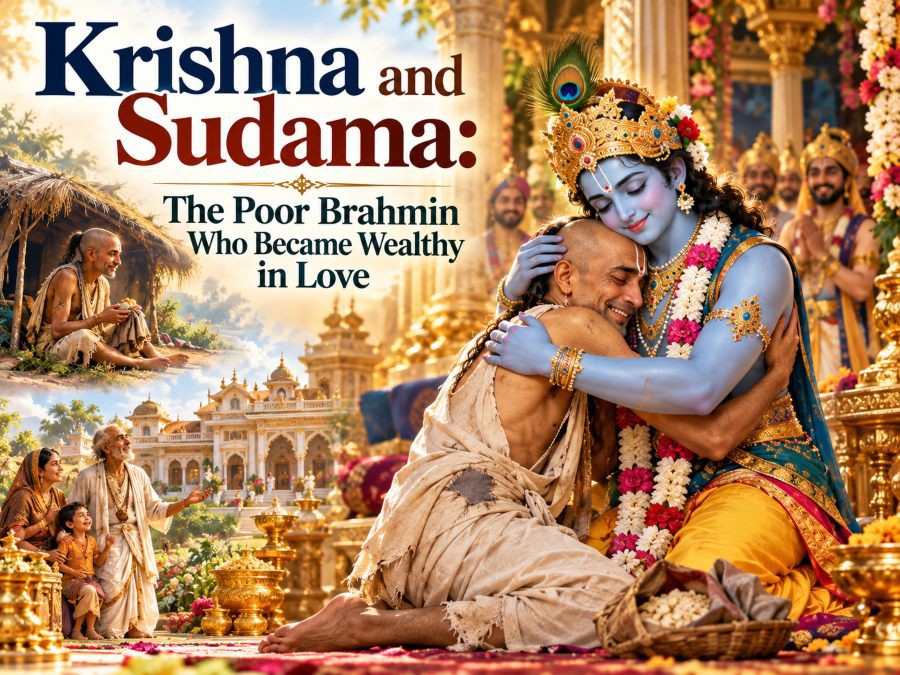 Krishna and Sudama: The Poor Brahmin Who Became Wealthy in LoveRead more
 -
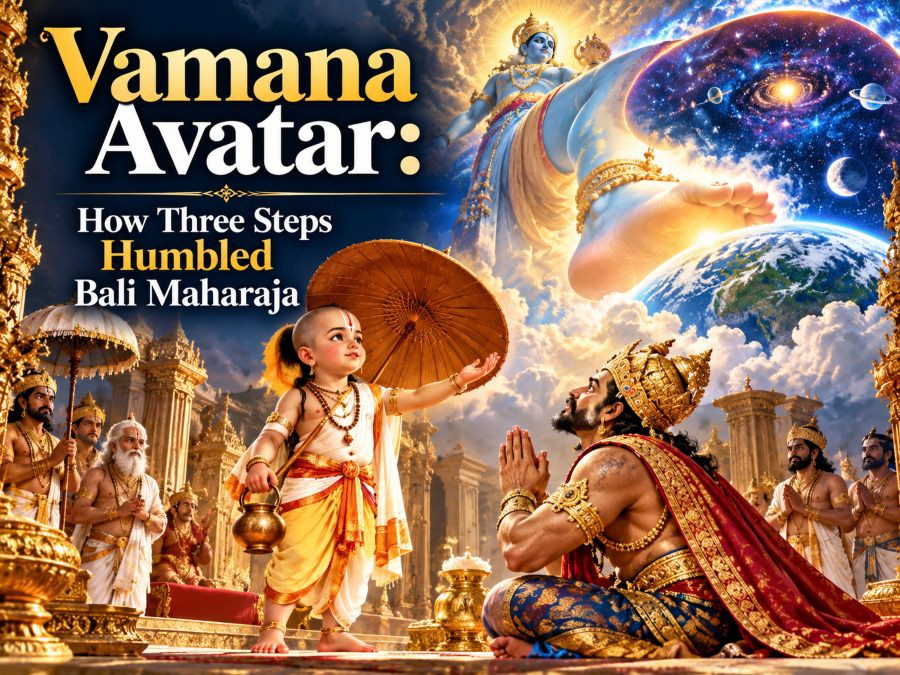 Vamana Avatar: How Three Steps Humbled Bali MaharajaRead more
Why did a powerful king give away three worlds to a boy asking for three steps? Learn the Vamana avatar story from...
-
 The Bhagavatam on Marriage: Duty, Love and Spiritual PartnershipRead more
What does the Bhagavatam say about marriage? Through the stories of Kardama and Devahuti, Rukmini's secret letter and...
-
 What Is Prema? The Bhagavatam's Highest Stage of Love for GodRead more
Prema is love for God with no "because" attached. Learn how the Bhagavatam describes it, the nine steps from faith to...
-
 Is Shiva Parvati Kalyana Mentioned in Srimad Bhagavatam? What the Scripture Really SaysRead more
Looking for Shiva and Parvati's wedding in the Srimad Bhagavatam? Find out what the scripture actually describes,...
-
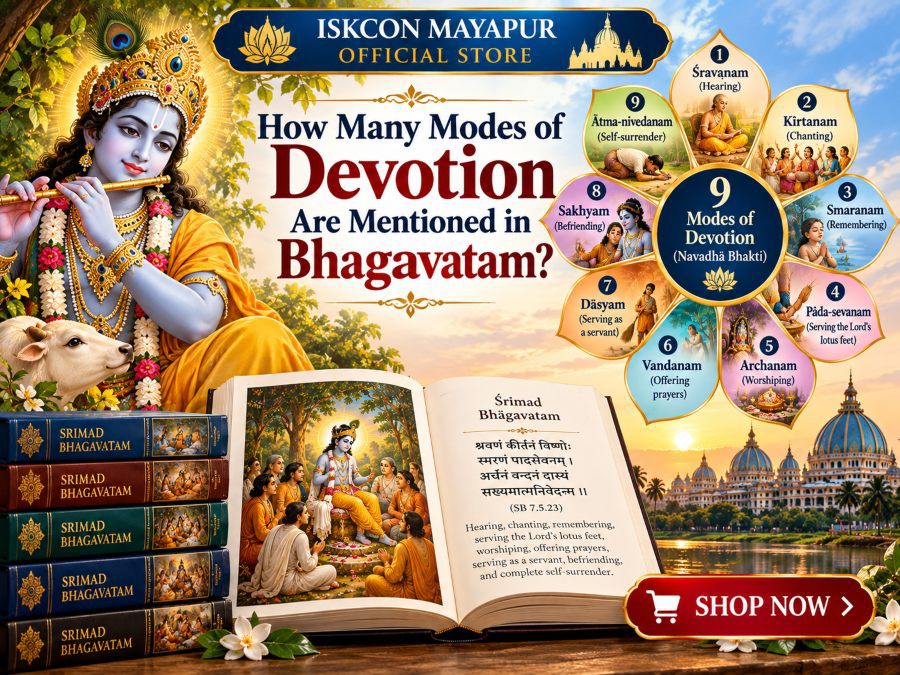 How Many Modes of Devotion Are Mentioned in Bhagavatam?Read more
A young boy named Prahlada listed nine ways to serve God, and the Bhagavatam keeps them as its answer. Learn what the...
-
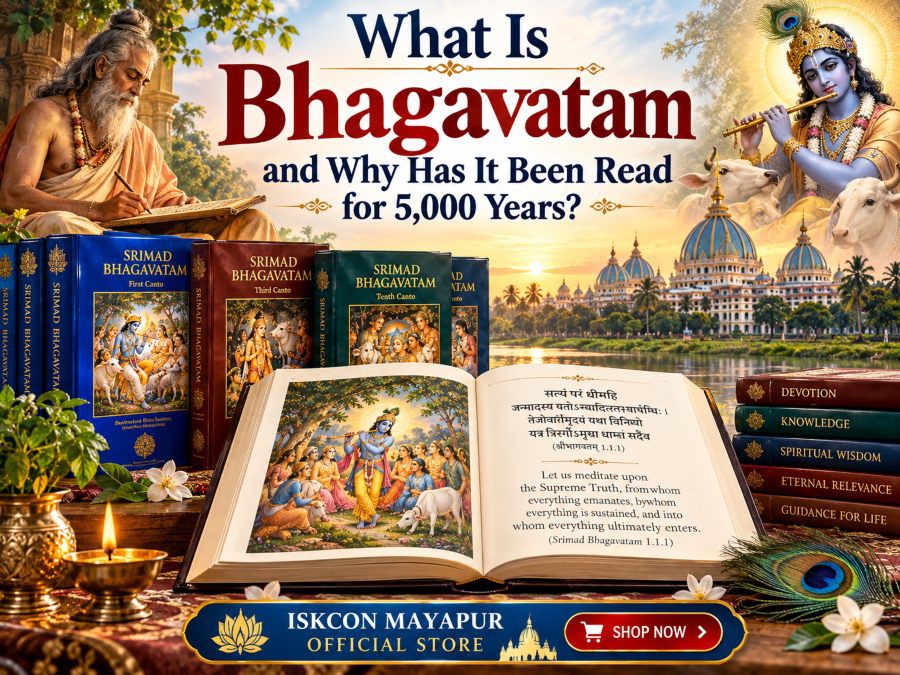 What Is Bhagavatam and Why Has It Been Read for 5,000 Years?Read more
A dying king asked one question, and the answer became the Bhagavatam. Learn what this Sanskrit scripture contains,...
-
 Who Is Lord Krishna? His Meaning, Teachings and Pastimes ExplainedRead more
Discover who Krishna is according to Srimad Bhagavatam, including His divine identity, childhood pastimes, teachings,...
-
 Incense in Islam: Bakhoor, Agarbatti and What Tradition SaysRead more
Is burning fragrance part of Muslim tradition? Explore incense in Islam, from the Prophetic practice of fumigating...
-
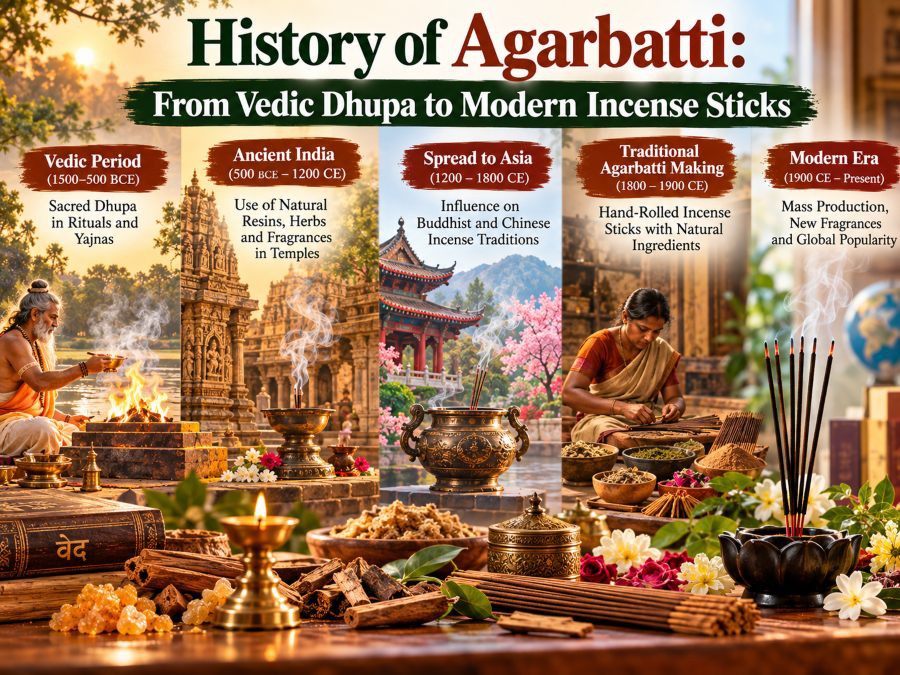 History of Agarbatti: From Vedic Dhupa to Modern Incense SticksRead more
Where did agarbatti really come from? Follow the history of agarbatti from Vedic fire rituals and temple dhupa to...
Blog categories
- Default category (0)
- MUSICAL INSTRUMENT (1)
- BOOK (5)
- DEVOTIONAL GIFT (0)
- Blog (30) click
- CHANDAN (12)
- Bhagavatam Wisdom Series (68)
- Krishna Consciousness (14)
- Mridangam Musical Instrument (6)
- Bhagavad Gita for Beginners (13)
- Bhagavad Gita As It Is (37) click
- Bhagavad Gita As It Is Telugu (0)
- Bhagavad Gita As It Is Marathi (0)
- Bhagavad Gita As It Is In Hindi (0)
- Bhagavad Gita As It Is In English (0)
- Bhagavad Gita As It Is In Bengali (8)
- Bhagavad Gita As It Is In Kannada (0)
- Bhagavad Gita As It Is In Gujarati (0)
- Bhagavad Gita As It Is In Panjabi (0)
- Bhagavad Gita As It Is In Tamil (0)
- Bhagavad Gita As It Is Odia (0)
- BHAGAVAD GITA As It Is GERMAN (0)
- Bhagavad Gita As It Is In French (0)
- Bhagavad Gita As It Is In Nepali (0)
- Bhagavad Gita As It Is In Assamese (0)
- Incense or Agarbatti (38)
- Lord Chaitanya Mahaprabhu (3)
- Vedic Temple Mayapur (14)
- kalki (15)
- Mahabharata – Dharma & Destiny (27)
- Vaishnava Scriptures (4)
- healthy product (4)
- chaitanya mahaprabhu (5)
- Tulsi Mala Guide (17)
Search in blog
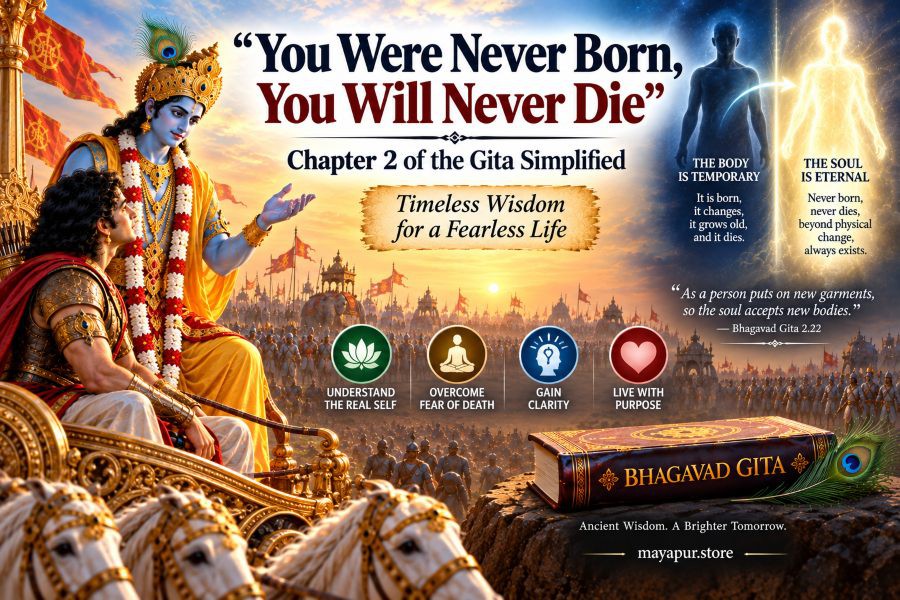
“You Were Never Born, You Will Never Die” — Chapter 2 of the Gita Simplified
“You Were Never Born, You Will Never Die” — Chapter 2 of the Gita Simplified
What if death is not the end of who you are—but only the end of one temporary body? This is one of the most powerful ideas presented in Bhagavad Gita Chapter 2, where Krishna begins answering Arjuna's grief by explaining the eternal nature of the soul. Arjuna is standing on the battlefield of Kurukshetra, surrounded by people he loves, and he cannot bear the thought of their deaths. Krishna's response changes the entire conversation: the body is temporary, but the self within the body is never destroyed.
The teaching sounds simple.
But its meaning is enormous.
If the soul was never truly born and can never truly die, then our understanding of identity, fear, grief, success, failure, and even the purpose of life has to change.
This is one of the central ideas of the Bhagavad Gita, and Chapter 2 presents it in a way that directly addresses Arjuna's emotional crisis.
Why Krishna Talks About the Soul When Arjuna Is Worried About War
Arjuna's immediate concern is painfully practical.
He sees his relatives and teachers on the opposite side of the battlefield. He thinks about their deaths and feels responsible for what may happen.
His bow falls from his hand.
He does not want victory if victory means destroying the people he loves.
Krishna could have responded by discussing military strategy.
Instead, he starts with something much deeper:
Who is actually dying?
Arjuna is looking at bodies.
Krishna wants him to understand the self within those bodies.
This distinction becomes the foundation of Chapter 2.
According to Krishna, the physical body is temporary. It appears, changes, grows old, and eventually dies. The soul, however, is eternal.
That means the destruction of the body does not mean the destruction of the person at the deepest level.
“You Were Never Born”: What Does Krishna Mean?
The phrase “you were never born” can sound strange at first.
Obviously, every person has a birth date.
Every physical body begins at a particular point in time.
Krishna is talking about something deeper than the body.
The soul, according to the Gita, does not begin when the physical body is born.
Birth is the beginning of the body's particular journey.
The eternal self already exists.
This is a completely different way of understanding personal identity.
Most people naturally think:
“I was born, I am living now, and one day I will die.”
The Gita asks us to reconsider that sequence.
The body is born.
The body grows.
The body changes.
The body eventually dies.
But the soul is not created at physical birth and does not cease to exist at physical death.
This is why Krishna tells Arjuna that the wise do not see the self as something that comes into existence and then disappears.
The Body Has Changed Many Times Already
There is an interesting observation Krishna makes that can help us understand this teaching.
Think about yourself at five years old.
Then imagine yourself at fifteen.
Then twenty-five.
Then thirty-five or fifty.
The physical body changes continuously.
The face changes.
The height changes.
The cells change.
Strength changes.
Abilities change.
Even the way you think can change dramatically.
Yet there is a continuous sense of identity.
You can look at an old photograph and say:
“That was me.”
The child and the adult are physically different, but you experience them as part of one continuing self.
Krishna uses this everyday experience to introduce a much deeper idea: the conscious self remains present while the body moves through different stages.
If the body can change so dramatically while the sense of self continues, then physical transformation may not be the destruction of the self.
Death, therefore, can be understood differently.
The Soul Does Not Die When the Body Dies
This is the central teaching that gives Chapter 2 its distinctive character.
Krishna describes the soul as eternal and indestructible.
It cannot be destroyed by weapons.
Fire cannot burn it.
Water cannot wet it.
Wind cannot dry it.
These descriptions emphasize that the soul is not ordinary physical matter.
A weapon can damage a body.
Fire can consume a body.
Water can affect physical substances.
But the eternal self described by Krishna exists beyond these material processes.
This is why the Gita does not define death as the destruction of the soul.
The body ends.
The soul continues.
That distinction is the philosophical foundation behind Krishna's attempt to help Arjuna overcome his paralyzing grief.
Why This Teaching Changes the Way We Think About Death
Death is frightening largely because we associate it with disappearance.
We see someone alive.
Then the body stops functioning.
Their voice is gone.
Their physical presence is gone.
We can no longer interact with them in the same way.
From an ordinary material perspective, this feels like complete loss.
The Bhagavad Gita offers another interpretation.
The physical body has been lost, but the soul has not been destroyed.
This does not mean grief is unnecessary.
It does not mean that losing someone should feel easy.
And it certainly does not mean that relationships have no value.
Instead, the teaching asks us to understand death from a wider spiritual perspective.
Separation from a physical body is not the same thing as destruction of the eternal self.
For someone experiencing grief, that distinction can be deeply meaningful.
The Famous Clothing Analogy
One of Krishna's most memorable explanations compares the body to clothing.
A person wears clothes.
Eventually, those clothes become old or unsuitable.
They are removed and replaced.
The person wearing them remains.
Krishna uses this comparison to explain the relationship between the soul and the body.
The body is like a temporary covering.
The soul is the conscious being who inhabits it.
This analogy also helps explain the idea of reincarnation presented in the Gita.
The body changes, while the soul continues its journey.
The comparison is powerful because we already understand the difference between ourselves and what we wear.
Nobody believes their identity disappears simply because they change clothes.
Krishna asks Arjuna to apply that distinction at a much deeper level.
Why We Often Forget Our Deeper Identity
If the soul is eternal, why do we identify so strongly with the body?
Because the body is what we experience directly.
We see our reflection.
We feel hunger.
We experience physical pain.
We receive praise or criticism about our appearance.
We work through our bodies.
We interact with the world through our senses.
It is natural to think, “This body is me.”
But the Gita encourages us to distinguish between the person and the temporary vehicle through which that person acts.
This distinction can be difficult to grasp intellectually.
It becomes easier when we observe how much our identity changes over time.
You are not physically the same person you were ten years ago.
Yet you remain aware of yourself as the same continuing individual.
That continuity points toward a deeper understanding of identity.
What Happens to Fear When You See Yourself Differently?
Fear often becomes stronger when we believe temporary circumstances define our entire existence.
If success is your identity, failure becomes terrifying.
If physical appearance is your identity, aging becomes frightening.
If possessions are your identity, losing money feels like losing yourself.
If the body is your complete identity, death appears to be total destruction.
The Bhagavad Gita offers a different foundation.
If the soul is eternal, then temporary circumstances cannot completely define who you are.
You may experience success.
You may experience failure.
You may become young, old, healthy, or physically weak.
You may gain possessions and later lose them.
But none of these temporary conditions represents the complete self.
That understanding can create a different relationship with life's changes.
“You Will Never Die” Does Not Mean the Body Is Immortal
This distinction is important.
Krishna is not saying that the physical body will live forever.
The body is clearly temporary.
It grows old and eventually stops functioning.
The statement about never dying refers to the eternal self.
This is why the teaching should not be reduced to the idea that humans are physically immortal.
That would miss the point entirely.
The Gita presents two different levels of identity:
The temporary body
· It is born.
· It grows.
· It changes.
· It becomes old.
· It eventually dies.
The eternal soul
· It is not created by bodily birth.
· It does not perish with the body.
· It is not destroyed by material forces.
· It continues beyond bodily change.
Understanding this distinction is at the heart of Sankhya Yoga in Chapter 2.
How This Helps Arjuna With His Dilemma
Arjuna's biggest problem is not that he lacks courage.
His problem is that his understanding has become clouded by grief and attachment.
He sees death as the ultimate destruction of the people he loves.
Krishna challenges that assumption.
If the soul is eternal, then the physical death of the body does not mean the annihilation of the person.
This does not automatically answer every moral question surrounding war.
But it changes the foundation from which Arjuna must think.
He can no longer view the battlefield only through the lens of physical bodies.
He has to consider the deeper nature of the self, his responsibility, and the proper way to act without becoming overwhelmed by attachment.
That is why Krishna's teaching about the soul comes before many of his teachings about action.
First understand who you are. Then understand how you should act.
The Lesson for Everyday Life
You do not need to stand on a battlefield to benefit from this teaching.
Modern life gives us plenty of reasons to become overly attached to temporary things.
We worry about getting older.
We compare our appearance with others.
We become obsessed with professional status.
We fear losing money.
We chase recognition.
We become devastated by failure.
The teaching of the Bhagavad Gita invites us to step back.
Ask yourself:
Am I confusing something temporary with my permanent identity?
That question can change the way you experience ordinary problems.
A failed business does not mean your existence has failed.
A rejected application does not make you worthless.
A change in appearance does not erase your identity.
Aging does not mean that your deepest self is disappearing.
And physical death, according to Krishna's teaching, does not destroy the soul.
The Soul Teaching Is Also a Lesson in Courage
Arjuna's courage must eventually come from understanding, not simply emotion.
If he believes everything ends with the body, fear can dominate his decisions.
If he understands the soul as eternal, he can begin to see death from a broader perspective.
This does not turn him into someone who feels nothing.
It gives him a deeper foundation from which to act.
That distinction is worth remembering.
Real spiritual courage is not the absence of emotion.
It is the ability to see beyond immediate emotion and act according to deeper understanding.
Arjuna still has feelings.
He still cares.
But he learns not to let grief completely determine his judgment.
What Chapter 2 Says About the Purpose of Life
If the soul is eternal and the body temporary, then what is the purpose of living?
The Bhagavad Gita gradually develops an answer throughout its chapters.
Human life should not be reduced to physical comfort and temporary achievement.
We have responsibilities.
We have choices.
We have the opportunity to develop spiritual knowledge.
We can perform our duties while cultivating devotion, self-control, wisdom, and freedom from selfish attachment.
Chapter 2 begins this larger journey.
Its teaching about the soul is therefore not merely about what happens after death.
It is also about how we should live before death.
If you understand yourself as more than the body, your priorities can change.
You may become less obsessed with temporary recognition.
You may become more thoughtful about your actions.
You may begin asking what kind of person you are becoming rather than simply what you are accumulating.
A Simple Way to Remember Krishna's Teaching
When trying to understand this section of the Bhagavad Gita, remember three ideas:
1. The body is temporary.
It changes from childhood through old age and eventually dies.
2. The soul is eternal.
It is not created by physical birth and is not destroyed by physical death.
3. Spiritual knowledge should influence action.
Understanding the self helps a person face responsibility without becoming controlled by fear and attachment.
These three ideas form a simple framework for understanding much of Krishna's teaching in Chapter 2.
Final Thoughts: The Person Is More Than the Body
The statement “You were never born, you will never die” is not meant to deny the reality of physical birth and death.
It points toward a deeper identity.
The body is born.
The body changes.
The body grows old.
The body eventually dies.
But according to Krishna's teaching in the Bhagavad Gita, the soul is eternal.
For Arjuna, this knowledge is the beginning of freedom from paralyzing grief.
For us, it offers a different way to think about identity, aging, loss, fear, and the purpose of life.
We spend enormous amounts of energy protecting, improving, decorating, and identifying with the body. There is nothing wrong with caring for the body. But the Gita asks us not to mistake the temporary covering for the complete self.
That is the deeper message behind the title:
You were never born, and you will never die.
Not because the physical body is permanent.
But because, according to Krishna, the eternal self is beyond birth and death.
Once that idea begins to take root, Chapter 2 becomes more than a philosophical discussion about the soul. It becomes an invitation to look at ourselves differently.
We are living through a temporary bodily experience.
But the deepest self, Krishna teaches Arjuna, is eternal.
Posted in: Bhagavad Gita As It Is
Related posts
-
 Why the Bhagavad Gita Feels Like a Personal Conversation with KrishnaThe Bhagavad Gita feels like a personal conversation with Krishna because its timeless wisdom directly addresses our...Read more
 -
 Shrimad Bhagwat Geeta: The Forgotten Life Manual for Modern StressShrimad Bhagwat Geeta is more than a sacred scripture—it’s a forgotten life manual that offers timeless solutions for...Read more
 -
 Who Wrote the Bhagavad Gita? Discover the true authorship of the Bhagavad Gita—exploring Ved Vyasa’s role as the compiler, Lord Krishna’s divine...Read more
 -
 How Many Shlokas in Bhagavad Gita? Complete Chapter-Wise Breakdown & MeaningDiscover how many shlokas are in the Bhagavad Gita, with a complete chapter-wise breakdown, variations in verse...Read more
 -
 How to Read Bhagavad Gita: A Complete Step-by-Step Guide for BeginnersDiscover how to read the Bhagavad Gita step by step—learn the right mindset, chapter order, and tips to understand...Read more
Leave a comment