
Why did Krishna run to embrace a poor brahmin in rags? Read the Sudama story from the Bhagavatam and learn how a...
Latest posts
-
 Krishna and Sudama: The Poor Brahmin Who Became Wealthy in LoveRead more
 -
 Vamana Avatar: How Three Steps Humbled Bali MaharajaRead more
Why did a powerful king give away three worlds to a boy asking for three steps? Learn the Vamana avatar story from...
-
 The Bhagavatam on Marriage: Duty, Love and Spiritual PartnershipRead more
What does the Bhagavatam say about marriage? Through the stories of Kardama and Devahuti, Rukmini's secret letter and...
-
 What Is Prema? The Bhagavatam's Highest Stage of Love for GodRead more
Prema is love for God with no "because" attached. Learn how the Bhagavatam describes it, the nine steps from faith to...
-
 Is Shiva Parvati Kalyana Mentioned in Srimad Bhagavatam? What the Scripture Really SaysRead more
Looking for Shiva and Parvati's wedding in the Srimad Bhagavatam? Find out what the scripture actually describes,...
-
 How Many Modes of Devotion Are Mentioned in Bhagavatam?Read more
A young boy named Prahlada listed nine ways to serve God, and the Bhagavatam keeps them as its answer. Learn what the...
-
 What Is Bhagavatam and Why Has It Been Read for 5,000 Years?Read more
A dying king asked one question, and the answer became the Bhagavatam. Learn what this Sanskrit scripture contains,...
-
 Who Is Lord Krishna? His Meaning, Teachings and Pastimes ExplainedRead more
Discover who Krishna is according to Srimad Bhagavatam, including His divine identity, childhood pastimes, teachings,...
-
 Incense in Islam: Bakhoor, Agarbatti and What Tradition SaysRead more
Is burning fragrance part of Muslim tradition? Explore incense in Islam, from the Prophetic practice of fumigating...
-
 History of Agarbatti: From Vedic Dhupa to Modern Incense SticksRead more
Where did agarbatti really come from? Follow the history of agarbatti from Vedic fire rituals and temple dhupa to...
Blog categories
- Default category (0)
- MUSICAL INSTRUMENT (1)
- BOOK (5)
- DEVOTIONAL GIFT (0)
- Blog (30) click
- CHANDAN (12)
- Bhagavatam Wisdom Series (68)
- Krishna Consciousness (14)
- Mridangam Musical Instrument (6)
- Bhagavad Gita for Beginners (13)
- Bhagavad Gita As It Is (37) click
- Bhagavad Gita As It Is Telugu (0)
- Bhagavad Gita As It Is Marathi (0)
- Bhagavad Gita As It Is In Hindi (0)
- Bhagavad Gita As It Is In English (0)
- Bhagavad Gita As It Is In Bengali (8)
- Bhagavad Gita As It Is In Kannada (0)
- Bhagavad Gita As It Is In Gujarati (0)
- Bhagavad Gita As It Is In Panjabi (0)
- Bhagavad Gita As It Is In Tamil (0)
- Bhagavad Gita As It Is Odia (0)
- BHAGAVAD GITA As It Is GERMAN (0)
- Bhagavad Gita As It Is In French (0)
- Bhagavad Gita As It Is In Nepali (0)
- Bhagavad Gita As It Is In Assamese (0)
- Incense or Agarbatti (38)
- Lord Chaitanya Mahaprabhu (3)
- Vedic Temple Mayapur (14)
- kalki (15)
- Mahabharata – Dharma & Destiny (27)
- Vaishnava Scriptures (4)
- healthy product (4)
- chaitanya mahaprabhu (5)
- Tulsi Mala Guide (17)
Search in blog
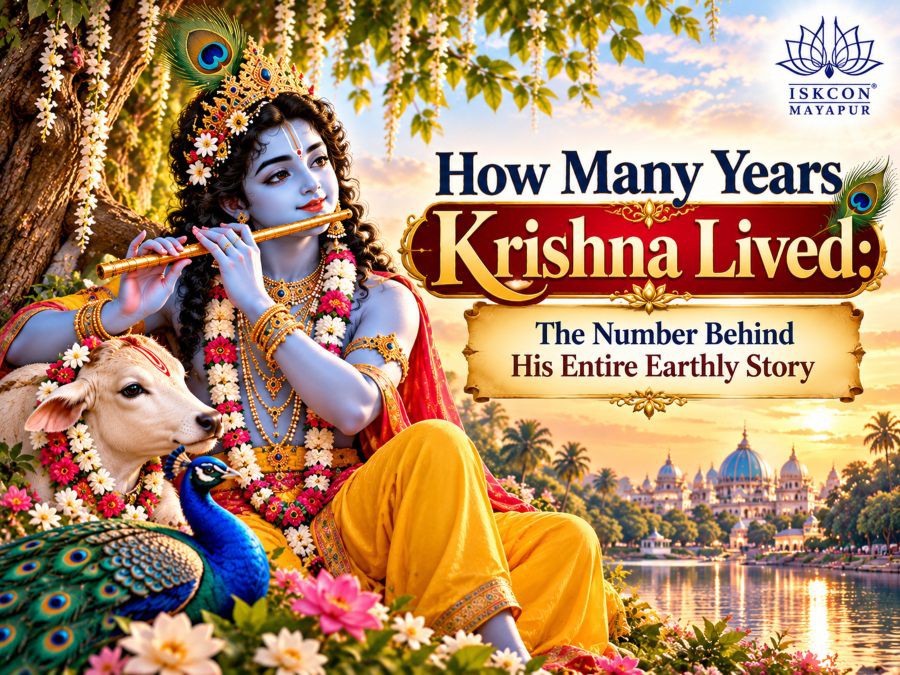
How Many Years Krishna Lived: The Number Behind His Entire Earthly Story
How Many Years Krishna Lived: The Number Behind His Entire Earthly Story
125 years. That's the number the tradition gives for Krishna's entire time on Earth — and once you actually map out what happened across those 125 years, the number stops looking like a round, symbolic figure and starts looking like a genuinely packed, event-heavy life that most historical figures, real or legendary, would need several lifetimes to match.
A cowherd childhood. A palace coup. Advanced military and philosophical training. Building a fortified island capital from scratch. A war that reshaped an entire subcontinent's political order. Decades of rule afterward. And an ending that's almost unbearably quiet compared to everything that came before it. This piece walks through how many years Krishna lived, where that number comes from in the actual texts, and how his life gets divided into distinct phases — a breakdown covered in more devotional depth over at mayapur.store as well.
The Short Answer: 125 Years
The Bhagavata Purana states this number directly, and it's the figure most consistently cited across Vaishnava tradition and Puranic literature: Krishna lived 125 years on Earth before his departure.

That departure — his nirvana or disappearance from the physical world — is traditionally dated to 3102 BCE, which, not coincidentally, is also the traditionally accepted starting point of Kali Yuga, the current cosmic age. Work backward 125 years from that departure date, and you land on approximately 3228 BCE for his birth — the same figure most often cited when people ask when Krishna was actually born.
A few things worth establishing before going further:
- This 125-year span covers his entire life from birth in Mathura's prison cell to his departure near Prabhasa, on the western coast of India.
- It's not treated as an approximate or rounded figure in the tradition — Puranic literature is specific about this number, unlike some other biographical details that get described more loosely.
- The number carries theological weight beyond biography, since his departure is treated as marking an actual transition point between cosmic ages, not just the end of one person's life.
Breaking Down the 125 Years: A Life in Distinct Chapters
Here's where the number actually becomes interesting, because 125 years isn't one continuous, uniform stretch. Traditional chronology divides it into fairly distinct phases, each with a different setting, a different Krishna, almost — the cowherd child and the aging statesman in Dwaraka barely resemble each other on the surface, even though the texts insist it's the same continuous life and the same complete personality throughout.
Phase One: Birth Through Early Childhood (Roughly Years 0-3)
Krishna's earliest years unfold in Gokul, where he's secretly raised by Nanda and Yashoda after being swapped for their newborn daughter to protect him from King Kamsa. This period includes some of the most famous demon-slaying episodes in the entire canon — Putana, Trinavarta, Shakatasura — all of which, according to the Bhagavatam, occur while Krishna is still an infant or very young toddler.
This early phase matters for understanding the pacing of his life:
- Threats to his life begin literally within days of birth and continue steadily through early childhood, establishing a pattern of danger that recurs throughout his years in Vraja.
- The family relocates from Gokul to Vrindavana during this period, seeking safer pastureland, which is why later stories are set in Vrindavana rather than Gokul specifically.
- Even this early stretch isn't uneventful padding before the "real" story starts — the tradition treats these childhood pastimes as spiritually significant in their own right, not merely as backstory.
Phase Two: The Vrindavana Years (Roughly Ages 3-10)
This is the period most people actually picture when they think of Krishna — butter theft, cowherding, the Govardhana Hill episode, and eventually the Rasa Lila with the gopis. According to traditional chronology, this entire beloved chapter of his story — the one that's inspired the most poetry, art, and devotional literature of any period in his life — occupies only about seven years out of his total 125.
That's a detail worth sitting with. The phase of Krishna's life that dominates popular imagination and devotional focus most heavily is, by simple year-count, one of the shorter chapters of his overall biography.
Phase Three: The Move to Mathura and Killing Kamsa (Around Age 10-11)
Krishna and his brother Balarama travel to Mathura, ostensibly to participate in a wrestling tournament arranged by Kamsa (who intends to use the event to kill them). Instead, Krishna kills the tournament's champion wrestlers, and then Kamsa himself, fulfilling the prophecy that had driven Kamsa's murderous paranoia since before Krishna's birth.
This marks a genuine turning point in the pacing of the story. Everything before this point happens in a rural, pastoral setting over roughly a decade. Everything after happens on a considerably larger political and geographic stage, compressed into a life that still has well over a century left to run.
Phase Four: Education Under Sandipani Muni
Shortly after taking Mathura back from Kamsa's rule and restoring his grandfather Ugrasena to the throne, Krishna and Balarama are sent to the ashram of the sage Sandipani Muni for formal education — a detail the Bhagavatam includes specifically, describing them mastering the full range of traditional subjects, including the sixty-four arts and sciences, in a remarkably short span, traditionally described as 64 days.
Why this phase gets included despite its brevity:
- It establishes that Krishna's abilities, while divine in origin according to the tradition, still involve a formal education process rather than simply appearing fully formed.
- It sets up the guru-disciple relationship structure that recurs throughout Vaishnava tradition — even Krishna, in his human pastimes, is shown accepting a teacher.
- The famous episode of retrieving Sandipani Muni's deceased son from Yamaraja's abode as guru-dakshina (a teacher's fee) occurs during this period.
Phase Five: Building Dwaraka and the Middle Years
Facing continued aggression from Jarasandha (Kamsa's father-in-law, who repeatedly attacks Mathura seeking revenge), Krishna makes a decision that later commentators treat as a demonstration of strategic wisdom rather than cowardice: he relocates the entire Yadava clan to a new, more defensible capital — Dwaraka, built on reclaimed coastal land off the western coast, according to tradition constructed with the help of Vishwakarma, architect of the celestial realm.
This is where Krishna marries Rukmini and his other principal queens, has numerous children, and settles into a role as statesman and political figure rather than the wandering cowherd of his earlier years. This phase occupies a substantial portion of the 125-year total — decades pass in Dwaraka before the events of the Mahabharata war even begin.
Phase Six: The Mahabharata War Period
By traditional chronology, Krishna is often placed in something close to his eighties when the Kurukshetra war actually occurs — a detail that surprises a lot of people who picture him as perpetually youthful throughout the epic. His role during this period is primarily as Arjuna's charioteer and advisor rather than a direct combatant, having pledged at the war's outset that he would carry weapons for whichever side chose his army, but personally remain unarmed if the opposing side instead chose him alone as an advisor.
The Bhagavad Gita — the entire eighteen-chapter philosophical dialogue delivered on the battlefield before fighting begins — occurs within this single, specific moment in his life: a conversation lasting perhaps an hour or two, positioned near the very end of a life spanning well over a century, yet carrying disproportionate philosophical weight relative to its brief place in the overall timeline.
Phase Seven: The Post-War Years in Dwaraka (Roughly 36 Years)
Here's a stretch of Krishna's life that gets surprisingly little attention relative to its actual length. After the war concludes, Krishna returns to Dwaraka and continues ruling for approximately 36 more years — nearly three decades longer than the entire Vrindavana chapter that dominates popular devotional imagination.
This period ends with one of the more sobering episodes in the whole canon: the self-destruction of the Yadava clan itself, brought on by a curse (from sages provoked by some of the younger Yadavas, according to the Bhagavatam) and by drunken infighting among Krishna's own kinsmen at Prabhasa. Krishna's own sons and much of his extended family die in this internal collapse, largely without Krishna intervening to stop it — a detail commentators read as a deliberate demonstration that even divine intervention doesn't override the consequences a community brings on itself.
Phase Eight: The Departure
Krishna's death, in the traditional account, is almost jarringly understated given everything that precedes it. Resting alone under a tree near Prabhasa in the aftermath of the Yadava clan's destruction, he's mistaken for a deer by a hunter named Jara, who shoots an arrow into his foot — the one vulnerable point on his body, according to the narrative — and Krishna departs from the physical world shortly after.
Why this ending matters for understanding the full 125-year arc:
- It closes a life that began with a king trying to kill an infant through arranged assassinations, and ends with an accidental hunter's arrow — bookending an existence defined throughout by threats to his physical body that never quite land until the very end.
- The location and manner are treated in tradition as symbolically significant, marking the precise transition into Kali Yuga.
- Balarama, his elder brother, departs shortly before or around the same time, generally described as consciously leaving his body through yogic means rather than by external cause.
Why the 125-Year Span Gets Divided So Unevenly
Step back and look at the actual proportions: roughly 10 years in Vraja (Gokul and Vrindavana combined), a brief transitional period in Mathura and under Sandipani Muni, and then well over a century — the vast majority of his entire life — spent as a ruling figure based in Dwaraka, encompassing both the pre-war political maneuvering and 36 full years of governance after the Mahabharata war concluded.
That's a strange asymmetry once you notice it. Popular devotional focus, artwork, and storytelling weight overwhelmingly toward the pastoral Vrindavana years and toward the single battlefield conversation of the Bhagavad Gita — a combined span of maybe a decade and an afternoon, respectively, out of 125 years. The remaining century-plus, spent building a kingdom, raising a family, managing political alliances, and eventually watching that entire world collapse from within, gets comparatively little devotional attention despite representing the overwhelming majority of his actual lived time on Earth.
What This Timeline Tells You About How the Tradition Reads a Life
There's a genuine insight buried in this uneven distribution, and it's worth naming directly rather than leaving it as a passing observation: the tradition isn't treating "significance" as something proportional to duration. A single afternoon's dialogue on a battlefield carries more devotional and philosophical weight, in how the tradition actually engages with Krishna's life, than three and a half decades of subsequent governance.
That's a specific claim about what actually matters in a life — not the accumulation of years, but the density of meaning within specific moments. Whether or not you find that framework persuasive, it explains something that would otherwise look like an odd editorial choice: why a 125-year life gets remembered, overwhelmingly, through a handful of episodes that together account for a small fraction of the actual calendar time involved.
The Bottom Line on How Long Krishna Lived
125 years, according to the Bhagavata Purana and the broader Puranic tradition — beginning around 3228 BCE and ending with his departure near 3102 BCE, an event traditionally marking the start of Kali Yuga itself. Within that span: roughly a decade of childhood in Vraja, a brief and eventful transition through Mathura and formal education, and then well over a century spent building, ruling, and eventually watching the collapse of Dwaraka.
The number itself is specific and consistently cited. What's more interesting is what the tradition chooses to remember from inside that number — and how little of the actual calendar time it takes to hold almost all of the meaning.
Posted in: Krishna Consciousness
Related posts
-
 Krishna Consciousness: The Endless Path of Bhakti and DevotionExplore Krishna Consciousness—the eternal path of bhakti and devotion rooted in ancient wisdom. Discover the...Read more
 -
 Why Krishna Consciousness is the Key to Inner Peace & HappinessDiscover how Krishna Consciousness offers the key to lasting inner peace and true happiness through devotion,...Read more
 -
 Unlocking the Power of Bhakti Yoga through Krishna ConsciousnessUnlock the power of Bhakti Yoga through Krishna Consciousness—discover how devotion, chanting, and ISKCON Mayapur...Read more
 -
 Discovering Krishna Consciousness: The Science of Self-RealizationDiscover Krishna Consciousness as the science of self-realization—unlock your true spiritual identity and attain...Read more
 -
 Chant, Dance, and Rejoice: Experiencing Krishna ConsciousnessExperience the joy of Krishna Consciousness through chanting, dancing, and rejoicing. Discover how these devotional...Read more
Leave a comment