
Why did Krishna run to embrace a poor brahmin in rags? Read the Sudama story from the Bhagavatam and learn how a...
Latest posts
-
 Krishna and Sudama: The Poor Brahmin Who Became Wealthy in LoveRead more
 -
 Vamana Avatar: How Three Steps Humbled Bali MaharajaRead more
Why did a powerful king give away three worlds to a boy asking for three steps? Learn the Vamana avatar story from...
-
 The Bhagavatam on Marriage: Duty, Love and Spiritual PartnershipRead more
What does the Bhagavatam say about marriage? Through the stories of Kardama and Devahuti, Rukmini's secret letter and...
-
 What Is Prema? The Bhagavatam's Highest Stage of Love for GodRead more
Prema is love for God with no "because" attached. Learn how the Bhagavatam describes it, the nine steps from faith to...
-
 Is Shiva Parvati Kalyana Mentioned in Srimad Bhagavatam? What the Scripture Really SaysRead more
Looking for Shiva and Parvati's wedding in the Srimad Bhagavatam? Find out what the scripture actually describes,...
-
 How Many Modes of Devotion Are Mentioned in Bhagavatam?Read more
A young boy named Prahlada listed nine ways to serve God, and the Bhagavatam keeps them as its answer. Learn what the...
-
 What Is Bhagavatam and Why Has It Been Read for 5,000 Years?Read more
A dying king asked one question, and the answer became the Bhagavatam. Learn what this Sanskrit scripture contains,...
-
 Who Is Lord Krishna? His Meaning, Teachings and Pastimes ExplainedRead more
Discover who Krishna is according to Srimad Bhagavatam, including His divine identity, childhood pastimes, teachings,...
-
 Incense in Islam: Bakhoor, Agarbatti and What Tradition SaysRead more
Is burning fragrance part of Muslim tradition? Explore incense in Islam, from the Prophetic practice of fumigating...
-
 History of Agarbatti: From Vedic Dhupa to Modern Incense SticksRead more
Where did agarbatti really come from? Follow the history of agarbatti from Vedic fire rituals and temple dhupa to...
Blog categories
- Default category (0)
- MUSICAL INSTRUMENT (1)
- BOOK (5)
- DEVOTIONAL GIFT (0)
- Blog (30) click
- CHANDAN (12)
- Bhagavatam Wisdom Series (68)
- Krishna Consciousness (14)
- Mridangam Musical Instrument (6)
- Bhagavad Gita for Beginners (13)
- Bhagavad Gita As It Is (37) click
- Bhagavad Gita As It Is Telugu (0)
- Bhagavad Gita As It Is Marathi (0)
- Bhagavad Gita As It Is In Hindi (0)
- Bhagavad Gita As It Is In English (0)
- Bhagavad Gita As It Is In Bengali (8)
- Bhagavad Gita As It Is In Kannada (0)
- Bhagavad Gita As It Is In Gujarati (0)
- Bhagavad Gita As It Is In Panjabi (0)
- Bhagavad Gita As It Is In Tamil (0)
- Bhagavad Gita As It Is Odia (0)
- BHAGAVAD GITA As It Is GERMAN (0)
- Bhagavad Gita As It Is In French (0)
- Bhagavad Gita As It Is In Nepali (0)
- Bhagavad Gita As It Is In Assamese (0)
- Incense or Agarbatti (38)
- Lord Chaitanya Mahaprabhu (3)
- Vedic Temple Mayapur (14)
- kalki (15)
- Mahabharata – Dharma & Destiny (27)
- Vaishnava Scriptures (4)
- healthy product (4)
- chaitanya mahaprabhu (5)
- Tulsi Mala Guide (17)
Search in blog
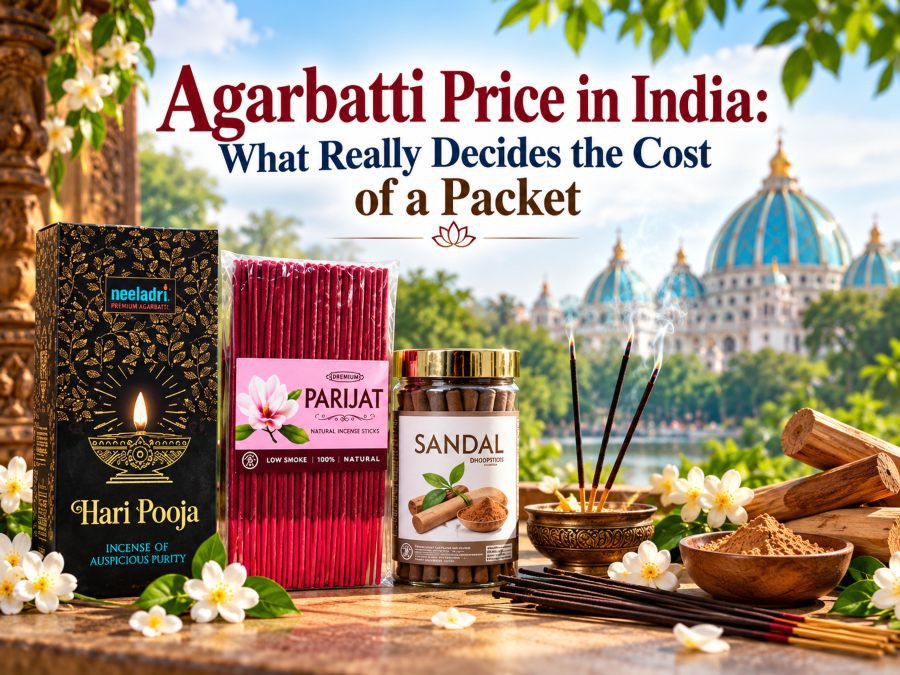
Agarbatti Price in India: What Really Decides the Cost of a Packet
Agarbatti Price in India: What Really Decides the Cost of a Packet
Picture two packets on the same shelf. Both say "Sandalwood." One costs ₹20. The other costs ₹400. Same word on the label, same thin stick inside. So who is getting fooled?
Usually nobody. The gap comes from what the stick is made of, how it was rolled, how many sticks you actually get, and how long each one burns. Devotional stores like Mayapur Store hear this question all the time, because a buyer who understands the price can choose the right stick for the right purpose instead of grabbing the cheapest or the dearest box.
So what does agarbatti actually cost?
Prices swing by city, brand and pack size, but rough bands help you get your bearings:
- Small everyday packs (15 to 30 sticks): ₹10 to ₹40
- Standard 100 g packs from established brands: ₹60 to ₹200
- Masala or hand-rolled premium packs (around 100 g): ₹200 to ₹800
- Gift boxes, resin blends and rare-ingredient sticks: ₹500 and up
Treat these as bands, not a rate card. A number on its own tells you very little, which is exactly why the word "sandalwood" can sit on a ₹20 packet and a ₹400 one. The rest of this piece explains what pushes a packet up or down that ladder.
The bamboo nobody talks about
Every agarbatti starts as a thin bamboo splint. It is the least glamorous part, yet it sets the base cost. Splints differ in thickness, straightness and finish. A smooth, evenly cut stick costs more to produce than a rough one that snaps at the base. Bamboo supply also moves with season and demand, so a rise in raw splint prices travels quietly all the way to the shelf. You will never see it printed on the box, but it is in the price.
The scent bill: where most of the money hides
Fragrance is the biggest swing factor. A stick can smell of sandalwood in three very different ways:
- Synthetic fragrance oil. Cheap, strong and consistent. It hits your nose fast and fades fast.
- Blended oils. A little natural material mixed with synthetic compounds to round off the smell.
- Natural materials. Sandalwood powder, guggal resin, herbs, flowers and real essential oils. These cost more to source and are harder to work with.
Real sandalwood oil sits among the most expensive aromatic materials in the world. A ₹20 packet cannot hold meaningful amounts of it. That does not make the packet dishonest. The label describes a scent profile, not a recipe. Rose, oud (agar) and saffron follow the same pattern: the closer a stick gets to the actual plant material, the higher the bill.
So when a premium packet feels expensive, ask one question: is the money going into the fragrance itself, or into the box wrapped around it?
Dipped or masala? The difference you can see and smell
Put two sticks side by side. One is often dark grey or black and slim. The other is brown or greenish, slightly rough and thicker.
The dark one is usually a charcoal-based stick dipped in perfume. Charcoal powder gives it a burning body, and the scent comes from the liquid it soaked up. It lights easily, burns quickly and makes a loud first impression.
The brown one is typically masala agarbatti. A dough of wood powder, herbs, resins and a natural binder (often called jigat or makko powder) is rolled onto the bamboo and dried in the sun. The stick itself smells like its ingredients, which is why masala sticks tend to burn slower and give a rounder, warmer fragrance.
Masala costs more for plain reasons. There are more ingredients in every stick, more drying time and more handling. Neither type is automatically better. Charcoal-based sticks suit a quick freshening of the room. Masala sticks suit a long puja or a quiet hour of japa.
Hands versus machines
Machines can roll thousands of sticks an hour. Hand rolling is slower, but skilled rollers produce a denser, more even coat, and a good deal of premium masala work is still done by hand, often in home-based units around traditional hubs like Mysuru, Bengaluru and parts of Gujarat.
Labour is one of the largest costs in a hand-rolled stick. If a "hand-rolled" packet costs the same as a machine-made one, ask questions. If it costs three times more, labour usually explains a fair share of the gap. It is also the part of the price that reaches actual people, which some buyers happily pay for.
The count-versus-weight trap
This is where most buyers get tripped. The packet that looks cheaper at the counter can cost more to burn.
Here is a made-up example to show the maths:
- Pack A: ₹40 for 30 thin sticks, each burning about 20 minutes. That is 10 hours of burning, or ₹4 per hour.
- Pack B: ₹150 for 40 thick masala sticks, each burning about 45 minutes. That is 30 hours of burning, or ₹5 per hour.
Pack B looks nearly four times dearer, yet it costs only a rupee more per burning hour and lasts three times as long. Your own sticks will burn differently, but the habit is worth keeping: check weight, count and burn time, not just the sticker.
Some packs print only the number of sticks, others only grams. A 100 g pack of thick sticks might hold around 40 pieces, while thin ones can hold twice that or more. Two "100 g" packs can therefore give you very different amounts of actual incense time.
Boxes, brands and the long road to the shelf
You pay for more than the stick:
- Packaging. Rigid boxes, foil and cellophane add cost. A well-sealed pack does keep fragrance alive longer, so it is not all show.
- Brand and marketing. Nationally advertised names carry the cost of advertising and a wide distribution chain.
- Margins along the way. Distributor, wholesaler and retailer each take a cut.
- GST and freight. Tax applies at the rate the government sets from time to time, and transport adds more for heavy bulk cartons.
- Festival demand. Around Diwali, Navratri and Janmashtami, demand jumps and prices at some shops follow.
- Freshness. Fragrance oils fade and sticks dry out or absorb damp. Sellers who move stock quickly hand you a fresher stick.
A store that sells directly to devotees can shorten part of this chain. That is one reason a good temple-oriented stick can cost less than a heavily advertised one of similar quality.
Reading a label like a detective
Labels are loud, but they are not always precise. A few words show up everywhere:
- "Natural" is used loosely. Ask what is natural: the binder, the fragrance or only the bamboo?
- "Premium" has no fixed meaning. It tells you about the seller's pricing, not the ingredients.
- "Hand-rolled" describes a process. It does not guarantee a good scent.
- "Temple grade" or "puja special" is a marketing phrase unless the maker also lists ingredients.
The reassuring labels carry plain facts: net weight, stick count, a list of main ingredients, a manufacturer's name and address, and a date. If a seller can tell you what is inside the stick, that is worth more than any adjective on the front.
Cheap can be fine. Here is when it isn't
A low price is not a warning by itself. A ₹20 pack of decent sticks does a perfectly good job for a quick freshening. Trouble starts when a stick shows these signs:
- A sharp chemical smell that gives you a headache
- Thick, sooty smoke that leaves a dark film on nearby walls or pictures
- Sticks that crumble, snap at the base or refuse to stay lit
- A label that says only "fragrance," with no weight, no ingredients and no maker
- A scent that disappears within a minute or two
If a packet fails on two of these, the low price is not saving you anything. And if you burn incense daily in a small room, ventilation matters more than any brand. Open a window, keep the stick away from beds and pets, and burn one stick at a time.
Working out what is worth paying for
Match the stick to the job:
- Daily puja: Mid-range masala or well-made dipped sticks. You use them every day, so steady quality and a fair cost per hour matter more than luxury.
- Meditation or long sessions: Slow-burning masala sticks with natural ingredients. Fewer refills and calmer smoke.
- Festivals and gatherings: Larger packs, where the cost per stick drops. Check freshness before you stock up.
- Gifting: Sealed, boxed and presentable. A premium blend is worth it here because the box is part of the gift.
- Bathrooms and quick freshening: Simple dipped sticks do the job. Save the good stuff for the altar.
Three habits protect your money. Buy one small pack before you commit to a large one. Work out the cost per burning hour. And store opened packs in an airtight tin, away from damp and sunlight.
Quick answers
Is expensive agarbatti always better?
No. Price rises with ingredients, labour, packaging and brand spending. Only the first two improve the stick itself. A costly box holding a thin, synthetic stick is just a costly box.
Why does the same brand cost different amounts in different shops?
Pack size, stock age, freight and local margins all play a part. Compare the price per gram or per stick, not per packet.
Does buying in bulk save money?
Usually, per stick, yes. It only works if you use the stock before the fragrance fades, so buy what you will burn within a few months.
The price tag is a story, not a verdict
An agarbatti price is a short summary of a long chain: the bamboo, the scent, the hands that rolled it, the box it travelled in and the shelf it sat on. Once you can read that chain, the confusing gap between ₹20 and ₹400 stops looking like a trick and starts looking like a set of choices.
Pick by purpose, not by price alone. Count the burning hours, read the label for facts instead of adjectives, and let your own nose have the final say. A stick that suits your worship, your room and your budget is the right one, whatever the number says.
Posted in: Incense or Agarbatti
Related posts
-
 How to Light Incense SticksDiscover the right way to light incense sticks (agarbatti) for worship, meditation, and peace. Learn step-by-step...Read more
 -
 Where to Buy Incense SticksDiscover where to buy the best natural incense sticks for your daily puja, meditation, and relaxation. Explore pure,...Read more
 -
 Is Incense Sticks Bad for Pregnancy? Wondering if incense sticks are safe during pregnancy? Discover the truth about incense smoke, its effects on...Read more
 -
 Do Incense Sticks Trigger Fire Alarms? Wondering if incense sticks can trigger fire alarms? Learn how smoke affects detectors, safe burning tips, and...Read more
 -
 How Many Incense Sticks to Burn for Good LuckDiscover how many incense sticks to burn for good luck and prosperity. Learn the ideal numbers, rituals, and natural...Read more
Leave a comment