
Why did Krishna run to embrace a poor brahmin in rags? Read the Sudama story from the Bhagavatam and learn how a...
Latest posts
-
 Krishna and Sudama: The Poor Brahmin Who Became Wealthy in LoveRead more
 -
 Vamana Avatar: How Three Steps Humbled Bali MaharajaRead more
Why did a powerful king give away three worlds to a boy asking for three steps? Learn the Vamana avatar story from...
-
 The Bhagavatam on Marriage: Duty, Love and Spiritual PartnershipRead more
What does the Bhagavatam say about marriage? Through the stories of Kardama and Devahuti, Rukmini's secret letter and...
-
 What Is Prema? The Bhagavatam's Highest Stage of Love for GodRead more
Prema is love for God with no "because" attached. Learn how the Bhagavatam describes it, the nine steps from faith to...
-
 Is Shiva Parvati Kalyana Mentioned in Srimad Bhagavatam? What the Scripture Really SaysRead more
Looking for Shiva and Parvati's wedding in the Srimad Bhagavatam? Find out what the scripture actually describes,...
-
 How Many Modes of Devotion Are Mentioned in Bhagavatam?Read more
A young boy named Prahlada listed nine ways to serve God, and the Bhagavatam keeps them as its answer. Learn what the...
-
 What Is Bhagavatam and Why Has It Been Read for 5,000 Years?Read more
A dying king asked one question, and the answer became the Bhagavatam. Learn what this Sanskrit scripture contains,...
-
 Who Is Lord Krishna? His Meaning, Teachings and Pastimes ExplainedRead more
Discover who Krishna is according to Srimad Bhagavatam, including His divine identity, childhood pastimes, teachings,...
-
 Incense in Islam: Bakhoor, Agarbatti and What Tradition SaysRead more
Is burning fragrance part of Muslim tradition? Explore incense in Islam, from the Prophetic practice of fumigating...
-
 History of Agarbatti: From Vedic Dhupa to Modern Incense SticksRead more
Where did agarbatti really come from? Follow the history of agarbatti from Vedic fire rituals and temple dhupa to...
Blog categories
- Default category (0)
- MUSICAL INSTRUMENT (1)
- BOOK (5)
- DEVOTIONAL GIFT (0)
- Blog (30) click
- CHANDAN (12)
- Bhagavatam Wisdom Series (68)
- Krishna Consciousness (14)
- Mridangam Musical Instrument (6)
- Bhagavad Gita for Beginners (13)
- Bhagavad Gita As It Is (37) click
- Bhagavad Gita As It Is Telugu (0)
- Bhagavad Gita As It Is Marathi (0)
- Bhagavad Gita As It Is In Hindi (0)
- Bhagavad Gita As It Is In English (0)
- Bhagavad Gita As It Is In Bengali (8)
- Bhagavad Gita As It Is In Kannada (0)
- Bhagavad Gita As It Is In Gujarati (0)
- Bhagavad Gita As It Is In Panjabi (0)
- Bhagavad Gita As It Is In Tamil (0)
- Bhagavad Gita As It Is Odia (0)
- BHAGAVAD GITA As It Is GERMAN (0)
- Bhagavad Gita As It Is In French (0)
- Bhagavad Gita As It Is In Nepali (0)
- Bhagavad Gita As It Is In Assamese (0)
- Incense or Agarbatti (38)
- Lord Chaitanya Mahaprabhu (3)
- Vedic Temple Mayapur (14)
- kalki (15)
- Mahabharata – Dharma & Destiny (27)
- Vaishnava Scriptures (4)
- healthy product (4)
- chaitanya mahaprabhu (5)
- Tulsi Mala Guide (17)
Search in blog
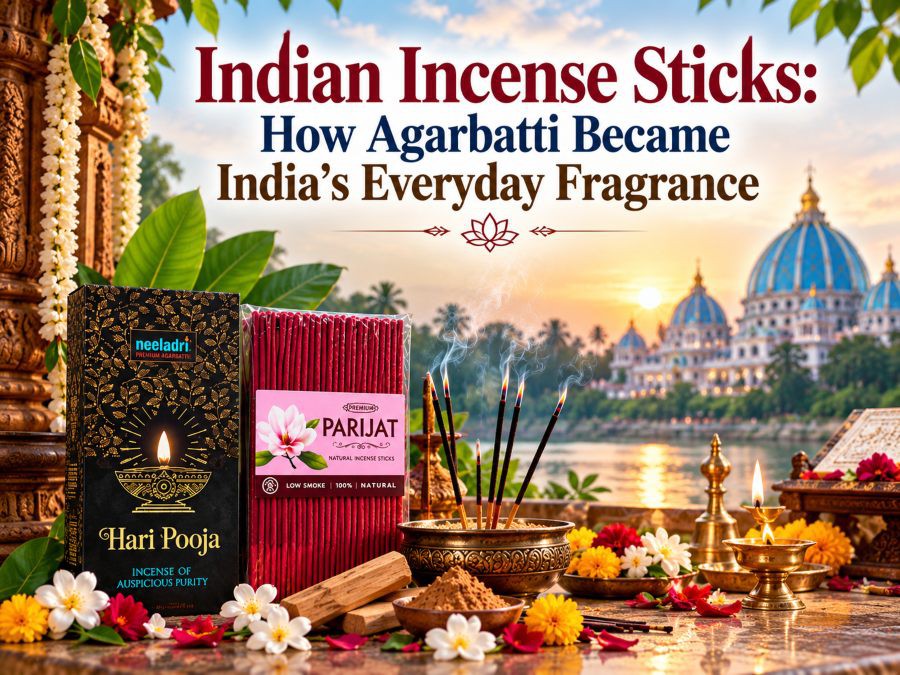
Indian Incense Sticks: How Agarbatti Became India's Everyday Fragrance
Indian Incense Sticks: How Agarbatti Became India's Everyday Fragrance
Walk into an Indian home at 6 a.m. and follow your nose. Before the tea has finished brewing, someone has lit a thin brown stick and pushed it into a brass holder, a banana, a lump of dough or a chipped steel cup. Smoke curls upward. The house changes character. Nobody announces it. It just happens, in millions of homes, every single day. That small ritual sits at the heart of the world of Incense Sticks and agarbatti, and its history is stranger and richer than a ₹20 packet suggests.
What does "agarbatti" actually mean?
The word is a marriage of two parts. Agar is agarwood, the dark, resin-soaked heartwood prized across Asia for its deep, smoky sweetness. Batti means a stick, a wick or a light. So the name points to a "stick of agar."
Here is the twist: most agarbatti today contains no agarwood at all. Real agar is scarce and very expensive, so the name has become a general label for any rolled fragrant stick, the way "Xerox" came to mean any photocopy. The word kept the memory of a luxury ingredient while the product spread to every household budget.
That tells you something about how India treats fragrance. It is not a luxury reserved for kings. It is a daily habit that borrowed royal vocabulary.
Before the stick, there was the fire
Long before anyone rolled paste onto bamboo, people in the subcontinent burned fragrant substances in fire. Vedic ritual offered resins, herbs, ghee and woods to the flame, and the smoke was considered a carrier: it took the offering upward. Ayurvedic tradition described dhupana, the fumigation of rooms, clothing and the sick with medicinal smoke.
This is the root of the whole practice. Dhupa, meaning aromatic smoke offered in worship, became one of the standard items in temple and home ritual, sitting alongside lamp, flowers, food and fragrance. In Gaudiya Vaishnava Deity worship, for example, incense is offered as part of the sequence of upacharas, each item an act of hospitality toward the Lord.
So when you light a stick before a picture of your deity, you are repeating a gesture that is older than the stick itself. The stick is just the most convenient container humans have found for it.
The bamboo revolution
The ancient forms were loose: powders on charcoal, lumps of resin, cones, balls and coils. They worked, but they were messy, and you needed a burner and some skill.
The stick with a bamboo core changed the game. It gave incense a handle. You could light it in a second, plant it anywhere and walk away. Historians generally place the spread of this format in the last couple of centuries, with older solid-stick forms travelling across Asia much earlier, and the exact story of who did what first is honestly murky. What is clear is that India took the idea and made it its own.
The bamboo core also made incense cheap to scale. A thin splint costs little, holds shape, and gives the paste something to grip. Add the fact that a stick burns at a steady pace, and you have a product a family can use daily without thinking about it.
Mysuru, Bengaluru and the birth of an industry
If agarbatti has a modern capital, it sits in Karnataka. Mysuru and Bengaluru became hubs for stick-making in the twentieth century, helped by the region's sandalwood tradition, ready supplies of flowers and a skilled workforce. Family units began rolling sticks at home, and larger brands grew out of that base. Several household names still trace their roots to Mysuru workshops from the mid-1900s.
The industry has one feature few others share: a large part of it runs on home-based work. Women in particular roll sticks from their own houses, paid by the quantity. A skilled roller can finish an astonishing number in a day, and the work fits around cooking, children and festivals. Gujarat, Tamil Nadu, Kerala and parts of the northeast also built their own clusters, each with a slightly different style.
This is one reason a packet of agarbatti is more than a product. A great deal of it passes through human hands before it reaches your shelf.
What is really inside the stick?
Open two packets and you may be holding two different things.
The masala stick
A dough of wood powder, herbs, resins and a natural binder is rolled onto the bamboo and dried in the sun. Common ingredients include sandalwood powder, guggul resin, benzoin, camphor and floral or herbal materials. The stick itself carries the scent, so it smells of its ingredients even before you light it, and it tends to burn slowly with a rounder, warmer smoke.
The dipped stick
A plain stick, often built on charcoal or wood dust, is dipped in a fragrance oil and dried. It lights easily, burns quicker and hits the nose fast. It is the workhorse of everyday freshening because it is affordable and consistent.
The plain dhoop stick
Some sticks are thick, dark and heavy on resin. They lean toward the dhoop tradition, produce more smoke and are chosen for ritual weight rather than a quick perfume.
A quick way to tell them apart:
- Sniff the unlit stick. A masala stick smells earthy or herbal on its own.
- Check the colour. Uniform black or grey often means charcoal.
- Watch the ash. A masala stick leaves a firmer, lighter ash.
None of these is "the real one." They are tools for different jobs, and the honest question is which job you have.
Why a burning stick feels so at home in India
Look at where the stick shows up and you find a map of Indian daily life:
- The home altar: morning and evening, often with a lamp
- Temples: fragrance drifts over the crowd from the sanctum
- Shops and stalls: a stick before the cash box, lit before the first sale
- Vehicles: a small holder near the dashboard on many taxis and trucks
- Festivals: Diwali, Navratri, Janmashtami and weddings all carry the smell
- Quiet moments: study, japa, meditation, the end of a long day
What links these is transition. Lighting a stick marks a threshold: the day is beginning, the shop is opening, the prayer is about to start. The smell works as a bookmark for the mind. After enough repetition, the fragrance alone can tell your body it is time to slow down. That is less mystical than it sounds. Smell is tied closely to memory and mood, and a scent you have paired with calm for years becomes a shortcut back to calm.
This is also why the same fragrance can feel like "home" to one person and simply strong to another. The stick carries whatever you have taught it to carry.
A word on smoke and sense
Any burning material releases particles, and incense is no exception. Studies have looked at indoor air quality and long-term heavy incense use, and the honest summary is that ventilation and moderation matter. Sensible habits cost nothing:
- Burn one stick at a time
- Keep a window open or a fan running
- Place sticks away from beds, curtains and pets
- Choose sticks that smell of ingredients rather than sharp chemicals
- Give asthmatic family members a say in what burns and when
If a scent gives you a headache, trust that signal and change the stick, not your opinion of yourself.
How to choose a good stick without becoming an expert
You do not need a chemistry degree. You need three questions.
1. What is it for? Puja, meditation, freshening the room or a gift. A stick that is perfect for one job can be wasteful for another.
2. What does the label admit? Net weight, stick count, a list of main ingredients and a maker's name are good signs. Adjectives such as "premium" mean nothing on their own.
3. How does it behave? A good stick lights without fuss, burns evenly, leaves a modest ash and keeps its fragrance for a while rather than vanishing in a minute or two.
Buy a small pack first. Store it in an airtight tin, away from damp and sunlight, so the fragrance does not fade before you have used it. And remember that price and quality do not always travel together, as the difference between a dipped stick and a hand-rolled masala stick shows.
Quick answers
Is agarbatti only used in Hindu worship?
No. It is most closely tied to Hindu and Vaishnava worship, but Buddhists, Jains and many others burn incense too, and plenty of people simply enjoy it as a household fragrance.
Which is better, a masala stick or a dipped stick?
Neither wins outright. Masala sticks give a richer, slower burn suited to worship and long sitting. Dipped sticks suit quick freshening and tight budgets.
How many sticks should I light at a time?
One is enough for most rooms. Many families light one or a small number during puja by tradition, and the space and ventilation should guide the rest.
The stick that stayed
Empires rose and fell, trade routes shifted, technologies came and went, and the thin stick on the altar stayed. It stayed because it does something simple and hard to replace: it turns an ordinary minute into a marked one. A few grams of wood, resin and herb, a splinter of bamboo, and a match are enough to change how a room feels.
So next time you light one, notice it. Notice the first thread of smoke, the moment the scent reaches you, the small drop in your shoulders. Behind that moment stand ancient fire rituals, Karnataka workshops, home rollers, forest resins and the habits of countless mornings. Understanding Incense Sticks and agarbatti does not make the ritual less special. It makes the next stick you light a little more alive.
Posted in: Incense or Agarbatti
Related posts
-
 How to Light Incense SticksDiscover the right way to light incense sticks (agarbatti) for worship, meditation, and peace. Learn step-by-step...Read more
 -
 Where to Buy Incense SticksDiscover where to buy the best natural incense sticks for your daily puja, meditation, and relaxation. Explore pure,...Read more
 -
 Is Incense Sticks Bad for Pregnancy? Wondering if incense sticks are safe during pregnancy? Discover the truth about incense smoke, its effects on...Read more
 -
 Do Incense Sticks Trigger Fire Alarms? Wondering if incense sticks can trigger fire alarms? Learn how smoke affects detectors, safe burning tips, and...Read more
 -
 How Many Incense Sticks to Burn for Good LuckDiscover how many incense sticks to burn for good luck and prosperity. Learn the ideal numbers, rituals, and natural...Read more
Leave a comment