
Why did Krishna run to embrace a poor brahmin in rags? Read the Sudama story from the Bhagavatam and learn how a...
Latest posts
-
 Krishna and Sudama: The Poor Brahmin Who Became Wealthy in LoveRead more
 -
 Vamana Avatar: How Three Steps Humbled Bali MaharajaRead more
Why did a powerful king give away three worlds to a boy asking for three steps? Learn the Vamana avatar story from...
-
 The Bhagavatam on Marriage: Duty, Love and Spiritual PartnershipRead more
What does the Bhagavatam say about marriage? Through the stories of Kardama and Devahuti, Rukmini's secret letter and...
-
 What Is Prema? The Bhagavatam's Highest Stage of Love for GodRead more
Prema is love for God with no "because" attached. Learn how the Bhagavatam describes it, the nine steps from faith to...
-
 Is Shiva Parvati Kalyana Mentioned in Srimad Bhagavatam? What the Scripture Really SaysRead more
Looking for Shiva and Parvati's wedding in the Srimad Bhagavatam? Find out what the scripture actually describes,...
-
 How Many Modes of Devotion Are Mentioned in Bhagavatam?Read more
A young boy named Prahlada listed nine ways to serve God, and the Bhagavatam keeps them as its answer. Learn what the...
-
 What Is Bhagavatam and Why Has It Been Read for 5,000 Years?Read more
A dying king asked one question, and the answer became the Bhagavatam. Learn what this Sanskrit scripture contains,...
-
 Who Is Lord Krishna? His Meaning, Teachings and Pastimes ExplainedRead more
Discover who Krishna is according to Srimad Bhagavatam, including His divine identity, childhood pastimes, teachings,...
-
 Incense in Islam: Bakhoor, Agarbatti and What Tradition SaysRead more
Is burning fragrance part of Muslim tradition? Explore incense in Islam, from the Prophetic practice of fumigating...
-
 History of Agarbatti: From Vedic Dhupa to Modern Incense SticksRead more
Where did agarbatti really come from? Follow the history of agarbatti from Vedic fire rituals and temple dhupa to...
Blog categories
- Default category (0)
- MUSICAL INSTRUMENT (1)
- BOOK (5)
- DEVOTIONAL GIFT (0)
- Blog (30) click
- CHANDAN (12)
- Bhagavatam Wisdom Series (68)
- Krishna Consciousness (14)
- Mridangam Musical Instrument (6)
- Bhagavad Gita for Beginners (13)
- Bhagavad Gita As It Is (37) click
- Bhagavad Gita As It Is Telugu (0)
- Bhagavad Gita As It Is Marathi (0)
- Bhagavad Gita As It Is In Hindi (0)
- Bhagavad Gita As It Is In English (0)
- Bhagavad Gita As It Is In Bengali (8)
- Bhagavad Gita As It Is In Kannada (0)
- Bhagavad Gita As It Is In Gujarati (0)
- Bhagavad Gita As It Is In Panjabi (0)
- Bhagavad Gita As It Is In Tamil (0)
- Bhagavad Gita As It Is Odia (0)
- BHAGAVAD GITA As It Is GERMAN (0)
- Bhagavad Gita As It Is In French (0)
- Bhagavad Gita As It Is In Nepali (0)
- Bhagavad Gita As It Is In Assamese (0)
- Incense or Agarbatti (38)
- Lord Chaitanya Mahaprabhu (3)
- Vedic Temple Mayapur (14)
- kalki (15)
- Mahabharata – Dharma & Destiny (27)
- Vaishnava Scriptures (4)
- healthy product (4)
- chaitanya mahaprabhu (5)
- Tulsi Mala Guide (17)
Search in blog
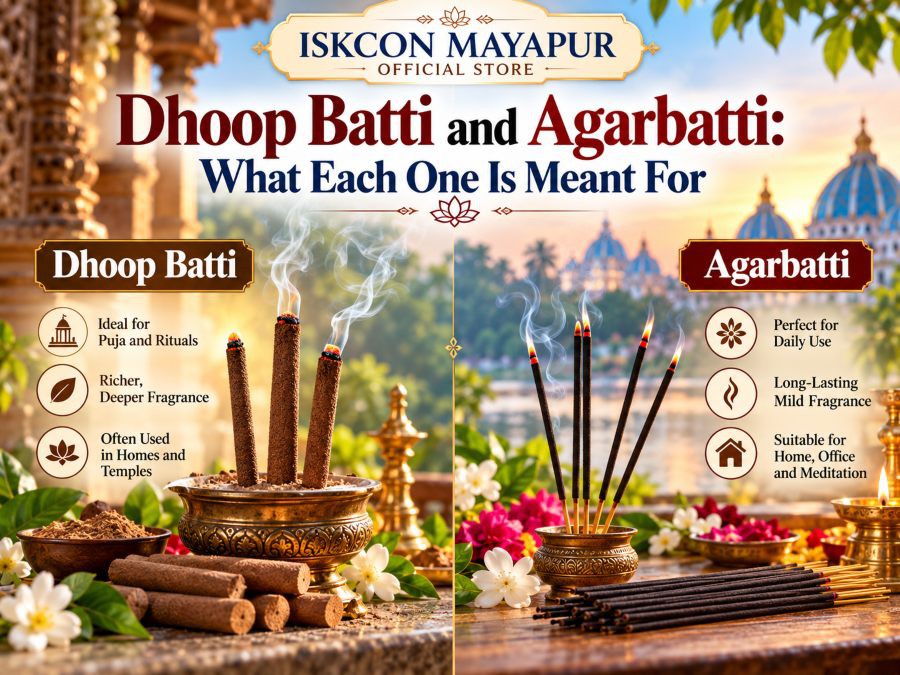
Dhoop Batti and Agarbatti: What Each One Is Meant For
Dhoop Batti and Agarbatti: What Each One Is Meant For
Two sticks sit side by side on a temple shop counter. One is slim, light brown, tied in a neat bundle. The other is thick, dark and slightly crumbly, and it smells of resin even through the wrapper. The shopkeeper calls both "incense." So why does one leave a gentle trail while the other fills the room like a small bonfire? The answer decides which one belongs in your morning puja, your evening aarti and your small apartment. You can browse the full dhoop batti and agarbatti range once you know what you are looking for, and that starts with understanding how the two differ.
Two words, one habit, very different jobs
In most Indian homes the two words blur together. People say "light some agarbatti" and mean anything that burns and smells nice. But the traditions behind them are separate, and so is the way each one behaves.

Agarbatti is a stick built on a thin bamboo core. The name comes from agar, the prized resinous wood, and batti, a stick or wick. It is the everyday format: easy to hold, easy to plant in a holder, and steady enough to burn without attention.
Dhoop batti comes from dhoop, the old word for aromatic smoke offered in worship. A dhoop batti is generally thicker and heavier, made to produce a fuller cloud. Many are stickless: the paste is pressed or extruded into a solid piece with no bamboo inside.
That single difference in build explains most of what follows. One is designed to perfume. The other is designed to fill.
Inside an agarbatti: the bamboo makes the rules
A splint of bamboo gives agarbatti its handle and its pace. Paste or fragrance sticks to it, and the core keeps the burning line steady. Because the stick is thin, a small amount of material burns for a long stretch, usually somewhere between twenty and forty-five minutes depending on thickness.
There are two broad recipes:
- Masala agarbatti: a dough of wood powder, herbs, resins and a natural binder, rolled and dried in the sun. The scent lives inside the stick.
- Dipped agarbatti: a plain stick soaked in fragrance oil. The scent lives on the surface.
Both are meant to release fragrance at a modest, controlled rate. If you want a room to smell pleasant for half an hour without turning hazy, this is the format built for it.
Inside a dhoop batti: the resin does the talking
Dhoop batti leans on resins, herbs, barks and woody powders, pressed into a dense body. Without a bamboo core, there is more fragrant material per centimetre, and the whole piece burns down to ash. The result is a bigger, longer-lasting smoke and a deeper, more medicinal or temple-like smell.
Common ingredients you will see include:
- Guggul (a tree resin used in worship and Ayurvedic tradition)
- Benzoin (loban), warm and sweet
- Sandalwood powder, soft and woody
- Camphor, sharp and clean
- Herbs, barks and flower powders, which shift the character of the blend
Many dhoop batti sticks need a nudge to catch. You light the tip, let it flame for a few seconds, then blow it out and let it smoulder. Impatient lighting is the top reason people think a dhoop stick is "not working."
Smoke is the real dividing line
If you remember one thing from this article, make it this: the main difference between the two is how much smoke each is built to make.
Agarbatti is a scent-first product. Smoke is a side effect. Dhoop is a smoke-first product. In ritual terms, the smoke is the offering, the carrier that takes the gesture upward. A temple sanctum with a thick, slow-rolling cloud of dhoop looks and feels different from one scented with a few thin sticks.
That is also why dhoop asks for more care indoors. More smoke means more particles in a closed room, so a window or fan matters more. In a large hall or an open courtyard, that same volume is exactly what you want. In a small bedroom, it usually is not.
Side by side: a quick comparison
Agarbatti | Dhoop batti | |
Core | Bamboo splint | Usually none (stickless) |
Shape | Thin, long | Thick, short, dense |
Smoke | Light to moderate | Moderate to heavy |
Scent style | Floral, woody, sweet, fresh | Resinous, earthy, temple-like |
Burn feel | Steady, easy | Slow smoulder, needs a proper start |
Best space | Homes, rooms, shops | Temples, halls, open areas |
Handling | Plug into a holder | Needs a stand or dish for ash |
Neither column is a winner. They answer different questions.
Which one for which moment?
Think of it as matching the tool to the task.
Morning puja at a small home altar. Agarbatti. One or two sticks, a steady fragrance, and no cloud drifting into the kitchen.
Evening aarti with a group. Dhoop batti, if the room is big or the doors are open. The fuller smoke suits the rhythm of the ritual.
Meditation or japa. Agarbatti, preferably a slow-burning masala stick. You want a soft background, not something that pulls your attention or your throat.
Festival days such as Diwali, Janmashtami or Navratri. A mix works well: agarbatti for general fragrance, dhoop for the altar or entrance where the smoke can spread.
Freshening a room, a study or a shop. Agarbatti. It is easier to control and quicker to switch off.
Cleansing a space after cleaning, or before an important gathering. Dhoop, used briefly and with the windows open.
The pattern is simple. If you need presence, choose dhoop. If you need a background, choose agarbatti.
The wider dhoop family
Once you leave the stick, the dhoop world widens. You will meet:
- Dhoop cones and cups: dense, short and burnt on a heat-safe plate. They give a strong burst of smoke.
- Loban and benzoin resin: burned on a small charcoal disc in a proper dhoop burner. Traditional, aromatic and quick to fill a room.
- Guggul and sambrani: classic temple resins with a deep, earthy sweetness.
- Loose dhoop powder: sprinkled over hot coal by hand.
A dhoop batti is essentially the convenient, pre-shaped version of these older practices. It saves you from lighting charcoal, which is why so many households prefer it.
Common mix-ups, cleared up
"Dhoop is stronger, so it must be better." Stronger is not the same as better. Overwhelming a small room with thick smoke helps nobody, least of all your lungs.
"Agarbatti is just for fragrance, dhoop is the real ritual." Both have long histories in worship. Many temples and devotees use agarbatti daily as part of the offering sequence.
"A stickless stick is a lower-quality stick." Not at all. It simply follows a different design. The quality lies in the ingredients and the making.
"More sticks mean more devotion." Tradition varies by lineage and deity, but a crowded holder mostly means more smoke. One or a few, offered with attention, is the usual guidance.
Reading a label without a chemistry degree
Whichever you pick, look for facts over adjectives:
- Net weight and stick count. A 100 g pack of thick dhoop holds far fewer pieces than a 100 g pack of thin agarbatti, so compare like with like.
- Ingredients. Named resins, woods and herbs are a good sign. A label that says only "fragrance" tells you little.
- Maker's name and address. Real makers are happy to be found.
- Smell before you light. A pack that smells of resin and herbs is promising. A sharp chemical note that stings the nose is not.
- Pack condition. Sealed, dry and clean. Damp ruins both types, and old dhoop can turn dusty and crumble.
For dhoop especially, ask how long each piece burns and whether it needs a stand. It saves a scorched shelf.
Burning them safely
Good incense habits are boring, and they work:
- Use a proper holder or a heat-safe dish for the ash
- Keep sticks and cones away from curtains, paper and bedding
- Burn one piece at a time in small rooms
- Open a window or run a fan, especially with dhoop
- Keep it out of reach of children and pets
- Never leave it burning in an empty house
- If someone at home has asthma or a sensitive chest, choose lighter sticks and shorter sessions
A little care lets you enjoy the ritual without a lingering headache.
Quick answers
Can I use dhoop batti and agarbatti together?
Yes, and many families do. A common pairing is agarbatti for the general fragrance and one dhoop stick at the altar. Just keep the total smoke in check in small spaces.
Which lasts longer?
Per piece, a thick dhoop stick often burns longer and smokes more. A thin agarbatti burns steadily for a shorter time. Longer is not always better, so match the burn time to your session.
Is dhoop batti bad for your health?
Any smoke carries particles, and dhoop makes more of it. Moderation and ventilation are the sensible answer, not fear. If you have breathing problems, ask a doctor and choose lighter options.
Which is better for beginners?
Agarbatti. It is simple to light, easy to control and forgiving if you make a mistake.
Pick the smoke you actually want
The fight between dhoop batti and agarbatti is a false one. They were never rivals. One is a quiet companion, the other a slow-rolling cloud, and each has a place in Indian worship and daily life.
Ask yourself three plain questions before your next purchase: how big is the room, how long is the session, and how much smoke can you comfortably live with? Answer those honestly and the choice mostly makes itself. Then buy a small pack, try it for a week and let your own nose decide.
That is really the whole idea behind Dhoop Batti and Agarbatti: not two products competing for the same shelf, but two tools that let you set the mood of your space, one gentle stick or one generous curl of smoke at a time.
Posted in: Incense or Agarbatti
Related posts
-
 How to Light Incense SticksDiscover the right way to light incense sticks (agarbatti) for worship, meditation, and peace. Learn step-by-step...Read more
 -
 Where to Buy Incense SticksDiscover where to buy the best natural incense sticks for your daily puja, meditation, and relaxation. Explore pure,...Read more
 -
 Is Incense Sticks Bad for Pregnancy? Wondering if incense sticks are safe during pregnancy? Discover the truth about incense smoke, its effects on...Read more
 -
 Do Incense Sticks Trigger Fire Alarms? Wondering if incense sticks can trigger fire alarms? Learn how smoke affects detectors, safe burning tips, and...Read more
 -
 How Many Incense Sticks to Burn for Good LuckDiscover how many incense sticks to burn for good luck and prosperity. Learn the ideal numbers, rituals, and natural...Read more
Leave a comment