
Why did Krishna run to embrace a poor brahmin in rags? Read the Sudama story from the Bhagavatam and learn how a...
Latest posts
-
 Krishna and Sudama: The Poor Brahmin Who Became Wealthy in LoveRead more
 -
 Vamana Avatar: How Three Steps Humbled Bali MaharajaRead more
Why did a powerful king give away three worlds to a boy asking for three steps? Learn the Vamana avatar story from...
-
 The Bhagavatam on Marriage: Duty, Love and Spiritual PartnershipRead more
What does the Bhagavatam say about marriage? Through the stories of Kardama and Devahuti, Rukmini's secret letter and...
-
 What Is Prema? The Bhagavatam's Highest Stage of Love for GodRead more
Prema is love for God with no "because" attached. Learn how the Bhagavatam describes it, the nine steps from faith to...
-
 Is Shiva Parvati Kalyana Mentioned in Srimad Bhagavatam? What the Scripture Really SaysRead more
Looking for Shiva and Parvati's wedding in the Srimad Bhagavatam? Find out what the scripture actually describes,...
-
 How Many Modes of Devotion Are Mentioned in Bhagavatam?Read more
A young boy named Prahlada listed nine ways to serve God, and the Bhagavatam keeps them as its answer. Learn what the...
-
 What Is Bhagavatam and Why Has It Been Read for 5,000 Years?Read more
A dying king asked one question, and the answer became the Bhagavatam. Learn what this Sanskrit scripture contains,...
-
 Who Is Lord Krishna? His Meaning, Teachings and Pastimes ExplainedRead more
Discover who Krishna is according to Srimad Bhagavatam, including His divine identity, childhood pastimes, teachings,...
-
 Incense in Islam: Bakhoor, Agarbatti and What Tradition SaysRead more
Is burning fragrance part of Muslim tradition? Explore incense in Islam, from the Prophetic practice of fumigating...
-
 History of Agarbatti: From Vedic Dhupa to Modern Incense SticksRead more
Where did agarbatti really come from? Follow the history of agarbatti from Vedic fire rituals and temple dhupa to...
Blog categories
- Default category (0)
- MUSICAL INSTRUMENT (1)
- BOOK (5)
- DEVOTIONAL GIFT (0)
- Blog (30) click
- CHANDAN (12)
- Bhagavatam Wisdom Series (68)
- Krishna Consciousness (14)
- Mridangam Musical Instrument (6)
- Bhagavad Gita for Beginners (13)
- Bhagavad Gita As It Is (37) click
- Bhagavad Gita As It Is Telugu (0)
- Bhagavad Gita As It Is Marathi (0)
- Bhagavad Gita As It Is In Hindi (0)
- Bhagavad Gita As It Is In English (0)
- Bhagavad Gita As It Is In Bengali (8)
- Bhagavad Gita As It Is In Kannada (0)
- Bhagavad Gita As It Is In Gujarati (0)
- Bhagavad Gita As It Is In Panjabi (0)
- Bhagavad Gita As It Is In Tamil (0)
- Bhagavad Gita As It Is Odia (0)
- BHAGAVAD GITA As It Is GERMAN (0)
- Bhagavad Gita As It Is In French (0)
- Bhagavad Gita As It Is In Nepali (0)
- Bhagavad Gita As It Is In Assamese (0)
- Incense or Agarbatti (38)
- Lord Chaitanya Mahaprabhu (3)
- Vedic Temple Mayapur (14)
- kalki (15)
- Mahabharata – Dharma & Destiny (27)
- Vaishnava Scriptures (4)
- healthy product (4)
- chaitanya mahaprabhu (5)
- Tulsi Mala Guide (17)
Search in blog
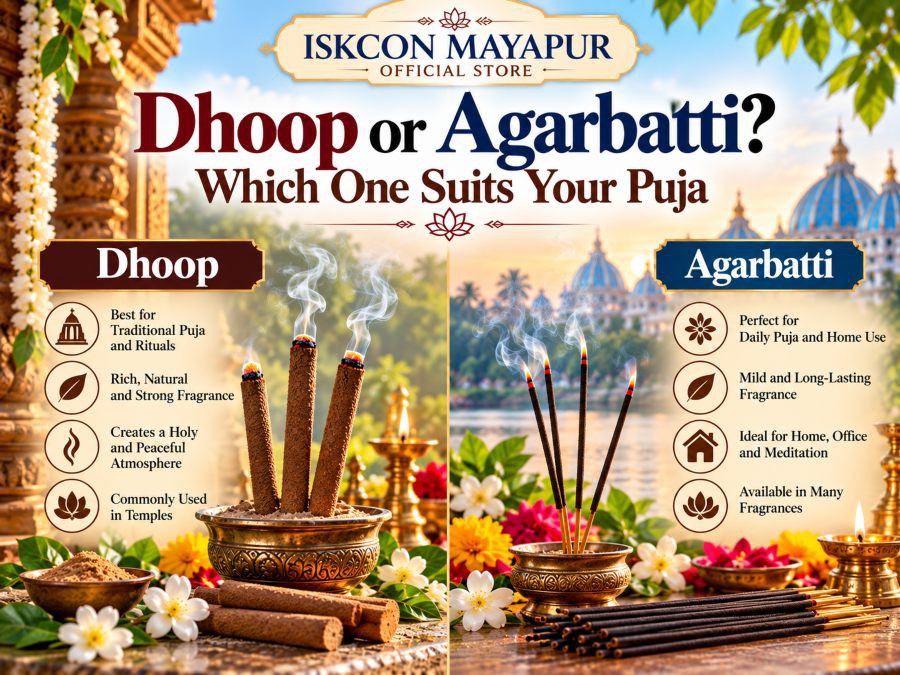
Dhoop or Agarbatti? Which One Suits Your Puja
Dhoop or Agarbatti? Which One Suits Your Puja
It is 5:15 a.m. The bath is done, the lamp is filled, the flowers are waiting on a steel plate. You reach for the incense shelf and stop. In your left hand is a slim packet of agarbatti. In your right is a box of dhoop your aunt gave you at Diwali. Both smell lovely. Which one goes in front of the deity? If you would rather look at the options before deciding, you can browse the full collection and come back, but the choice usually gets easier once you understand what your puja is actually asking for.
The question behind the question
Most people frame the choice as which is better. That is the wrong question, and it is why the debate never ends.
A puja is not one thing. A five-minute morning offering at a shelf altar, a family aarti with twenty people, a Satyanarayan katha, and a quiet hour of japa before sunrise are four different events. Each has its own size, its own rhythm and its own air. Dhoop or agarbatti is really a question about the event, not about the incense.
So the honest answer starts with a counter-question: what does this puja need the incense to do?
What incense does in worship
In the Indian ritual sequence, fragrance and smoke are not decoration. They are part of the offering itself. Dhupa, the offering of aromatic smoke, appears alongside the lamp, flowers, water and food in the classic list of items presented to the deity. In Vaishnava worship, including the Gaudiya tradition practised in ISKCON temples, incense is offered early in the sequence of upacharas, as an act of welcome and hospitality.
Two ideas sit underneath this:
- Smoke as messenger. Rising smoke was seen as a carrier that lifts the offering upward.
- Fragrance as hospitality. You would not receive a guest in a stale room. A pleasant scent says: you are wanted here.
Both agarbatti and dhoop can serve these purposes. What differs is how much smoke and how much presence each brings, which matters far more in some pujas than others.
The morning home puja: small, steady, personal
Think about the shape of this ritual. It is short. It happens in a small corner. The person offering is usually alone or with one or two family members, and often has somewhere to be right after.
Agarbatti fits this almost perfectly. One or two sticks give a steady fragrance for the length of the puja without clouding a small altar niche. You light it, offer it, and place it in the holder. Nothing needs supervision.
Dhoop can work here too, but it asks more of you. A thick stick that smokes heavily in a small flat will follow you into the kitchen and the bedroom. If your altar sits inside a cupboard or a narrow alcove, the smoke has nowhere to go.
Choose agarbatti for the daily puja unless your home has a large, airy prayer room.
Evening aarti and group worship: where dhoop comes into its own
Now change the picture. The room is large, or the door is open onto a courtyard. There are many people, bells, a conch, a lamp being waved in slow circles. The ritual is loud, visual and collective.
A single thin stick can vanish in that setting. A dhoop stick or a small dish of resin produces a fuller, slower cloud that the whole room can see and smell. The smoke becomes part of the scene, curling around the lamp, catching the light. In temples this is the norm for good reason.
If your group puja happens indoors in a modest hall, use dhoop sparingly and open a window. A little goes a long way.
Festival days: use both, on purpose
Janmashtami, Diwali, Navratri, Ram Navami, Govardhan Puja. Festival pujas run long, involve many offerings and usually bring extra guests. They deserve a little more fragrance than an ordinary Tuesday.
A layered approach works well:
- Agarbatti at the main altar and near the entrance, for steady background fragrance
- One dhoop stick or resin offering at the deity's feet during the special moment of the ritual, such as aarti or abhishek
- A break between the two, so the room can clear before the next round
This gives you the visual and spiritual weight of dhoop without living inside a cloud for three hours.
Meditation and japa: quiet wins
Japa, chanting on beads, asks for a calm, stable atmosphere. Thick smoke pulls attention to your throat. A gentle stick in the corner does not.
A slow-burning masala agarbatti is the natural pick. It burns for a long stretch, it does not spit or flare, and its fragrance stays in the background where it belongs. Many practitioners keep one specific scent for japa alone, so the smell itself becomes a signal to settle.
Small flats, closed rooms and sensitive lungs
Here is where honesty matters. Modern homes are tighter than old courtyard houses. Windows stay shut in summer for the AC and in winter for the cold. Smoke lingers.
If you live in a compact apartment, or someone at home has asthma, allergies or a child with a sensitive chest:
- Choose agarbatti as the default
- Burn one stick at a time
- Keep a window slightly open or run a fan
- Save dhoop for the balcony, terrace or an occasional larger puja
- Avoid heavy synthetic fragrances that sting the nose
Devotion does not require smoke you cannot breathe. A deity is not offended by a lighter offering.
Match the stick to the moment
Here is a quick guide you can save on your phone:
- Daily morning puja, small altar: agarbatti
- Daily evening puja with family: agarbatti, or dhoop if the room is large
- Group aarti or kirtan in a hall: dhoop, with ventilation
- Festival main puja: both, in measured amounts
- Japa or meditation: slow-burning agarbatti
- Havan or fire ritual: follow the ritual's own materials, and keep loose incense minimal since the fire already produces smoke
- Housewarming or blessing a new space: dhoop briefly, with doors and windows open, then agarbatti for the settled fragrance
A note on tradition: your lineage has a voice
Practices differ. Some families light one stick. Some light three or five. Some traditions specify particular fragrances for particular deities, or avoid certain ingredients. In Gaudiya Vaishnava practice, offerings are made with attention to cleanliness and devotion, and temples follow their own guidelines.
If you belong to a sampradaya, or your family has its own custom, that comes first. A wise elder or your temple's pujari can settle in one sentence what an article cannot. This guide helps you choose within your tradition, not override it.
Offering incense with care
Whichever you pick, a few habits show respect for the ritual and for the people around you:
- Bathe and wash your hands before beginning, as most traditions prefer
- Use fresh sticks. Avoid relighting a used stub
- Do not blow the flame out with your mouth. Many families fan it out with a hand or a small cloth
- Offer before you eat or drink anything, following your household custom
- Use a clean holder and clear the ash regularly
- Keep the smoke moving toward the deity rather than fanning it around casually
None of these is complicated. They simply turn the act from "lighting something" into "offering something."
Mistakes that spoil a good puja
Lighting too many sticks. A packed holder produces harsh smoke and fatigues the nose. One thoughtful stick often feels richer than five.
Ignoring the room. A perfect stick in an unventilated closet is still a headache.
Choosing by price alone. A cheap stick with a sharp chemical smell distracts more than it uplifts. A costly one with a scent you dislike does no better.
Mixing many fragrances at once. Rose, sandalwood and a strong resin fighting each other is noise, not offering.
Leaving incense unattended. Always put it out safely or watch it burn down.
Buying with your puja in mind
Before you pick a pack, ask yourself:
- How large is my puja space?
- How long does my puja last?
- Who else breathes this air?
- Does my tradition prefer certain fragrances or ingredients?
Then check the label. Look for net weight, stick count, a list of main ingredients and a maker's name. Smell the pack before you buy. A clean herbal or resinous scent is a good sign. A sharp, sweet chemical one is not. Buy a small pack first, use it for a week, and see how your home reacts.
For dhoop, ask how it should be lit and whether it needs a stand or dish, so you do not scorch a shelf. Store everything airtight and dry.
Quick answers
Is dhoop more sacred than agarbatti?
No. Both are used in worship, and both have long histories. Sanctity comes from the spirit of the offering and your tradition's practice, not from the format.
Can I offer both in the same puja?
Yes. Many households use agarbatti for steady fragrance and dhoop at a key moment, such as aarti. Keep the total smoke sensible.
How many should I light?
Customs vary. One is enough for most home altars, and your family or temple tradition may specify a number.
What if I have no ventilation?
Choose a light agarbatti, burn a single stick, and crack a window. Skip dhoop until you can burn it in a more open space.
Which is better for beginners?
Agarbatti. It lights easily, burns predictably and is forgiving.
The right answer is the one your puja can carry
So, dhoop or agarbatti? For most homes, most mornings, agarbatti does the job gracefully. For big gatherings, open courtyards and the peak moments of a festival, dhoop brings a presence that a thin stick cannot. For everything in between, use both with a light hand.
The deity is not counting the smoke. What reaches Him is the care behind the offering: the clean holder, the fresh stick, the room you have prepared and the mind you have brought to the moment. Choose the incense that lets you offer that comfortably, and let the rest take care of itself.
Posted in: Incense or Agarbatti
Related posts
-
 How to Light Incense SticksDiscover the right way to light incense sticks (agarbatti) for worship, meditation, and peace. Learn step-by-step...Read more
 -
 Where to Buy Incense SticksDiscover where to buy the best natural incense sticks for your daily puja, meditation, and relaxation. Explore pure,...Read more
 -
 Is Incense Sticks Bad for Pregnancy? Wondering if incense sticks are safe during pregnancy? Discover the truth about incense smoke, its effects on...Read more
 -
 Do Incense Sticks Trigger Fire Alarms? Wondering if incense sticks can trigger fire alarms? Learn how smoke affects detectors, safe burning tips, and...Read more
 -
 How Many Incense Sticks to Burn for Good LuckDiscover how many incense sticks to burn for good luck and prosperity. Learn the ideal numbers, rituals, and natural...Read more
Leave a comment