
Why did Krishna run to embrace a poor brahmin in rags? Read the Sudama story from the Bhagavatam and learn how a...
Latest posts
-
 Krishna and Sudama: The Poor Brahmin Who Became Wealthy in LoveRead more
 -
 Vamana Avatar: How Three Steps Humbled Bali MaharajaRead more
Why did a powerful king give away three worlds to a boy asking for three steps? Learn the Vamana avatar story from...
-
 The Bhagavatam on Marriage: Duty, Love and Spiritual PartnershipRead more
What does the Bhagavatam say about marriage? Through the stories of Kardama and Devahuti, Rukmini's secret letter and...
-
 What Is Prema? The Bhagavatam's Highest Stage of Love for GodRead more
Prema is love for God with no "because" attached. Learn how the Bhagavatam describes it, the nine steps from faith to...
-
 Is Shiva Parvati Kalyana Mentioned in Srimad Bhagavatam? What the Scripture Really SaysRead more
Looking for Shiva and Parvati's wedding in the Srimad Bhagavatam? Find out what the scripture actually describes,...
-
 How Many Modes of Devotion Are Mentioned in Bhagavatam?Read more
A young boy named Prahlada listed nine ways to serve God, and the Bhagavatam keeps them as its answer. Learn what the...
-
 What Is Bhagavatam and Why Has It Been Read for 5,000 Years?Read more
A dying king asked one question, and the answer became the Bhagavatam. Learn what this Sanskrit scripture contains,...
-
 Who Is Lord Krishna? His Meaning, Teachings and Pastimes ExplainedRead more
Discover who Krishna is according to Srimad Bhagavatam, including His divine identity, childhood pastimes, teachings,...
-
 Incense in Islam: Bakhoor, Agarbatti and What Tradition SaysRead more
Is burning fragrance part of Muslim tradition? Explore incense in Islam, from the Prophetic practice of fumigating...
-
 History of Agarbatti: From Vedic Dhupa to Modern Incense SticksRead more
Where did agarbatti really come from? Follow the history of agarbatti from Vedic fire rituals and temple dhupa to...
Blog categories
- Default category (0)
- MUSICAL INSTRUMENT (1)
- BOOK (5)
- DEVOTIONAL GIFT (0)
- Blog (30) click
- CHANDAN (12)
- Bhagavatam Wisdom Series (68)
- Krishna Consciousness (14)
- Mridangam Musical Instrument (6)
- Bhagavad Gita for Beginners (13)
- Bhagavad Gita As It Is (37) click
- Bhagavad Gita As It Is Telugu (0)
- Bhagavad Gita As It Is Marathi (0)
- Bhagavad Gita As It Is In Hindi (0)
- Bhagavad Gita As It Is In English (0)
- Bhagavad Gita As It Is In Bengali (8)
- Bhagavad Gita As It Is In Kannada (0)
- Bhagavad Gita As It Is In Gujarati (0)
- Bhagavad Gita As It Is In Panjabi (0)
- Bhagavad Gita As It Is In Tamil (0)
- Bhagavad Gita As It Is Odia (0)
- BHAGAVAD GITA As It Is GERMAN (0)
- Bhagavad Gita As It Is In French (0)
- Bhagavad Gita As It Is In Nepali (0)
- Bhagavad Gita As It Is In Assamese (0)
- Incense or Agarbatti (38)
- Lord Chaitanya Mahaprabhu (3)
- Vedic Temple Mayapur (14)
- kalki (15)
- Mahabharata – Dharma & Destiny (27)
- Vaishnava Scriptures (4)
- healthy product (4)
- chaitanya mahaprabhu (5)
- Tulsi Mala Guide (17)
Search in blog
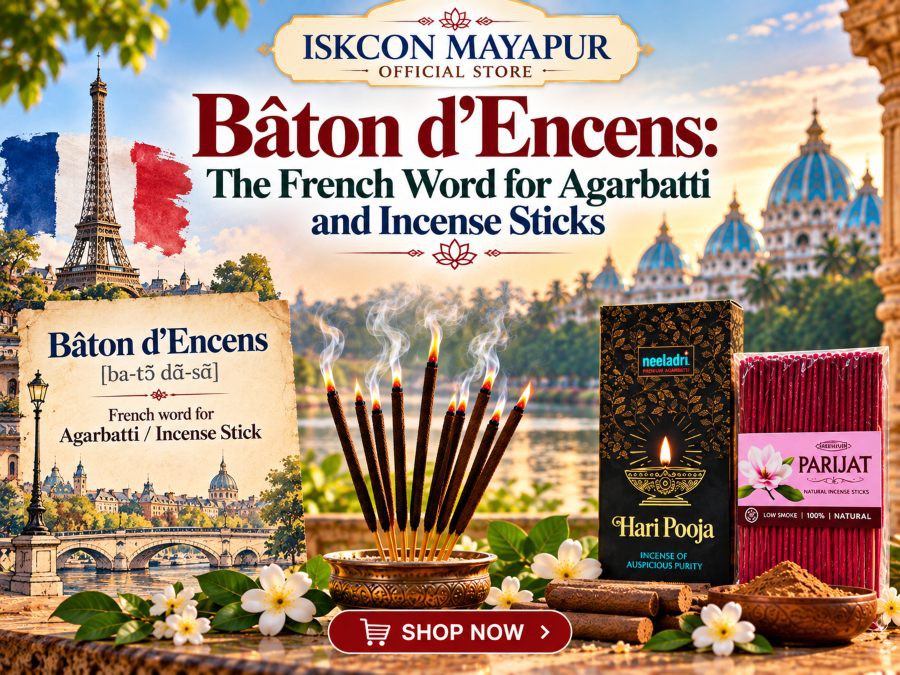
Baton d'Encens: The French Word for Agarbatti and Incense Sticks
Baton d'Encens: The French Word for Agarbatti and Incense Sticks
A French traveller steps into a small shop in Vrindavan and points at a rack of thin brown sticks. "Un bâton d'encens," she says, and the shopkeeper smiles and hands her an agarbatti. Two words, two languages, one object. If you have ever wondered how the French say incense stick, how the term differs from the Indian one and why it matters for anyone buying or writing about incense, start with the phrase baton d'encens and follow it through this guide. It is a small piece of vocabulary with a surprisingly deep root system.
The phrase, word by word
Break it into parts and it becomes easy to remember.
- Bâton means stick, rod or baton. It comes from Old French baston.
- D' is the contracted form of de, meaning "of."
- Encens means incense.
So a bâton d'encens is literally a "stick of incense." The plural is bâtons d'encens. The word bâton is masculine, so you say un bâton d'encens for one and des bâtons d'encens for several.
Notice the circumflex on the â. In everyday searching, many people type "baton d'encens" without it, and search engines treat both versions as the same. In careful French writing, the accent belongs there.
How to say it out loud
English speakers often stumble on the nasal vowels. A rough guide:
- bâton sounds like bah-TAWN, with the "n" barely pronounced and the vowel carried through the nose
- d'encens sounds like dahn-SAHN, again with soft nasal endings
Do not try to sound out the final "s" in encens. It stays silent. Listen once to a native speaker and the pattern clicks.
Where "encens" comes from
Here is the part most vocabulary lists skip. Encens traces back to the Latin incensum, meaning "something burnt," from the verb incendere, "to set on fire." The English word incense comes from the same source, and so do words like incendiary.
That means English and French share the same ancestor for this word. The Indian term is a different story. Agarbatti joins agar (the resinous agarwood) and batti (a stick or wick). One language names the act of burning, the other names a prized ingredient and the shape of the object.
Neither is more correct. They simply reflect what each culture found worth naming.
A subtle French twist: "encens" can mean frankincense
In French, encens is the general word for incense, but in many contexts it points specifically to frankincense, the pale resin of the Boswellia tree. The more precise French word for frankincense is oliban. Because Catholic church tradition has long burned frankincense during Mass, the word encens carries strong church associations for many French speakers.
Why does this matter for a shopper or a writer? If you say encens to a French speaker without context, they might picture a church thurible or a bag of resin grains rather than a rolled stick. Adding bâton removes the doubt and tells them exactly what you mean.
A small vocabulary map
If you are writing product descriptions, translating a label or shopping abroad, these terms come up constantly.
- Bâton d'encens or bâtonnet d'encens: incense stick
- Encens indien: Indian incense
- Cône d'encens: incense cone
- Encens en grains or résine d'encens: resin incense, burnt on charcoal
- Porte-encens: incense holder
- Brûle-encens: incense burner
- Encensoir: a censer, typically the swinging metal vessel used in ceremonies
- Cendres: ash
- Fumée: smoke
- Parfum or senteur: fragrance or scent
- Santal: sandalwood
- Brûler de l'encens: to burn incense
- Allumer un bâton d'encens: to light an incense stick
Save this list. It covers most of what you need to read a French label or write a bilingual product page.
Baton d'encens versus agarbatti: same stick, different shades
In everyday use, the two terms overlap heavily. Someone who says bâton d'encens usually means the familiar rolled stick with a thin core, just as someone who says agarbatti does. But the words carry different associations.
Agarbatti often signals something tied to Indian culture and worship: masala blends, guggul, sandalwood, flower fragrances and the rhythms of daily puja. The word tells you where the stick comes from and what it is for.
Bâton d'encens is a broader, more neutral phrase. It could describe an Indian stick, a Japanese one, a Tibetan one or a Nepali one. French shops usually add an origin word: encens indien, encens japonais, encens tibétain. The base phrase leaves the tradition open.
That is a useful difference for sellers. If you want to reach a French-speaking audience, "baton d'encens" is the entry point, and "encens indien" is the phrase that tells them your sticks come from India.
The France-India thread most people miss
There is a real link between French speakers and Indian incense, and it runs through Puducherry (Pondicherry), a coastal town that was a French territory for generations. Its Franco-Indian heritage still shows in street names, architecture and food. The nearby spiritual community of Auroville and the Sri Aurobindo Ashram became known for incense making, and their products reached French-speaking buyers across Europe and beyond.
Beyond that, French interest in Indian spirituality, yoga and Ayurveda has grown steadily for decades. Many French readers who search for bâtons d'encens are curious about Indian sticks in particular: what they are made of, what the fragrances mean, and how they are used in worship. A bilingual guide meets that curiosity halfway.
What French-speaking buyers usually ask
When people search in French for incense sticks, a few questions come up again and again:
- Quelle est la différence entre encens et bâton d'encens? The first is the material or category, the second is one shape it takes.
- Combien de temps brûle un bâton? Usually twenty to forty-five minutes, depending on size and recipe.
- Est-ce dangereux pour la santé? Any smoke carries particles, so moderation and ventilation apply.
- Quel parfum choisir? Sandalwood, rose, jasmine and resin blends are popular starting points.
- Où placer le porte-encens? On a stable, heat-safe surface away from curtains and paper.
Those are the same questions asked in India. Only the vocabulary changes.
How French and Indian traditions use incense
The same smoke, but different habits.
In France
Incense appears in two main places: the church, where frankincense is burned in a censer at solemn moments, and the home, where sticks and cones create atmosphere for relaxing, reading, yoga or meditation. It is often chosen for mood rather than ritual, though many people connect it with spiritual practice.
In India
Incense is an offering as much as a fragrance. In Hindu and Vaishnava worship, dhupa (aromatic smoke) is presented alongside a lamp, flowers, water and food. Lighting a stick marks a threshold: the puja is about to begin, the shop is opening, the day has started.
Understanding this difference helps a French speaker read an Indian stick correctly. It is not only a room freshener. For many buyers, it is part of a daily act of devotion.
Translating labels and descriptions well
If you sell or write about incense in two languages, a few habits keep your translations clean.
Keep the Indian term visible. Write bâtons d'encens indiens (agarbatti) on the first mention so readers learn the original word and can recognise it later.
Name the ingredients in French. Bois de santal (sandalwood), résine de guggul, benjoin (benzoin), camphre (camphor), vétiver. Real ingredient names build trust.
Avoid literal translations of marketing phrases. "Premium quality" rarely translates naturally. Describe the actual features: hand-rolled, herbal, slow-burning.
Do not over-promise on health. Claims about healing or treatment are risky in any language. Describe fragrance and use, and leave medicine to doctors.
Check accents. Bâton, parfum, fumée. Missing accents look careless in print, even if search engines forgive them.
Safety words worth knowing
If you are giving instructions in French, these phrases cover the basics:
- Ne laissez jamais un bâton allumé sans surveillance. Never leave a lit stick unattended.
- Aérez la pièce. Ventilate the room.
- Tenez hors de portée des enfants et des animaux. Keep out of reach of children and pets.
- Utilisez un porte-encens stable. Use a stable holder.
- Éloignez des rideaux et du papier. Keep away from curtains and paper.
They translate directly and mean the same thing in both cultures: burn one stick at a time, give the smoke somewhere to go and treat the flame with respect.
Quick answers
What does "baton d'encens" mean in English?
It means "incense stick" or "stick of incense." It is the standard French phrase for the rolled sticks Indians call agarbatti.
Is agarbatti the same as bâton d'encens?
In practice, yes. Agarbatti is the Indian name and carries cultural context, while bâton d'encens is the general French term.
How do I say "Indian incense sticks" in French?
Bâtons d'encens indiens. Some sellers also write encens indien en bâtonnets.
What is the French word for incense holder?
Porte-encens. An incense burner is a brûle-encens.
Is it "encens" or "encense"?
Encens is the noun. Encenser is the verb, meaning to burn incense at or to praise someone lavishly, which is an interesting side meaning in French.
Do French people use incense sticks at home?
Many do, especially for relaxation, yoga and meditation, and Indian sticks are among the most popular.
A small word that carries a big idea
Learn baton d'encens and you gain more than a phrase. You learn that "incense" itself means "burnt," that a stick can be named for its shape or for its ingredient, and that the same thin bamboo splint has crossed languages, trade routes and centuries without losing its purpose.
For a French speaker meeting agarbatti for the first time, the bridge is simple: it is a bâton d'encens, made in India, offered with care. For an Indian reader meeting the French term, the bridge runs the other way. Same stick, same smoke, same quiet moment before prayer or rest.
So next time you light one, try saying the French phrase out loud. Un bâton d'encens. Three soft syllables, and a small reminder that fragrance has always been one of the easiest things for people to share.
Posted in: Incense or Agarbatti
Related posts
-
 How to Light Incense SticksDiscover the right way to light incense sticks (agarbatti) for worship, meditation, and peace. Learn step-by-step...Read more
 -
 Where to Buy Incense SticksDiscover where to buy the best natural incense sticks for your daily puja, meditation, and relaxation. Explore pure,...Read more
 -
 Is Incense Sticks Bad for Pregnancy? Wondering if incense sticks are safe during pregnancy? Discover the truth about incense smoke, its effects on...Read more
 -
 Do Incense Sticks Trigger Fire Alarms? Wondering if incense sticks can trigger fire alarms? Learn how smoke affects detectors, safe burning tips, and...Read more
 -
 How Many Incense Sticks to Burn for Good LuckDiscover how many incense sticks to burn for good luck and prosperity. Learn the ideal numbers, rituals, and natural...Read more
Leave a comment