
Why did Krishna run to embrace a poor brahmin in rags? Read the Sudama story from the Bhagavatam and learn how a...
Latest posts
-
 Krishna and Sudama: The Poor Brahmin Who Became Wealthy in LoveRead more
 -
 Vamana Avatar: How Three Steps Humbled Bali MaharajaRead more
Why did a powerful king give away three worlds to a boy asking for three steps? Learn the Vamana avatar story from...
-
 The Bhagavatam on Marriage: Duty, Love and Spiritual PartnershipRead more
What does the Bhagavatam say about marriage? Through the stories of Kardama and Devahuti, Rukmini's secret letter and...
-
 What Is Prema? The Bhagavatam's Highest Stage of Love for GodRead more
Prema is love for God with no "because" attached. Learn how the Bhagavatam describes it, the nine steps from faith to...
-
 Is Shiva Parvati Kalyana Mentioned in Srimad Bhagavatam? What the Scripture Really SaysRead more
Looking for Shiva and Parvati's wedding in the Srimad Bhagavatam? Find out what the scripture actually describes,...
-
 How Many Modes of Devotion Are Mentioned in Bhagavatam?Read more
A young boy named Prahlada listed nine ways to serve God, and the Bhagavatam keeps them as its answer. Learn what the...
-
 What Is Bhagavatam and Why Has It Been Read for 5,000 Years?Read more
A dying king asked one question, and the answer became the Bhagavatam. Learn what this Sanskrit scripture contains,...
-
 Who Is Lord Krishna? His Meaning, Teachings and Pastimes ExplainedRead more
Discover who Krishna is according to Srimad Bhagavatam, including His divine identity, childhood pastimes, teachings,...
-
 Incense in Islam: Bakhoor, Agarbatti and What Tradition SaysRead more
Is burning fragrance part of Muslim tradition? Explore incense in Islam, from the Prophetic practice of fumigating...
-
 History of Agarbatti: From Vedic Dhupa to Modern Incense SticksRead more
Where did agarbatti really come from? Follow the history of agarbatti from Vedic fire rituals and temple dhupa to...
Blog categories
- Default category (0)
- MUSICAL INSTRUMENT (1)
- BOOK (5)
- DEVOTIONAL GIFT (0)
- Blog (30) click
- CHANDAN (12)
- Bhagavatam Wisdom Series (68)
- Krishna Consciousness (14)
- Mridangam Musical Instrument (6)
- Bhagavad Gita for Beginners (13)
- Bhagavad Gita As It Is (37) click
- Bhagavad Gita As It Is Telugu (0)
- Bhagavad Gita As It Is Marathi (0)
- Bhagavad Gita As It Is In Hindi (0)
- Bhagavad Gita As It Is In English (0)
- Bhagavad Gita As It Is In Bengali (8)
- Bhagavad Gita As It Is In Kannada (0)
- Bhagavad Gita As It Is In Gujarati (0)
- Bhagavad Gita As It Is In Panjabi (0)
- Bhagavad Gita As It Is In Tamil (0)
- Bhagavad Gita As It Is Odia (0)
- BHAGAVAD GITA As It Is GERMAN (0)
- Bhagavad Gita As It Is In French (0)
- Bhagavad Gita As It Is In Nepali (0)
- Bhagavad Gita As It Is In Assamese (0)
- Incense or Agarbatti (38)
- Lord Chaitanya Mahaprabhu (3)
- Vedic Temple Mayapur (14)
- kalki (15)
- Mahabharata – Dharma & Destiny (27)
- Vaishnava Scriptures (4)
- healthy product (4)
- chaitanya mahaprabhu (5)
- Tulsi Mala Guide (17)
Search in blog
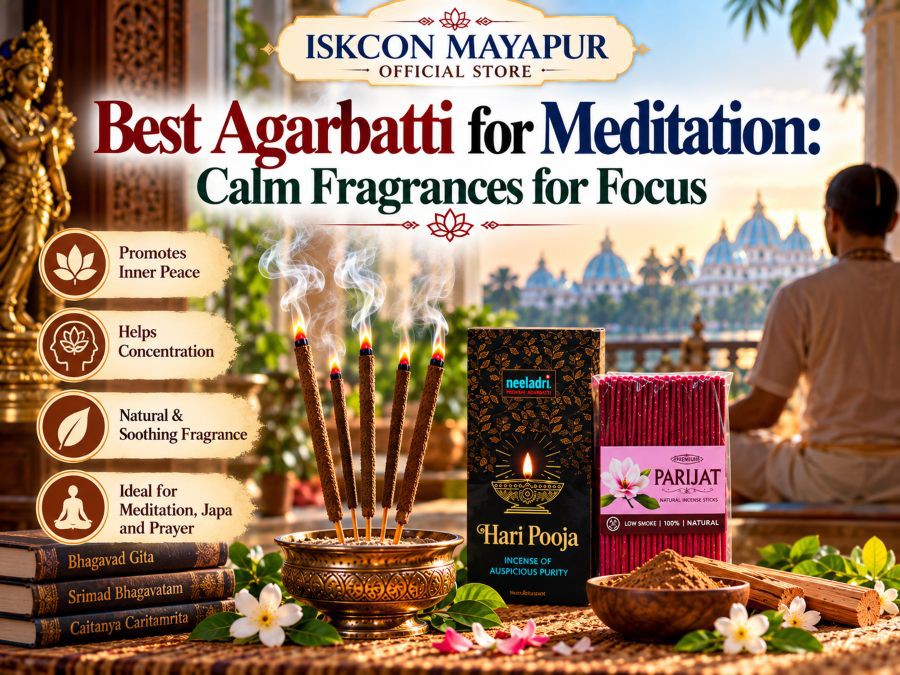
Best Agarbatti for Meditation: Calm Fragrances for Focus
Best Agarbatti for Meditation: Calm Fragrances for Focus
You sit down. The cushion is right, the phone is silent, the timer is set. Then your nose picks up something sharp and sugary from the stick burning behind you, and for the next ten minutes your mind is not on your breath. It is on the smell. The wrong stick can hijack a sitting before it starts. The right one disappears into the room and leaves you with nothing to do but settle. If you are shopping for incense for meditation, this guide explains which fragrances help you stay steady, which ones work against you, and how to burn a stick without letting it become the main event.
Why a smell can change how you sit
Smell is wired differently from the other senses. Signals from the nose travel to brain regions linked with memory and emotion far more directly than sight or sound do. That is why a whiff of a certain flower can drop you into a childhood afternoon.

You can use this. If you burn the same gentle fragrance every time you meditate, your mind starts to link that scent with the act of sitting quietly. After a few weeks, lighting the stick works like a signal. Your shoulders drop a little before you have even closed your eyes.
Nobody needs incense to meditate, and plenty of people practise without any. But if you like fragrance, treating it as a habit cue rather than a treat gives it a real job.
What a meditation stick should do (and what it should not)
A good stick for stillness behaves like a quiet guest. It should:
- Stay in the background. You notice it when you arrive, then forget it.
- Burn slowly and evenly, so you do not have to open your eyes to replace it.
- Smell the same from start to finish, without sudden sweet or chemical spikes.
- Produce modest smoke, so your throat and eyes stay comfortable.
- Leave the room smelling pleasant afterwards, not stale.
A bad one does the opposite. It announces itself, flares, throws off dark smoke and turns your sitting into a negotiation with your nose.
The scents that suit sitting still
Traditions in India have long favoured a handful of materials for worship, japa and quiet reflection. Here are the ones worth knowing, described as fragrances, not as cures.
Sandalwood (chandana)
Soft, creamy and slightly sweet. It is probably the most common choice for meditation in India, and it rarely offends anyone. Real sandalwood is costly, so a genuine sandalwood-based stick often has a smoother, less sugary note than a cheap imitation.
Guggul
A resin with a deep, earthy, slightly balsamic smell. It is grounding and a little heavy, which many people like for longer sittings. A little goes a long way.
Vetiver (khus)
The root of a grass, smelling of damp soil after rain. Cool and calm. It suits warm afternoons and humid evenings.
Benzoin (loban)
Warm and vanilla-like, with a rounded softness. It often appears in blends to smooth out sharper notes.
Tulsi
For many devotees, especially in Vaishnava practice, tulsi carries deep meaning. Its fragrance is green, lightly spicy and clean.
Lavender and light florals
Not classic Indian temple materials, but popular for relaxation. Choose a stick with a soft, natural-smelling floral rather than a perfumed one.
Champa and jasmine
Sweet and heady. Lovely for some, too intense for others. Test before committing to a long sitting.
Scents to leave for another time
Some fragrances are wonderful for cooking festivals or freshening a lobby, and poor for the cushion.
- Very sweet or fruity sticks. They can feel sticky and distracting.
- Strong camphor or menthol blends. Sharp, medicinal and alerting.
- Heavy rose or musk perfumes. They can dominate a small room.
- Anything with a chemical sting. If it makes your nose tingle, stop.
- Fragrances you strongly associate with something else, like a former workplace or a difficult memory.
Your own reaction is the final test. A scent that other people call "calming" but leaves you tense is not a calming scent for you.
Masala or dipped: which one for stillness?
This choice matters more than most people realise.
Masala sticks are made from a dough of wood powder, herbs, resins and a natural binder. The fragrance lives inside the stick, so it smells of its ingredients and tends to burn slowly and evenly. For meditation, this is usually the better choice.
Dipped sticks are plain sticks soaked in fragrance oil. They hit the nose fast, burn quicker and can smell sharp or artificial. They are fine for freshening a room, but a poor match for a long sitting.
A quick test: smell the unlit stick. A masala stick smells earthy or herbal by itself. A dipped stick smells like perfume.
Matching the stick to the type of sitting
Different practices ask for different atmospheres. These are traditional associations and personal experience, not rules.
- Japa (chanting on beads): sandalwood, guggul or tulsi. Steady and grounding. Many Vaishnava practitioners choose fragrances tied to worship.
- Silent breath-focused sitting: the softest, simplest stick you can find. Often plain sandalwood or a light woody blend.
- Morning practice: something fresh and gentle. Sandalwood or light floral.
- Evening wind-down: warm resin blends such as benzoin or guggul.
- Long sittings of an hour or more: a thick, slow-burning masala stick, or two thin sticks lit one after another.
- Yoga or gentle stretching before sitting: vetiver or light herbal blends.
If you follow a specific tradition, your teacher or sampradaya may recommend particular fragrances. That guidance comes first.
How many sticks, and where to put them
Less is more. One stick is enough for most rooms. A crowded holder makes smoke, not calm.
For placement:
- Set the stick behind you or to one side, not directly in front of your face
- Keep it at least an arm's length away
- Use a stable holder with an ash catcher
- Place it on a heat-safe surface away from curtains, paper and bedding
- Face the room's airflow so smoke drifts away from you
If the smoke wanders into your face during a sitting, you will spend the session waving it off. Move it before you begin.
Timing the burn to the sitting
Nothing spoils a deep sitting like a stick that dies at minute fifteen or one that burns on for another hour after you have finished.
Here is a simple approach:
1. Time one stick from a new pack. Light it, note the minute it starts and when it ends.
2. Choose your sitting length to match, or pick a stick that outlasts it slightly.
3. Let the stick burn out on its own or snuff it gently when you are done. Do not leave it burning unattended.
Thin sticks usually burn around twenty to thirty minutes. Thick masala sticks can run forty-five minutes or longer. Your own pack may differ, so test it once.
Small habits that make incense work better
Light it before you sit, not after. Let the fragrance fill the room for two or three minutes, so the first breaths of your sitting are already settled.
Keep the scent consistent. Use the same blend for several weeks. The link between smell and calm needs repetition.
Ventilate a little. A slightly open window keeps the air fresh and stops smoke from building up.
Hold a stable routine. Light the stick, sit, breathe, end. The order itself is calming.
Notice the smell once, then let it go. If your attention drifts to the fragrance, treat it like any other passing thought.
Reading the label without a chemistry degree
You do not have to be an expert. You just need a few habits.
- Look for an ingredient list. Named woods, resins and herbs are a good sign. "Fragrance" alone tells you little.
- Check net weight and stick count.
- Find the maker's name and address.
- Look for a packing date, so the sticks are fresh.
- Smell the pack. A herbal, woody or resinous smell is promising. A sharp chemical note is not.
- Be wary of health claims. Promises to cure stress, anxiety or illness are marketing, not meditation advice.
Buy a small pack first. Try three or four sittings. If it still feels calm on day four, buy more.
Safety for people who sit in small rooms
Meditation often happens in bedrooms, study corners and small flats. That makes air quality worth a thought.
- Burn one stick at a time
- Open a window or run a fan
- Keep sticks away from curtains, papers and bedding
- Do not leave incense burning unattended, and never in an empty house
- Keep out of reach of children and pets
- If you have asthma, allergies or a sensitive chest, choose lighter sticks and shorter sessions, and check with a doctor if unsure
- If a scent gives you a headache or scratchy throat, put it out and try another
Any burning material releases fine particles, and natural ingredients do not make smoke harmless. If you find smoke uncomfortable, meditate without incense, or use a diffuser or a fresh flower instead. The practice matters more than the stick.
Storing sticks so they stay gentle
Herbal and resin sticks are sensitive.
- Keep them in an airtight tin or jar
- Store away from sunlight, heat and steam
- Do not leave the pack open on the altar
- Use within a few months for the best fragrance
- If a stick feels damp, dry it briefly in shade before lighting
A stale stick smells flat or dusty. A damp one sputters. Neither helps a quiet mind.
Common mistakes with meditation incense
Choosing by name alone. "Calm," "peace" and "zen" on a packet mean nothing without ingredients.
Lighting too many sticks. A room full of smoke is not a temple. It is a headache.
Switching fragrances every session. You lose the cue that makes the habit work.
Sitting in a stuffy room. Smoke has nowhere to go and your head tells you so.
Expecting incense to do the meditating. It supports the practice. It cannot replace it.
Quick answers
Which fragrance is best for meditation?
Sandalwood is the most common starting point in India because it is soft and familiar. Guggul, vetiver, tulsi and benzoin are also popular. The best one is whichever you find calm.
Is incense necessary for meditation?
No. Many people practise without it. Incense is an option that some find helpful as a signal to settle.
How long should a meditation stick burn?
Long enough to cover your sitting, without running far beyond it. Twenty to forty-five minutes suits most sessions.
Can I use the same stick for morning and evening?
Yes, and many people do. Keeping one scent for your practice strengthens the habit cue.
Is incense safe to burn daily?
With ventilation and moderation, many people use it daily. Anyone with breathing problems should ask a doctor and choose lighter options.
Should I light incense during japa?
Many devotees do, as part of their worship setup. Follow your own tradition's custom on fragrance and number of sticks.
Choose the scent that steps aside
The best incense for meditation is the one you barely notice. It clears a small space in the air, gives your mind a familiar landmark and lets you get on with the real work of sitting still.
Pick a masala stick with named ingredients. Try it for a week. Keep the room ventilated and the number of sticks small. Pay attention to how you feel at minute five, minute fifteen and after you stand up.
If your shoulders drop when the first thread of smoke rises, you have found your stick. If your mind keeps chasing the smell, try another. A good fragrance does not ask for attention. It quietly holds the door open, and you walk in.
Posted in: Incense or Agarbatti
Related posts
-
 How to Light Incense SticksDiscover the right way to light incense sticks (agarbatti) for worship, meditation, and peace. Learn step-by-step...Read more
 -
 Where to Buy Incense SticksDiscover where to buy the best natural incense sticks for your daily puja, meditation, and relaxation. Explore pure,...Read more
 -
 Is Incense Sticks Bad for Pregnancy? Wondering if incense sticks are safe during pregnancy? Discover the truth about incense smoke, its effects on...Read more
 -
 Do Incense Sticks Trigger Fire Alarms? Wondering if incense sticks can trigger fire alarms? Learn how smoke affects detectors, safe burning tips, and...Read more
 -
 How Many Incense Sticks to Burn for Good LuckDiscover how many incense sticks to burn for good luck and prosperity. Learn the ideal numbers, rituals, and natural...Read more
Leave a comment