
Why did Krishna run to embrace a poor brahmin in rags? Read the Sudama story from the Bhagavatam and learn how a...
Latest posts
-
 Krishna and Sudama: The Poor Brahmin Who Became Wealthy in LoveRead more
 -
 Vamana Avatar: How Three Steps Humbled Bali MaharajaRead more
Why did a powerful king give away three worlds to a boy asking for three steps? Learn the Vamana avatar story from...
-
 The Bhagavatam on Marriage: Duty, Love and Spiritual PartnershipRead more
What does the Bhagavatam say about marriage? Through the stories of Kardama and Devahuti, Rukmini's secret letter and...
-
 What Is Prema? The Bhagavatam's Highest Stage of Love for GodRead more
Prema is love for God with no "because" attached. Learn how the Bhagavatam describes it, the nine steps from faith to...
-
 Is Shiva Parvati Kalyana Mentioned in Srimad Bhagavatam? What the Scripture Really SaysRead more
Looking for Shiva and Parvati's wedding in the Srimad Bhagavatam? Find out what the scripture actually describes,...
-
 How Many Modes of Devotion Are Mentioned in Bhagavatam?Read more
A young boy named Prahlada listed nine ways to serve God, and the Bhagavatam keeps them as its answer. Learn what the...
-
 What Is Bhagavatam and Why Has It Been Read for 5,000 Years?Read more
A dying king asked one question, and the answer became the Bhagavatam. Learn what this Sanskrit scripture contains,...
-
 Who Is Lord Krishna? His Meaning, Teachings and Pastimes ExplainedRead more
Discover who Krishna is according to Srimad Bhagavatam, including His divine identity, childhood pastimes, teachings,...
-
 Incense in Islam: Bakhoor, Agarbatti and What Tradition SaysRead more
Is burning fragrance part of Muslim tradition? Explore incense in Islam, from the Prophetic practice of fumigating...
-
 History of Agarbatti: From Vedic Dhupa to Modern Incense SticksRead more
Where did agarbatti really come from? Follow the history of agarbatti from Vedic fire rituals and temple dhupa to...
Blog categories
- Default category (0)
- MUSICAL INSTRUMENT (1)
- BOOK (5)
- DEVOTIONAL GIFT (0)
- Blog (30) click
- CHANDAN (12)
- Bhagavatam Wisdom Series (68)
- Krishna Consciousness (14)
- Mridangam Musical Instrument (6)
- Bhagavad Gita for Beginners (13)
- Bhagavad Gita As It Is (37) click
- Bhagavad Gita As It Is Telugu (0)
- Bhagavad Gita As It Is Marathi (0)
- Bhagavad Gita As It Is In Hindi (0)
- Bhagavad Gita As It Is In English (0)
- Bhagavad Gita As It Is In Bengali (8)
- Bhagavad Gita As It Is In Kannada (0)
- Bhagavad Gita As It Is In Gujarati (0)
- Bhagavad Gita As It Is In Panjabi (0)
- Bhagavad Gita As It Is In Tamil (0)
- Bhagavad Gita As It Is Odia (0)
- BHAGAVAD GITA As It Is GERMAN (0)
- Bhagavad Gita As It Is In French (0)
- Bhagavad Gita As It Is In Nepali (0)
- Bhagavad Gita As It Is In Assamese (0)
- Incense or Agarbatti (38)
- Lord Chaitanya Mahaprabhu (3)
- Vedic Temple Mayapur (14)
- kalki (15)
- Mahabharata – Dharma & Destiny (27)
- Vaishnava Scriptures (4)
- healthy product (4)
- chaitanya mahaprabhu (5)
- Tulsi Mala Guide (17)
Search in blog
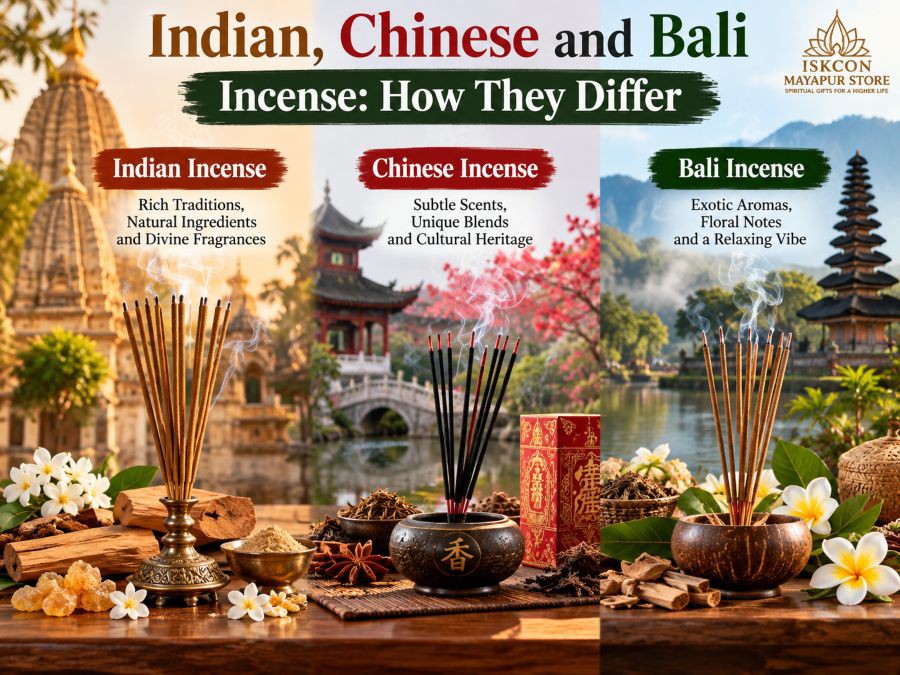
Indian, Chinese and Bali Incense: How They Differ
Indian, Chinese and Bali Incense: How They Differ
Light three sticks of incense from three different countries, and your room will tell three different stories. One smells like a temple courtyard at dawn. One smells like an old study lined with polished wood. One smells like a warm evening under frangipani trees. The idea is the same in each case, something fragrant burning slowly, yet the results are worlds apart.
If you have only ever grabbed whatever was cheapest at the corner shop, this comparison may change how you buy. And if you already love genuine Indian agarbatti, it will explain why it feels so different from the joss sticks you tried on holiday.
Same smoke, different job
Before comparing scents, ask what each culture wants incense to do.
In India, incense is mostly a companion to worship and daily rhythm. You light it beside a deity, at the start of a puja, or when the house needs to feel awake. The aroma is meant to be rich, warm and unmistakable, something you notice the moment you walk in.
In China, incense grew up alongside ancestor rites, Buddhist and Taoist temples, and scholarly life. Some of it is burned in enormous quantities at temples. Some is used quietly at a writing desk, to sharpen focus. The mood is often restrained, woody and layered.
In Bali, incense is woven into the day itself. Every morning families place small offerings at doorways, shrines and even on the pavement, and a stick of incense goes with them. The scent leans soft, floral and sweet, which suits a culture where the offering is small, frequent and personal.
Keep those three jobs in mind and the differences in ingredients, shape and smell start to make sense.
Indian incense: the bold, spiced classic
Walk into any Indian incense workshop and the first thing you see is a bamboo stick. Thin, straight, dipped or rolled in a fragrant paste. That stick is what most of the world means by agarbatti.
What is actually in it
The paste, often called masala, is the soul of the product. A traditional mix might include:
- Charcoal or wood powder as the burning base
- Makko (tabu) powder, a natural binder from tree bark
- Resins such as guggul, benzoin or halmaddi
- Sandalwood, vetiver, jatamansi or other aromatic roots and herbs
- Flower extracts or essential oils such as rose, jasmine, champa, kewra
The paste clings to the bamboo, the stick dries in the sun, and the result is a rigid, easy-to-light incense that burns evenly for roughly 30 to 45 minutes.
Why it smells the way it does
Indian incense often follows the logic of fragrance families. There is the white-flower family (champa, jasmine), the resinous family (guggul, loban, benzoin), the woody family (sandalwood, cedar) and the earthy family (vetiver, patchouli). A good maker layers a "top" scent you notice first and a "base" that lingers in the room after the stick has burned out.
The style is generous. Indian sticks tend to fill a space quickly, which suits a home shrine or a busy prayer room. That strength is a big part of the appeal, but it also explains why cheap versions can feel heavy or headache-inducing. When the fragrance is a synthetic oil sprayed onto a low-grade base, you get sweetness without depth. The real thing has a dry-down, a quiet second act after the first few minutes.
The dhoop cousin
Do not forget dhoop, the stickless version. Dhoop sticks and cones are made from the same kind of masala but without the bamboo. They burn thick, slow and heavy, and they are favoured for aarti and temple ceremonies. If you find agarbatti too light for a large room, dhoop is worth trying.
Chinese incense: patient, woody and quiet
Chinese incense has a longer, more literary history than most people realise. Burning fragrant woods appears in ritual records that stretch back thousands of years, and by the time of the imperial courts, incense had become an art form in its own right, with its own tools, its own vocabulary and its own connoisseurs.
The materials tell the story
Where Indian incense loves flowers and spice, Chinese incense leans toward wood and bark:
- Sandalwood and agarwood (the prized, resin-soaked heartwood)
- Cinnamon bark, star anise and clove
- Herbal medicine ingredients such as angelica root and licorice
- Tabu powder again as a binder
That herbal side is not a coincidence. Chinese incense grew close to traditional medicine, so recipes read a bit like apothecary formulas. The result is a smoke that feels dry, clean and slightly medicinal in a pleasant way, more like opening an old wooden chest than walking through a garden.
Shapes you will not see elsewhere
This is where Chinese incense gets truly distinctive.
- Coreless sticks with no bamboo at all, which burn with a purer wood aroma
- Large temple joss sticks, thick and tall, often tinted red, made to be burned in bundles
- Spiral coils hung from temple ceilings, designed to smoulder for days
- Powder incense pressed into decorative moulds and lit from one end, sometimes used as a timekeeper, since the trail burns at a steady pace
The powder-and-mould method is worth remembering. It reveals a philosophy: incense is not only for smelling but for marking time and creating stillness.
What it feels like in the room
A quality Chinese stick does not shout. It settles. Many people describe it as a scent that "clears the desk", which is why it has stayed popular among readers, calligraphers and meditators. The trade-off is that it is less immediately dramatic than Indian incense. You may need to sit with it for a few minutes before it reveals itself.
One honest warning: the very cheap red temple joss sticks sold in bulk are often loaded with fillers and synthetic scent. They are made for ceremony, not for enjoying at home. Quality varies a lot, so buy from someone who can tell you what is in the product.
Bali incense: the island's soft floral voice
Bali sits in a corner of Indonesia where Hindu tradition survived and thrived while the rest of the archipelago moved in other directions. That history shapes the incense. Balinese dupa is bound up with the daily offering ritual, and it looks and smells like it.
Lighter, sweeter, hand-touched
Balinese incense commonly uses:
- Frangipani, jasmine, ylang-ylang and lemongrass
- Local sandalwood or cendana-style woods
- Coconut, vanilla or spice notes in some blends
- Bamboo or very thin wooden cores, often hand-rolled
Many Balinese sticks are thinner and gentler than Indian ones. They give off a light, sweet, almost tropical smoke that drifts rather than pushes. You notice it in the corner of the room, not across the whole house.
Made for the everyday
Because Balinese households burn incense daily, often several sticks at a time as offerings, the scent is designed to be pleasant on repeat. Nobody wants a punishing fragrance for a habit performed every morning. That makes Bali incense a friendly starting point for beginners and for people who are sensitive to smoke or strong perfume.
The caution is simple. Many sticks labelled "Bali" in export markets are produced elsewhere or blended with synthetic fragrance. If the scent reads as candy-sweet with no woody or natural undertone, treat it with suspicion.
Side by side: the quick comparison
Indian | Chinese | Balinese | |
Scent character | Bold, spiced, floral or resinous | Woody, herbal, subtle | Soft, sweet, tropical floral |
Typical form | Bamboo stick, dhoop, cones | Coreless stick, coils, powder | Thin hand-rolled sticks |
Best for | Puja, home shrines, large rooms | Meditation, study, quiet spaces | Daily use, small rooms, relaxing |
Room presence | Strong, fills quickly | Gentle, builds slowly | Light, drifting |
Treat this as a guide, not a rulebook. Every country makes many styles, and a great maker in one place can produce something that breaks the pattern.
Smoke, ash and a little common sense
Whatever you choose, burning anything indoors deserves respect. Smoke contains fine particles, and heavy daily use in a closed room is not ideal, especially for children, pets, people with asthma, or anyone sensitive to fragrance.
A few habits go a long way:
- Open a window or door slightly while it burns
- Use a proper holder that catches ash and keeps the stick stable
- Keep sticks away from curtains, paper and shelves
- Do not burn several sticks in a tiny room at once
- Put them out fully when you leave
Ash is also a clue about quality. Clean, pale grey or white ash usually means a decent base. Dark, crumbly ash, a bitter smell, or a stick that sputters can point to fillers or poor binding.
How to choose without overthinking it
Forget the labels for a moment and answer three questions.
What is the moment? For worship, a festival or a room that needs presence, Indian incense is hard to beat. For focus or quiet evenings, a Chinese coreless stick suits. For a light morning ritual or a small space, Balinese is the easy choice.
How sensitive are you to smoke? If a strong scent gives you a headache, start with thinner, softer sticks and burn them for shorter periods.
Do you know who made it? This is the question people skip. A short ingredient list, a transparent maker and a fair price usually beat flashy packaging. If a bundle of fifty sticks costs less than a cup of tea and smells like a candy shop, ask yourself how a natural resin or real sandalwood got in there.
If you are unsure, buy small. Try one pack from each tradition, burn a single stick in a ventilated room, and give it ten full minutes before deciding. Fragrance changes as it burns, and the first minute is rarely the whole story.
The takeaway
Indian, Chinese and Bali incense are not three versions of one product. They are three answers to three different questions: how do we honour the divine, how do we quiet the mind, and how do we bring beauty into an ordinary morning?
Indian incense answers with warmth and abundance. Chinese incense answers with patience and depth. Balinese incense answers with softness and daily habit. Once you know that, choosing becomes simple: pick the question you are asking today.
Posted in: Incense or Agarbatti
Related posts
-
 How to Light Incense SticksDiscover the right way to light incense sticks (agarbatti) for worship, meditation, and peace. Learn step-by-step...Read more
 -
 Where to Buy Incense SticksDiscover where to buy the best natural incense sticks for your daily puja, meditation, and relaxation. Explore pure,...Read more
 -
 Is Incense Sticks Bad for Pregnancy? Wondering if incense sticks are safe during pregnancy? Discover the truth about incense smoke, its effects on...Read more
 -
 Do Incense Sticks Trigger Fire Alarms? Wondering if incense sticks can trigger fire alarms? Learn how smoke affects detectors, safe burning tips, and...Read more
 -
 How Many Incense Sticks to Burn for Good LuckDiscover how many incense sticks to burn for good luck and prosperity. Learn the ideal numbers, rituals, and natural...Read more
Leave a comment