
Why did Krishna run to embrace a poor brahmin in rags? Read the Sudama story from the Bhagavatam and learn how a...
Latest posts
-
 Krishna and Sudama: The Poor Brahmin Who Became Wealthy in LoveRead more
 -
 Vamana Avatar: How Three Steps Humbled Bali MaharajaRead more
Why did a powerful king give away three worlds to a boy asking for three steps? Learn the Vamana avatar story from...
-
 The Bhagavatam on Marriage: Duty, Love and Spiritual PartnershipRead more
What does the Bhagavatam say about marriage? Through the stories of Kardama and Devahuti, Rukmini's secret letter and...
-
 What Is Prema? The Bhagavatam's Highest Stage of Love for GodRead more
Prema is love for God with no "because" attached. Learn how the Bhagavatam describes it, the nine steps from faith to...
-
 Is Shiva Parvati Kalyana Mentioned in Srimad Bhagavatam? What the Scripture Really SaysRead more
Looking for Shiva and Parvati's wedding in the Srimad Bhagavatam? Find out what the scripture actually describes,...
-
 How Many Modes of Devotion Are Mentioned in Bhagavatam?Read more
A young boy named Prahlada listed nine ways to serve God, and the Bhagavatam keeps them as its answer. Learn what the...
-
 What Is Bhagavatam and Why Has It Been Read for 5,000 Years?Read more
A dying king asked one question, and the answer became the Bhagavatam. Learn what this Sanskrit scripture contains,...
-
 Who Is Lord Krishna? His Meaning, Teachings and Pastimes ExplainedRead more
Discover who Krishna is according to Srimad Bhagavatam, including His divine identity, childhood pastimes, teachings,...
-
 Incense in Islam: Bakhoor, Agarbatti and What Tradition SaysRead more
Is burning fragrance part of Muslim tradition? Explore incense in Islam, from the Prophetic practice of fumigating...
-
 History of Agarbatti: From Vedic Dhupa to Modern Incense SticksRead more
Where did agarbatti really come from? Follow the history of agarbatti from Vedic fire rituals and temple dhupa to...
Blog categories
- Default category (0)
- MUSICAL INSTRUMENT (1)
- BOOK (5)
- DEVOTIONAL GIFT (0)
- Blog (30) click
- CHANDAN (12)
- Bhagavatam Wisdom Series (68)
- Krishna Consciousness (14)
- Mridangam Musical Instrument (6)
- Bhagavad Gita for Beginners (13)
- Bhagavad Gita As It Is (37) click
- Bhagavad Gita As It Is Telugu (0)
- Bhagavad Gita As It Is Marathi (0)
- Bhagavad Gita As It Is In Hindi (0)
- Bhagavad Gita As It Is In English (0)
- Bhagavad Gita As It Is In Bengali (8)
- Bhagavad Gita As It Is In Kannada (0)
- Bhagavad Gita As It Is In Gujarati (0)
- Bhagavad Gita As It Is In Panjabi (0)
- Bhagavad Gita As It Is In Tamil (0)
- Bhagavad Gita As It Is Odia (0)
- BHAGAVAD GITA As It Is GERMAN (0)
- Bhagavad Gita As It Is In French (0)
- Bhagavad Gita As It Is In Nepali (0)
- Bhagavad Gita As It Is In Assamese (0)
- Incense or Agarbatti (38)
- Lord Chaitanya Mahaprabhu (3)
- Vedic Temple Mayapur (14)
- kalki (15)
- Mahabharata – Dharma & Destiny (27)
- Vaishnava Scriptures (4)
- healthy product (4)
- chaitanya mahaprabhu (5)
- Tulsi Mala Guide (17)
Search in blog
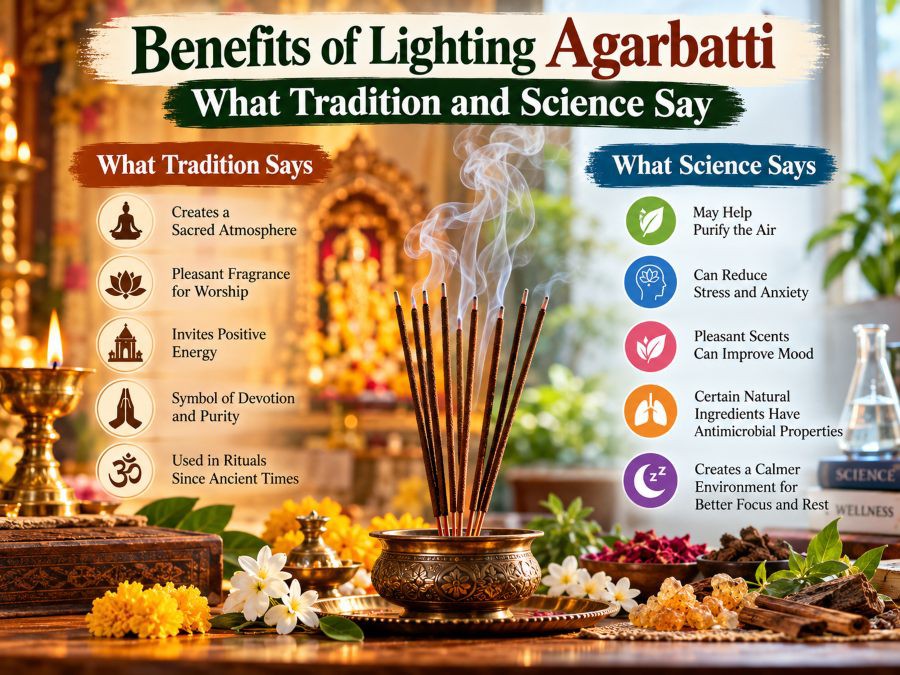
Benefits of Lighting Agarbatti: What Tradition and Science Say
Benefits of Lighting Agarbatti: What Tradition and Science Say
You have probably seen it a thousand times without really watching. A thin stick touches a flame, a small orange glow appears, and a ribbon of smoke starts climbing. Within a minute, the whole room feels different. Quieter, somehow. Why does such a tiny act carry so much weight?
Millions of Indian homes light Incense Sticks and agarbatti every morning without a second thought. This article looks at the real benefits of lighting agarbatti, separates what tradition promises from what research can actually support, and tells you plainly where the smoke deserves caution.
Why does a burning stick feel so meaningful?
Ask ten people why they light agarbatti and you will hear ten answers. "It's a habit." "My mother did it." "It makes the house feel clean." "It calms me down before puja."
Notice something about those answers. Almost none of them describe a measurable effect. They describe a feeling, tied to a routine, tied to a memory. That is exactly where tradition and science start to overlap, and where they start to disagree. So it helps to take them one at a time.
What tradition has always said
In the Indian devotional and Ayurvedic view, fragrant smoke is not decoration. It is a form of offering and a form of preparation.
Dhupa, the offering of incense, is one of the standard items presented to the deity during worship. In Vaishnava temples, including ISKCON temples, incense is offered during arati along with lamps, flowers, water and a fan. The idea is simple: the Lord is welcomed with pleasant things, and the worshipper's own mind is brought into a respectful frame.
Traditional texts and family customs also credit incense with several roles:
- Purifying the atmosphere of a home or shrine before worship
- Creating a sattvic mood, meaning calm, clear and steady
- Marking sacred time, such as sunrise, sunset or a festival
- Welcoming guests and deities with a pleasant, respectful scent
Many of the resins and woods used, such as sandalwood, guggul, benzoin and vetiver, also appear in Ayurvedic writing for their supposed effects on mind and body. Tradition rarely claims that agarbatti "cures" anything. It claims that agarbatti prepares you: the space, the mind, the moment.
That framing matters, because it is more modest and more accurate than the health claims you see on product boxes.
Benefit one: it turns a moment into a ritual
Here is the most reliable benefit, and it needs no laboratory.
Psychologists talk about cues. A cue is a small, repeatable signal that tells your brain what is about to happen. Lighting a lamp, closing a book, putting on running shoes: each one nudges the mind into a particular gear.
Agarbatti works beautifully as a cue. The scratch of the matchstick, the first thread of smoke and the familiar smell all say the same thing: this is the quiet part of the day. Do it at the same time for a few weeks, and your body starts responding before you have even sat down.
So if you want the calm without the guesswork, treat agarbatti as a trigger for a habit you already value: prayer, japa, journaling, stretching, or ten minutes of silence. The stick does not create the calm. It helps you arrive at it faster.
Benefit two: scent and mood, and what the research really shows
Smell is unusual among the senses. Signals from the nose travel to the olfactory bulb, which connects closely with brain regions involved in emotion and memory. This is why a whiff of a certain flower can drop you into a childhood afternoon in half a second.
What does research say about incense specifically? Honestly, it is a mixed and modest picture.
- Frankincense. One widely discussed laboratory study, published in 2008, reported that a compound found in frankincense resin, incensole acetate, produced anxiety-reducing and antidepressant-like effects in mice. It is interesting, but it was an animal study, and it does not prove that burning a stick in your living room does the same for you.
- Aromatherapy in general. Small studies on pleasant fragrances such as lavender and sandalwood suggest they may help some people feel more relaxed. Results vary, sample sizes are often small, and people's expectations play a big role.
- The placebo question. If you believe a scent calms you and you enjoy it, you may genuinely feel calmer. That is not "fake". Feeling better is still feeling better. It simply means we should be careful about promising specific medical effects.
The fair summary: a fragrance you love can lift your mood and soften stress for many people. Claims that incense treats depression, cures insomnia or "detoxifies" the body go far beyond what evidence supports.
Benefit three: a steadier mind for prayer, study and work
Some people light agarbatti when they study or meditate, and swear it sharpens focus. Is there anything behind it?
Probably a combination of three things:
1. Association. If you always light the same fragrance while concentrating, the scent becomes linked with concentration. Over time, it can prompt that state.
2. Reduced distraction. A pleasant background scent can dull the sensory noise of a room, especially if you are sensitive to stale air or street smells.
3. A visible timer. A stick burns for about half an hour, so it quietly gives a session a beginning and an end. Many people find that structure helpful.
None of these is magic. All of them are real, and all of them can be reproduced by anyone willing to build the habit.
Benefit four: freshening a room (with an honest footnote)
Cooking smells, damp corners, a closed-up prayer room: agarbatti handles these well. But here is the footnote most articles skip. Incense mostly covers odours. It does not clean the air.
In fact, burning anything indoors adds particles to the air. So if a room smells bad because of damp or poor ventilation, the better fix is airflow and cleaning, with agarbatti as the finishing touch rather than the solution.
The part nobody puts on the packet: smoke has a cost
Now for the uncomfortable bit. If we are being fair about the benefits of lighting agarbatti, we also have to be fair about the downsides.
Burning incense releases fine particles (often measured as PM2.5), along with carbon monoxide and other compounds. Studies measuring indoor air during incense burning, particularly in small, closed rooms, have found meaningful increases in particle levels. Some long-term studies of people with heavy, daily exposure have found associations with respiratory irritation and, in some populations, higher risk of certain conditions. The research is not uniform, and it does not prove that occasional home use will harm a healthy adult. But it is enough to say clearly:
- Heavy, daily burning in a closed room deserves caution.
- People with asthma, allergies or chronic lung conditions may react even to small amounts.
- Infants, young children and elderly relatives are more vulnerable to smoke.
- Pets, especially birds, can be very sensitive.
None of this means you must give up the practice. It means you should use it thoughtfully, the way you would treat any other source of smoke in the home.
How to keep the good and reduce the risk
A few simple habits make a large difference:
- Ventilate. Keep a window or door slightly open while it burns.
- Use one stick, not five. More smoke is not more devotion. It is just more smoke.
- Choose the right room. A large hall or a shrine with airflow is better than a tiny closed bedroom.
- Never leave it unattended. Use a stable holder that catches the ash.
- Do not burn it near a sleeping baby's face or close to anyone with breathing trouble.
- Extinguish fully when you are done, rather than letting it smoulder on.
- Watch how you feel. If your throat itches, your eyes water or your head aches, that is your answer. Switch scents, shorten the time or skip it.
Not all sticks are equal
Quality changes the experience more than most people expect. A stick made from real resins, woods and natural binders tends to smell layered and burn evenly. A cheap stick with a low-grade base and heavy synthetic fragrance often smells flat and sharp, and it can feel harsher on the throat.
When you buy, look for:
- A clear ingredient list, or at least a maker willing to tell you what is inside
- Even, pale ash, which often signals a decent base
- A scent that develops rather than hitting you with one loud note
- Reasonable pricing. Real sandalwood and quality resins cost money
Do not judge by strength alone. The loudest stick in the shop is rarely the best one. A good fragrance should feel like a welcome, not an ambush.
So, is it worth it?
Here is the honest verdict, friend to friend.
The strongest benefits of lighting agarbatti are the ones tradition has always emphasised: ritual, rhythm and mood. A small flame and a familiar scent can mark the start of prayer, steady a restless mind and make a home feel cared for. Research adds some support for the calming effect of pleasant fragrance, while also reminding us that smoke is not harmless and that big medical claims are not backed up.
Light it with intention. Choose quality. Keep the air moving. Treat it as one gentle habit among many rather than a cure for anything. Do that, and one thin stick can do exactly what generations of families have trusted it to do: turn an ordinary moment into a quiet one.
Posted in: Incense or Agarbatti
Related posts
-
 How to Light Incense SticksDiscover the right way to light incense sticks (agarbatti) for worship, meditation, and peace. Learn step-by-step...Read more
 -
 Where to Buy Incense SticksDiscover where to buy the best natural incense sticks for your daily puja, meditation, and relaxation. Explore pure,...Read more
 -
 Is Incense Sticks Bad for Pregnancy? Wondering if incense sticks are safe during pregnancy? Discover the truth about incense smoke, its effects on...Read more
 -
 Do Incense Sticks Trigger Fire Alarms? Wondering if incense sticks can trigger fire alarms? Learn how smoke affects detectors, safe burning tips, and...Read more
 -
 How Many Incense Sticks to Burn for Good LuckDiscover how many incense sticks to burn for good luck and prosperity. Learn the ideal numbers, rituals, and natural...Read more
Leave a comment