
Why did Krishna run to embrace a poor brahmin in rags? Read the Sudama story from the Bhagavatam and learn how a...
Latest posts
-
 Krishna and Sudama: The Poor Brahmin Who Became Wealthy in LoveRead more
 -
 Vamana Avatar: How Three Steps Humbled Bali MaharajaRead more
Why did a powerful king give away three worlds to a boy asking for three steps? Learn the Vamana avatar story from...
-
 The Bhagavatam on Marriage: Duty, Love and Spiritual PartnershipRead more
What does the Bhagavatam say about marriage? Through the stories of Kardama and Devahuti, Rukmini's secret letter and...
-
 What Is Prema? The Bhagavatam's Highest Stage of Love for GodRead more
Prema is love for God with no "because" attached. Learn how the Bhagavatam describes it, the nine steps from faith to...
-
 Is Shiva Parvati Kalyana Mentioned in Srimad Bhagavatam? What the Scripture Really SaysRead more
Looking for Shiva and Parvati's wedding in the Srimad Bhagavatam? Find out what the scripture actually describes,...
-
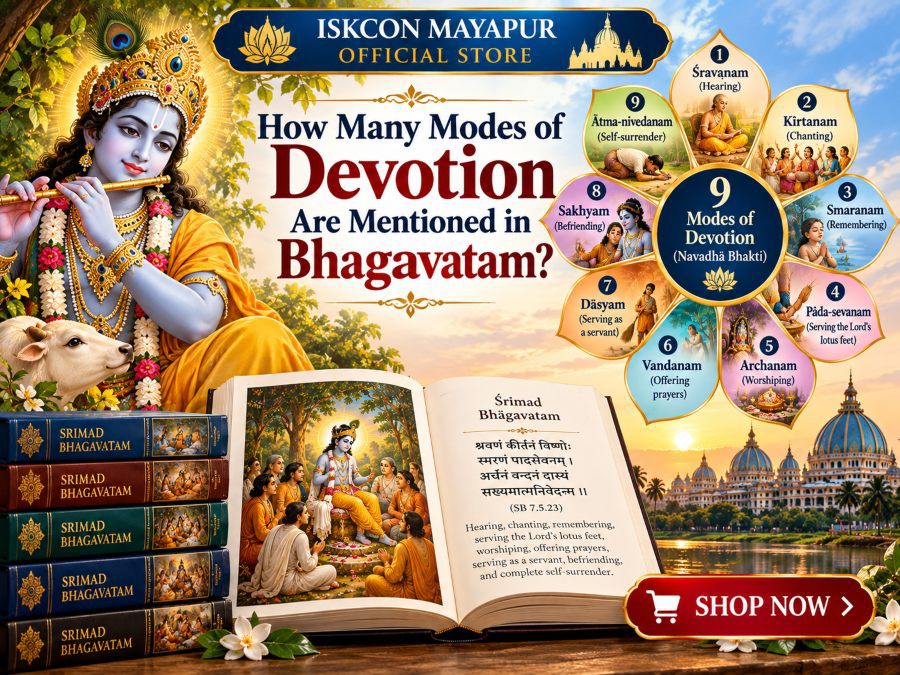 How Many Modes of Devotion Are Mentioned in Bhagavatam?Read more
A young boy named Prahlada listed nine ways to serve God, and the Bhagavatam keeps them as its answer. Learn what the...
-
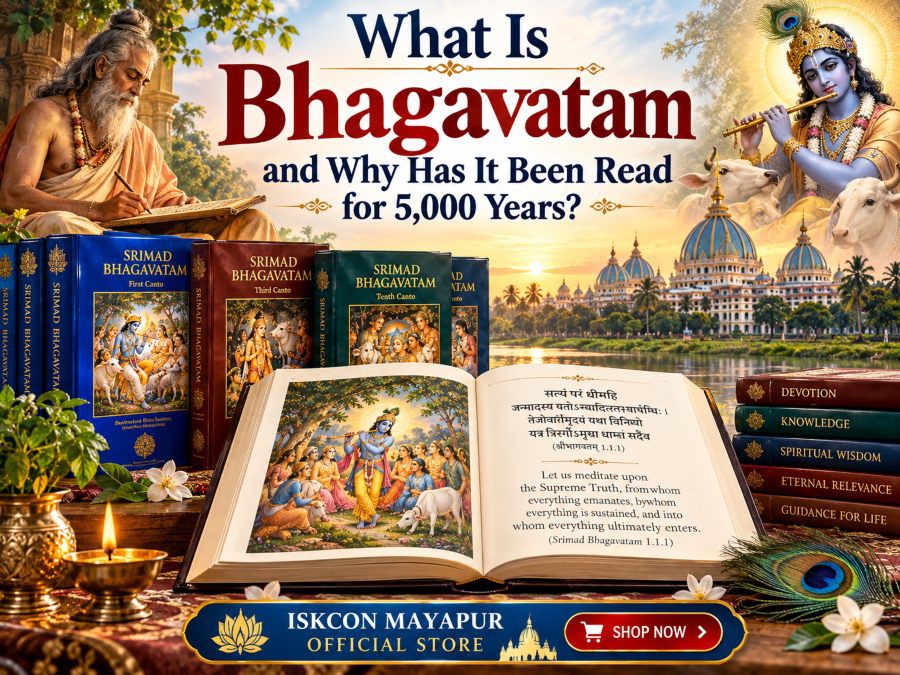 What Is Bhagavatam and Why Has It Been Read for 5,000 Years?Read more
A dying king asked one question, and the answer became the Bhagavatam. Learn what this Sanskrit scripture contains,...
-
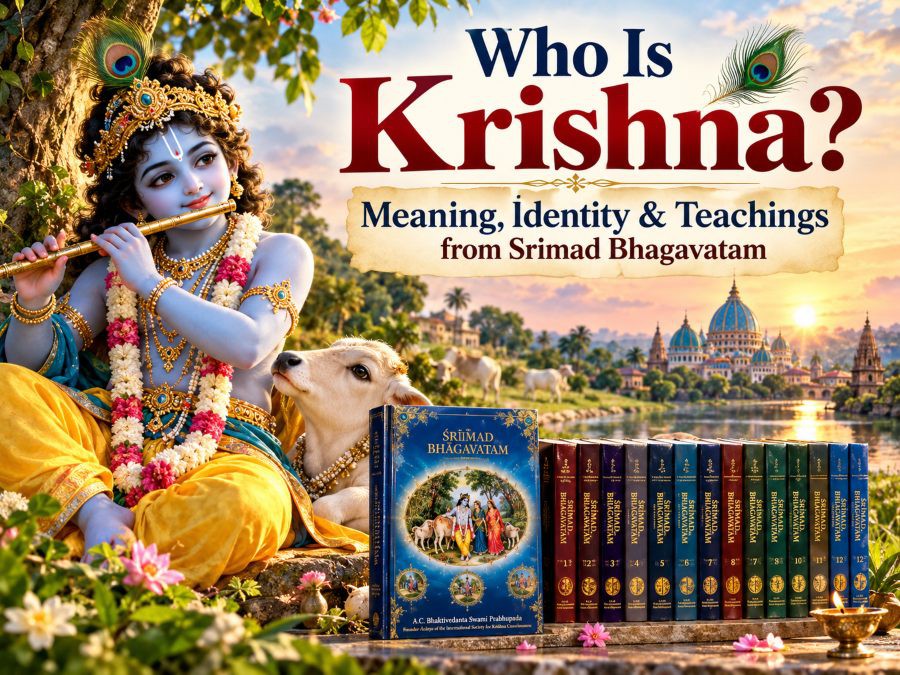 Who Is Lord Krishna? His Meaning, Teachings and Pastimes ExplainedRead more
Discover who Krishna is according to Srimad Bhagavatam, including His divine identity, childhood pastimes, teachings,...
-
 Incense in Islam: Bakhoor, Agarbatti and What Tradition SaysRead more
Is burning fragrance part of Muslim tradition? Explore incense in Islam, from the Prophetic practice of fumigating...
-
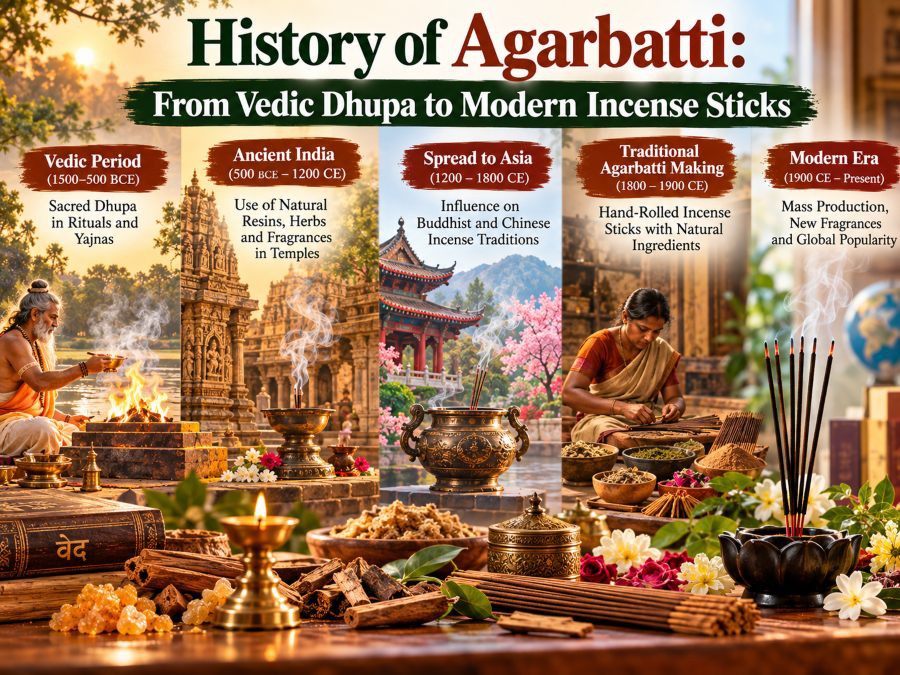 History of Agarbatti: From Vedic Dhupa to Modern Incense SticksRead more
Where did agarbatti really come from? Follow the history of agarbatti from Vedic fire rituals and temple dhupa to...
Blog categories
- Default category (0)
- MUSICAL INSTRUMENT (1)
- BOOK (5)
- DEVOTIONAL GIFT (0)
- Blog (30) click
- CHANDAN (12)
- Bhagavatam Wisdom Series (68)
- Krishna Consciousness (14)
- Mridangam Musical Instrument (6)
- Bhagavad Gita for Beginners (13)
- Bhagavad Gita As It Is (37) click
- Bhagavad Gita As It Is Telugu (0)
- Bhagavad Gita As It Is Marathi (0)
- Bhagavad Gita As It Is In Hindi (0)
- Bhagavad Gita As It Is In English (0)
- Bhagavad Gita As It Is In Bengali (8)
- Bhagavad Gita As It Is In Kannada (0)
- Bhagavad Gita As It Is In Gujarati (0)
- Bhagavad Gita As It Is In Panjabi (0)
- Bhagavad Gita As It Is In Tamil (0)
- Bhagavad Gita As It Is Odia (0)
- BHAGAVAD GITA As It Is GERMAN (0)
- Bhagavad Gita As It Is In French (0)
- Bhagavad Gita As It Is In Nepali (0)
- Bhagavad Gita As It Is In Assamese (0)
- Incense or Agarbatti (38)
- Lord Chaitanya Mahaprabhu (3)
- Vedic Temple Mayapur (14)
- kalki (15)
- Mahabharata – Dharma & Destiny (27)
- Vaishnava Scriptures (4)
- healthy product (4)
- chaitanya mahaprabhu (5)
- Tulsi Mala Guide (17)
Search in blog
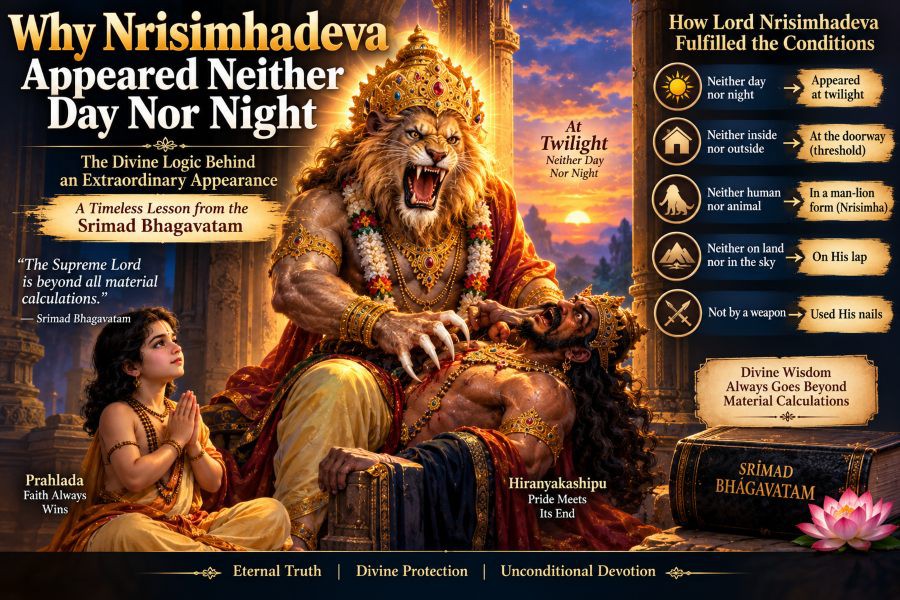
Why Nrisimhadeva Appeared Neither Day Nor Night
Why Nrisimhadeva Appeared Neither Day Nor Night
What happens when a tyrant tries to make himself impossible to defeat? Hiranyakashipu thought he had solved the problem of death by carefully shaping the conditions of his boon. He would not die during the day or at night, neither inside nor outside, neither on land nor in the sky, and not by a human or an animal. Yet the story of Lord Nrisimhadeva in the Srimad Bhagavatam shows that no material calculation can place the Supreme Lord inside a box. The Bhagavata Purana presents one of the most remarkable divine appearances in Hindu sacred literature: Nrisimhadeva emerged at twilight, on a threshold, and in a form that was neither fully human nor fully animal.
The details are dramatic, but the deeper idea is even more interesting.
Hiranyakashipu tried to control the conditions of his death.
Nrisimhadeva demonstrated that the Supreme Lord is not limited by the conditions of a material contract.
Hiranyakashipu Wanted Immortality Without Saying It
Hiranyakashipu did not receive literal immortality.
That distinction is important.
He performed severe austerities to gain extraordinary power and eventually received a boon from Lord Brahma. Because Brahma, as a created being, could not grant absolute immortality, Hiranyakashipu asked for protections that would make death appear practically impossible.
His requests covered several possibilities.
He did not want to die:
- during the day,
- during the night,
- inside a building,
- outside a building,
- on the ground,
- in the sky,
- by a human,
- by an animal,
- by a weapon,
- or under the ordinary circumstances he could imagine.
From Hiranyakashipu's perspective, this looked like brilliant planning.
He had studied the possibilities and attempted to eliminate them one by one.
But there was a flaw in his reasoning.
He was thinking about death as a problem of categories.
The Supreme Lord was not.
The Problem With Trying to Outsmart Death
Hiranyakashipu's ambition went beyond personal security.
He wanted control.
After gaining his powers, he became increasingly intolerant of worship directed toward Lord Vishnu. He wanted everyone to recognize him as the highest authority.
That is where the story becomes more than a tale about a demon receiving a powerful boon.
Hiranyakashipu had mistaken temporary protection for ultimate independence.
He could influence the conditions of his physical life.
He could frighten kings and devas.
He could punish those who opposed him.
But he could not become independent of the Supreme Lord.
The irony is striking: the more carefully Hiranyakashipu tried to eliminate every possible form of death, the more clearly his story demonstrated the limits of material security.
Then There Was Prahlada
Standing against Hiranyakashipu was his own son, Prahlada Maharaja.
Prahlada was devoted to Vishnu from childhood.
His father could not understand this devotion.
To Hiranyakashipu, Prahlada's faith was rebellion.
To Prahlada, remembering Vishnu was simply natural.
The conflict between father and son became increasingly severe. Hiranyakashipu tried repeatedly to kill Prahlada, yet Prahlada remained protected.
The contrast could not be sharper.
Hiranyakashipu trusted his boon.
Prahlada trusted Vishnu.
One relied on conditions.
The other relied on devotion.
“Where Is Your Vishnu?”
Eventually, Hiranyakashipu's anger reached its peak.
He asked Prahlada where Vishnu could be found.
Prahlada's answer was simple: the Supreme Lord is present everywhere.
This statement infuriated his father.
Hiranyakashipu challenged him further.
“If Vishnu is everywhere,” he essentially demanded, “is He present in this pillar?”
Prahlada affirmed the Lord's presence.
Hiranyakashipu struck the pillar.
And then the impossible happened.
A terrifying sound emerged.
The pillar appeared to split open.
From it came Lord Nrisimhadeva.
Not a conventional man.
Not a conventional beast.
Something beyond the categories Hiranyakashipu had attempted to control.
Why Did Nrisimhadeva Appear at Twilight?
This is one of the most famous details in the story.
Hiranyakashipu had protected himself from death during both day and night.
Nrisimhadeva therefore appeared at sandhya, the transitional period between day and night.
It was neither ordinary daytime nor ordinary nighttime.
This is not a random technical trick.
The episode demonstrates the limits of Hiranyakashipu's material calculations.
He tried to divide reality into two options:
day / night
But reality contains transitions.
There is dawn.
There is dusk.
There are moments that do not fit neatly into one category or another.
Nrisimhadeva's appearance at twilight reveals a larger spiritual principle:
The Supreme Lord is not trapped by the boundaries human beings construct around reality.
The Threshold: Neither Inside Nor Outside
Hiranyakashipu had also attempted to protect himself from death inside or outside.
Again, Nrisimhadeva's appearance answers the condition without violating the deeper meaning of the boon.
The Lord caught Hiranyakashipu at the threshold of the doorway.
A doorway is neither fully inside nor fully outside.
It is a boundary.
A transition.
A place between two spaces.
The symbolism is powerful.
Hiranyakashipu's entire strategy depended on fixed categories. Nrisimhadeva appeared precisely at the point where those categories meet.
This is why the story remains so memorable.
The Lord does not need to break the rules.
He simply reveals that Hiranyakashipu never possessed the complete control he imagined.
Neither Man Nor Beast
Perhaps the most famous part of Nrisimhadeva's form is His body itself.
Hiranyakashipu did not want to be killed by a human or an animal.
So Vishnu appeared as Nara-simha—part human and part lion.
The Lord was not an ordinary human.
He was not an ordinary lion.
He was a divine form beyond the categories covered by Hiranyakashipu's calculations.
This is one of the central theological ideas behind the story of Nrisimhadeva.
The Supreme Lord does not need to select one side of a material duality.
He can manifest a form that transcends the distinction.
That is why Nrisimhadeva is such a powerful symbol of divine freedom.
Neither Earth Nor Sky
The next condition concerned location.
Hiranyakashipu had sought protection from death on the ground and in the sky.
Nrisimhadeva placed him upon His lap.
The lap is neither the ground nor the open sky.
Again, the Lord's action fits the exact logic of the story.
Hiranyakashipu had attempted to cover every obvious possibility.
But he could not account for something outside his conceptual framework.
The lesson is not merely cleverness.
It is about the danger of assuming that reality is limited to the categories we already understand.
No Weapon Was Needed
Hiranyakashipu had also sought protection from weapons.
Nrisimhadeva did not need a conventional weapon.
The Lord used His nails.
The nails are part of His own body.
This detail makes the scene especially dramatic. The demon's protection was based on an external weapon being unable to kill him, while the Lord did not depend upon an ordinary weapon at all.
The story repeatedly makes the same point:
Hiranyakashipu's protection was conditional. Vishnu's power was not.
The Appearance of Nrisimhadeva Is Not a Loophole
It can be tempting to describe the episode as a clever loophole in Brahma's boon.
But that description misses the spiritual depth of the story.
A loophole suggests that Hiranyakashipu had genuinely secured absolute safety and that Vishnu merely found a technical escape.
The Srimad Bhagavatam presents something much greater.
Hiranyakashipu never possessed absolute control.
His boon gave him extraordinary protection, but not independence from the Supreme Lord.
Nrisimhadeva's appearance reveals that distinction.
The Lord does not defeat the boon.
He exposes its limits.
The Connection With Varaha
The story becomes even more interesting when viewed alongside other divine incarnations.
In the Srimad Bhagavatam, Lord Vishnu appears as Varaha to rescue the Earth and defeat Hiranyaksha, the brother of Hiranyakashipu.
The two brothers share a similar orientation toward power, yet their stories unfold differently.
Varaha confronts Hiranyaksha in a cosmic battle.
Nrisimhadeva appears specifically to protect Prahlada and end Hiranyakashipu's tyranny.
The forms are completely different.
Varaha is a divine boar.
Nrisimhadeva is half-man and half-lion.
The difference shows the adaptability of the Supreme Lord.
The form follows the purpose.
Varaha must rescue the Earth from the cosmic waters.
Nrisimhadeva must protect a devotee and answer the extraordinary conditions surrounding Hiranyakashipu's boon.
The Lord does not appear according to human expectations.
He appears according to divine purpose.
Why the Pillar Matters
The pillar is another detail worth thinking about.
Hiranyakashipu asks whether Vishnu exists within it.
The answer comes through direct revelation.
Nrisimhadeva emerges from the pillar.
For a devotee, this illustrates the Lord's omnipresence.
Vishnu is not restricted to temples, sacred places, or particular objects.
The Supreme Lord is present everywhere.
Hiranyakashipu's mistake was not simply failing to believe in Vishnu.
He wanted to determine where Vishnu could and could not exist.
The pillar destroys that assumption.
The Lord can appear wherever He chooses.
Nrisimhadeva and the Protection of Prahlada
The story would be incomplete if we focused only on the technical conditions of Hiranyakashipu's death.
The reason Nrisimhadeva appears is deeply connected with Prahlada's devotion.
Prahlada does not possess armies.
He does not have political power.
He cannot physically defeat his father.
His strength comes from devotion.
When Prahlada is threatened, Vishnu personally appears.
That relationship between the Supreme Lord and His devotee is one of the emotional centers of the Srimad Bhagavatam.
The story says something profound about spiritual protection:
Devotion does not always remove difficulty before it arrives, but the Bhagavatam presents the Lord as personally responding to the sincere devotee.
Prahlada's faith survives every attempt to destroy it.
The Difference Between Fear and Faith
Hiranyakashipu spends his life trying to avoid fear.
Prahlada does not.
That does not mean Prahlada enjoys danger. He simply does not place his ultimate security in the body.
His father is obsessed with survival.
His son is absorbed in devotion.
That contrast creates much of the story's power.
Hiranyakashipu asks:
“How can I make myself impossible to defeat?”
Prahlada's attitude is closer to:
“Whatever happens, I belong to Vishnu.”
These are two radically different approaches to existence.
One is based on control.
The other is based on surrender.
What Twilight Can Teach Us
The choice of twilight has spiritual significance beyond its role in fulfilling the conditions of the boon.
Twilight is a transition.
It reminds us that life itself is full of transitions.
Childhood becomes adulthood.
Health becomes illness.
Success becomes uncertainty.
Relationships change.
The body grows older.
Nothing remains permanently fixed.
Hiranyakashipu tried to build security by dividing existence into rigid categories.
Nrisimhadeva appeared in the space between them.
The image offers a quiet lesson: reality is often more subtle than the categories through which we try to control it.
The Limits of Material Protection
Hiranyakashipu's story does not suggest that planning or protection is meaningless.
There is nothing wrong with taking sensible precautions.
The problem arises when precautions become a substitute for spiritual understanding.
Money can provide comfort.
Medicine can protect health.
Security systems can protect property.
Power can protect political interests.
But none of them can make the individual permanently independent of time.
Hiranyakashipu takes this desire to an extreme.
He tries to negotiate with death itself.
Yet death finds a way through the space he failed to understand.
The Srimad Bhagavatam therefore asks us to consider a different form of security: spiritual knowledge and devotion.
Why the Form of Nrisimhadeva Is So Powerful
Nrisimhadeva can appear frightening.
His form is fierce.
His roar is terrifying.
His actions are violent toward Hiranyakashipu.
Yet devotees approach Him with affection.
Why?
Because the same form that is terrifying to the aggressor is protective toward the devotee.
This is an important feature of the story.
Divine ferocity and divine compassion are not opposites.
Nrisimhadeva's anger is directed toward the force threatening Prahlada.
His protection is directed toward the devotee.
The distinction matters.
The Lord's fierce form is not presented as uncontrolled rage. It serves a specific purpose.
Hiranyakashipu's Final Mistake
Hiranyakashipu's greatest mistake was not asking for protection.
It was believing that protection made him the supreme authority.
His boon increased his power, but instead of making him humble, it intensified his pride.
He began demanding worship.
He persecuted devotees.
He tried to eliminate the remembrance of Vishnu.
In the end, the very power he believed would make him invincible could not protect him from the Supreme Lord.
This gives the story a sharp warning:
The more power we receive, the more important humility becomes.
Without humility, protection can become arrogance.
Success can become entitlement.
Strength can become oppression.
What the Nrisimhadeva Story Teaches About Divine Justice
The story also challenges a common idea of justice.
Justice is not always immediate.
Hiranyakashipu appears powerful for a long time.
Prahlada suffers.
The demon seems almost unstoppable.
Yet the narrative eventually reaches a point where divine intervention becomes unavoidable.
Nrisimhadeva appears suddenly and changes everything.
For readers of the Srimad Bhagavatam, this reinforces faith in a moral order that extends beyond what is immediately visible.
The fact that injustice may temporarily appear victorious does not mean it has become permanent.
The Four Conditions That Make the Story Unforgettable
The famous circumstances surrounding Nrisimhadeva's appearance can be remembered as a series of “neither-nor” answers:
Hiranyakashipu's protection | Nrisimhadeva's response |
Neither day nor night | Twilight |
Neither inside nor outside | Doorway/threshold |
Neither human nor animal | Man-lion form |
Neither ground nor sky | The Lord's lap |
Not killed by a weapon | The Lord's nails |
The pattern is deliberate.
Each condition exposes the limits of Hiranyakashipu's attempt to control reality.
The Deeper Message: You Cannot Outsmart the Absolute
There is something almost philosophical about the entire encounter.
Hiranyakashipu believes the universe can be mastered through sufficient calculation.
If he can identify every possibility, he can eliminate every danger.
But the Absolute cannot be reduced to a list of possibilities.
That is why Nrisimhadeva's appearance is so profound.
The Lord does not fit into Hiranyakashipu's framework.
He transcends it.
This is also why the story has endured for centuries. It is not merely about an ancient demon receiving a strange death.
It is about the limits of human control.
We can calculate.
We can plan.
We can prepare.
But we cannot make ourselves absolute.
Nrisimhadeva and the Heart of the Srimad Bhagavatam
The Srimad Bhagavatam repeatedly returns to a central spiritual question: what happens when the living being turns away from the Supreme Lord and becomes absorbed in temporary power?
Hiranyakashipu provides one answer.
His material achievements increase, but his peace decreases.
His power grows, but his fear grows with it.
He controls others, yet remains controlled by anger, pride, and fear of losing control.
Prahlada offers the opposite answer.
He has almost no material power, yet remains inwardly fearless because of his devotion.
The contrast is the heart of the narrative.
Why Nrisimhadeva Appeared Neither Day Nor Night
So why did Nrisimhadeva appear neither day nor night?
Because the story reveals something far greater than a clever solution to a demon's boon.
The Supreme Lord is beyond the categories through which material power tries to control existence.
Hiranyakashipu attempted to defeat death by constructing conditions around it.
Nrisimhadeva appeared at the boundary between those conditions.
At twilight.
On a threshold.
In a form beyond ordinary categories.
With no conventional weapon.
And with Prahlada protected beside Him.
The message is both theological and deeply human.
We can spend our lives trying to create perfect security. We can accumulate wealth, influence, knowledge, and protection. Yet none of these makes us independent of the Supreme.
The story of Nrisimhadeva redirects the search for security toward something deeper: faith, devotion, humility, and recognition of divine authority.
Hiranyakashipu tried to make himself untouchable.
Prahlada simply trusted Vishnu.
And when the moment came, the Lord appeared in a form that no calculation could predict.
That is the enduring power of the Nrisimhadeva story in the Srimad Bhagavatam: when human arrogance tries to place limits on the Absolute, the Absolute reveals Himself beyond those limits.
Posted in: Bhagavatam Wisdom Series
Related posts
-
 Why to read srimad bhagavatamReading the Srimad Bhagavatam fosters deep spiritual growth by narrating the life and teachings of Lord Krishna,...Read more
 -
 When was srimad bhagavatam written?The Srimad Bhagavatam is believed to have been written around 9th-10th century CE, though its oral traditions date...Read more
 -
 How many chapters are there in srimad bhagavatam?The Srimad Bhagavatam consists of 12 cantos (books) containing 335 chapters in total. Each canto covers various...Read more
 -
 How many skandhas are there in srimad bhagavatamThe Srimad Bhagavatam is divided into 12 skandhas (cantos or books). Each skandha explores different themes,...Read more
 -
 How many slokas in srimad bhagavatamThe Srimad Bhagavatam contains approximately 18,000 shlokas (verses). These verses are spread across its 12 skandhas...Read more
Leave a comment