
Why did Krishna run to embrace a poor brahmin in rags? Read the Sudama story from the Bhagavatam and learn how a...
Latest posts
-
 Krishna and Sudama: The Poor Brahmin Who Became Wealthy in LoveRead more
 -
 Vamana Avatar: How Three Steps Humbled Bali MaharajaRead more
Why did a powerful king give away three worlds to a boy asking for three steps? Learn the Vamana avatar story from...
-
 The Bhagavatam on Marriage: Duty, Love and Spiritual PartnershipRead more
What does the Bhagavatam say about marriage? Through the stories of Kardama and Devahuti, Rukmini's secret letter and...
-
 What Is Prema? The Bhagavatam's Highest Stage of Love for GodRead more
Prema is love for God with no "because" attached. Learn how the Bhagavatam describes it, the nine steps from faith to...
-
 Is Shiva Parvati Kalyana Mentioned in Srimad Bhagavatam? What the Scripture Really SaysRead more
Looking for Shiva and Parvati's wedding in the Srimad Bhagavatam? Find out what the scripture actually describes,...
-
 How Many Modes of Devotion Are Mentioned in Bhagavatam?Read more
A young boy named Prahlada listed nine ways to serve God, and the Bhagavatam keeps them as its answer. Learn what the...
-
 What Is Bhagavatam and Why Has It Been Read for 5,000 Years?Read more
A dying king asked one question, and the answer became the Bhagavatam. Learn what this Sanskrit scripture contains,...
-
 Who Is Lord Krishna? His Meaning, Teachings and Pastimes ExplainedRead more
Discover who Krishna is according to Srimad Bhagavatam, including His divine identity, childhood pastimes, teachings,...
-
 Incense in Islam: Bakhoor, Agarbatti and What Tradition SaysRead more
Is burning fragrance part of Muslim tradition? Explore incense in Islam, from the Prophetic practice of fumigating...
-
 History of Agarbatti: From Vedic Dhupa to Modern Incense SticksRead more
Where did agarbatti really come from? Follow the history of agarbatti from Vedic fire rituals and temple dhupa to...
Blog categories
- Default category (0)
- MUSICAL INSTRUMENT (1)
- BOOK (5)
- DEVOTIONAL GIFT (0)
- Blog (30) click
- CHANDAN (12)
- Bhagavatam Wisdom Series (68)
- Krishna Consciousness (14)
- Mridangam Musical Instrument (6)
- Bhagavad Gita for Beginners (13)
- Bhagavad Gita As It Is (37) click
- Bhagavad Gita As It Is Telugu (0)
- Bhagavad Gita As It Is Marathi (0)
- Bhagavad Gita As It Is In Hindi (0)
- Bhagavad Gita As It Is In English (0)
- Bhagavad Gita As It Is In Bengali (8)
- Bhagavad Gita As It Is In Kannada (0)
- Bhagavad Gita As It Is In Gujarati (0)
- Bhagavad Gita As It Is In Panjabi (0)
- Bhagavad Gita As It Is In Tamil (0)
- Bhagavad Gita As It Is Odia (0)
- BHAGAVAD GITA As It Is GERMAN (0)
- Bhagavad Gita As It Is In French (0)
- Bhagavad Gita As It Is In Nepali (0)
- Bhagavad Gita As It Is In Assamese (0)
- Incense or Agarbatti (38)
- Lord Chaitanya Mahaprabhu (3)
- Vedic Temple Mayapur (14)
- kalki (15)
- Mahabharata – Dharma & Destiny (27)
- Vaishnava Scriptures (4)
- healthy product (4)
- chaitanya mahaprabhu (5)
- Tulsi Mala Guide (17)
Search in blog
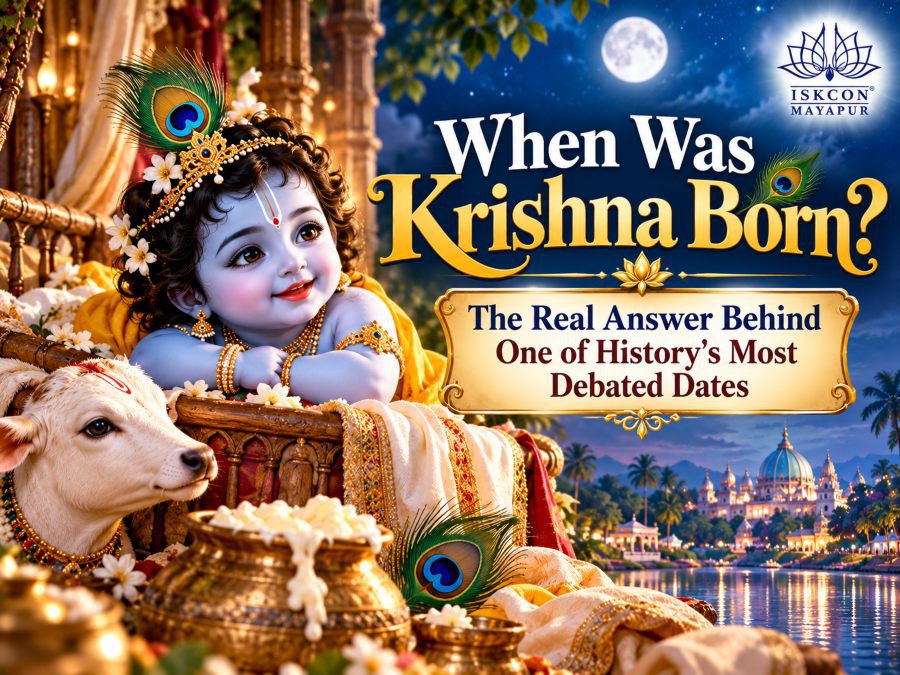
When Was Krishna Born? The Real Answer Behind One of History's Most Debated Dates
When Was Krishna Born? The Real Answer Behind One of History's Most Debated Dates
Here's a question that sounds simple until you actually try to answer it: what year was Krishna born?
Millions of people can tell you the date on the calendar when his birth is celebrated every year. Almost nobody can tell you, with real confidence, what year that birth actually happened in human history. And the gap between those two answers — the ritual date everyone knows, and the historical year almost nobody agrees on — is where this entire question gets interesting.
This isn't a case of nobody having tried to figure it out. Astronomers, Sanskrit scholars, archaeologists, and traditional Vedic astrologers have all taken a run at this problem, using completely different methods, and arrived at answers that sometimes agree and sometimes don't. If you want the real picture rather than a single confident number pulled from nowhere, you have to look at how each of these groups actually reached their conclusions — a process closely tied to devotional and scholarly work you'll also find explored in depth over at mayapur.store.

The Easy Part First: When Krishna's Birth Is Celebrated Every Year
Start with what's actually settled, because there's a lot of agreement here that gets overshadowed by the harder historical question.
Krishna birth is celebrated annually as Janmashtami, and the timing isn't arbitrary — it's built from three specific astronomical and calendrical markers working together:
- The month of Bhadrapada (or Shravana, depending on the regional calendar system used) in the Hindu lunar calendar, which typically falls in August or September on the Gregorian calendar.
- Ashtami tithi — the eighth day of the waning moon (Krishna Paksha), a lunar phase marker rather than a fixed solar date.
- Rohini nakshatra — a specific lunar mansion or star position that the moon is said to have occupied at the moment of birth, according to the Bhagavata Purana's own description of the night.
- Midnight — the Bhagavatam specifically places the moment of birth at midnight, not dawn or dusk, a detail that later became central to the ritual observance itself, with devotees traditionally staying awake and breaking their fast only after midnight has passed.
This is why Janmashtami doesn't fall on the same Gregorian date every year — it's tracking a lunar and astrological configuration, not a fixed solar date the way a birthday on a Western calendar would work. Some years the combination of Ashtami tithi and Rohini nakshatra doesn't align perfectly, which is part of why you'll sometimes see two different dates floated in different regions or different calendar traditions (Smarta versus Vaishnava calculations, for instance) for the same year's celebration.
So Why Doesn't the Year Get the Same Level of Agreement?
Here's the honest answer: dating any figure from this far back in Indian antiquity runs into a structural problem that has nothing to do with Krishna specifically. Ancient Indian chronology wasn't built around a single continuous dating system the way, say, Roman consular records or Chinese dynastic annals were. Events got recorded relative to reigns, yugas (cosmic ages), and astronomical configurations — methods that are internally consistent within the tradition but don't translate cleanly into a single Gregorian year without a lot of additional interpretive work.
That's not a dismissal of the sources. It's an explanation for why serious researchers, working entirely in good faith and using real astronomical data, have still landed on different specific years.
The Traditional Calculation: Around 3228 BCE
The most widely cited traditional date places Krishna's birth around 3228 BCE, with his departure from Earth — what the tradition calls his nirvana or disappearance — occurring 125 years later, around 3102 BCE.
That second date isn't a coincidence, and it's worth understanding why. 3102 BCE is also the traditionally accepted starting point of Kali Yuga, the current cosmic age described in Puranic literature. Krishna's departure from the physical world is directly linked, in traditional reckoning, to the beginning of this age — meaning the date isn't just a biographical detail, it's treated as a cosmological turning point.
A few things worth knowing about how this date gets calculated:
- It largely comes from Puranic genealogical lists — records of kings and dynasties (like the Puranic king-lists tracing the Kuru and Yadava lines) that, when their reign-lengths are added up and worked backward from more historically anchored later periods, land in this general range.
- The astronomer Aryabhata, writing around the 5th century CE, calculated the start of Kali Yuga as 3102 BCE using his own astronomical methods — a calculation that predates and independently supports the traditional dating rather than simply restating it.
- This date is the one most commonly cited in devotional and traditional Hindu literature when a specific year is given at all.
The Astronomer's Approach: Reading the Sky Descriptions in the Text
Here's where things get genuinely fascinating, because this isn't guesswork — it's closer to forensic astronomy.
The Mahabharata and the Bhagavata Purana are unusually specific about celestial events surrounding key moments in Krishna's life: eclipses, planetary positions, comet sightings, and star alignments described in enough technical detail that modern researchers have been able to feed them into planetarium software and check when, if ever, the sky actually looked that way.
Dr. B.N. Narahari Achar, a physicist, ran exactly this kind of analysis using planetarium software, cross-referencing the specific planetary configurations described around the Kurukshetra war (which the tradition places near the end of Krishna's life) against actual historical sky positions. His conclusion pointed to a war date around 3067 BCE, broadly consistent with the traditional range, though not identical to it.
Other researchers working with similar astronomical cross-referencing methods have proposed dates ranging more widely — some placing the Mahabharata war (and by extension, the later part of Krishna's life) anywhere from the 2nd millennium BCE to as early as 5000 BCE, depending on which specific astronomical passages they prioritize and how they interpret ambiguous Sanskrit terms for celestial phenomena.
Why the range is so wide even among people using the same basic method:
- Some astronomical references in the text are ambiguous enough to fit multiple possible real-world configurations, not just one.
- Researchers disagree about which passages are original versus later additions to the text, which changes what data is even considered reliable.
- Precession of the equinoxes and other long-term astronomical shifts require careful correction, and small errors in that correction can shift a calculated date by centuries.
What Archaeology Adds to the Picture
Textual and astronomical dating is one line of evidence. Physical archaeology is another, and it's produced its own genuinely striking findings, even if it doesn't settle the question either.
Marine archaeologist S.R. Rao led excavations off the coast of Dwarka, in Gujarat — the city the tradition identifies as Krishna's capital after he left Vrindavana and Mathura — and discovered submerged structures, including what appear to be walls, stone anchors, and pottery, at depths and locations consistent with a coastal settlement that would later have been submerged by rising sea levels. Later underwater surveys by India's National Institute of Oceanography added further findings in the same area.
What this evidence can and can't tell you:
- It supports the idea that a real, substantial coastal settlement existed at Dwarka in antiquity and was later submerged — a physical fact independent of any specific textual dating.
- Dating the pottery and structures themselves has produced estimates ranging from around 1500 BCE to considerably older, depending on the specific method and site used.
- None of this evidence can, by itself, confirm that this particular settlement is the Dwarka Krishna is described as ruling from, as opposed to a later or earlier settlement built on the same strategically useful coastal location.
Archaeology, in other words, tells you a real city existed roughly where the tradition says it did, submerged the way the tradition says it eventually was. It can't independently hand you a birth year for the person the tradition says lived there.
Why the Yuga System Complicates a "Simple" Year Answer
There's a deeper issue worth naming honestly: the traditional Indian dating system doesn't just use different years — it uses different scales of time than modern historical chronology typically works with.
Puranic cosmology describes four yugas — Satya, Treta, Dvapara, and Kali — cycling across durations measured in hundreds of thousands of years, not centuries. Krishna's life is traditionally placed at the very end of Dvapara Yuga, immediately before Kali Yuga begins. That framing carries theological weight independent of the specific calendar year: it positions Krishna's departure as marking an actual transition between cosmic ages, not just a historical death.
This is genuinely difficult to translate into a single Gregorian date without either accepting the tradition's own internal chronology wholesale, or treating the yuga system as symbolic rather than literal — and reasonable, serious researchers land on both sides of that specific interpretive choice. It's not a matter of one side having the facts and the other not; it's a disagreement about which framework is the right one to even ask the question in.
Comparing the Major Estimates Side by Side
Pulling the different approaches together, here's roughly where things stand:
- Traditional Puranic genealogy calculation: around 3228 BCE for birth, 3102 BCE for departure.
- Aryabhata's 5th-century CE astronomical calculation: Kali Yuga beginning 3102 BCE, independently supporting the traditional departure date.
- Narahari Achar's planetarium-based analysis: Mahabharata war (near the end of Krishna's life) around 3067 BCE.
- Other archaeoastronomy researchers: proposals ranging more broadly, some placing events considerably earlier than 3000 BCE.
- Archaeological dating of Dwarka's submerged structures: estimates from roughly 1500 BCE onward, depending on the site and method, without direct confirmation this is the specific settlement described in the texts.
Notice that several of these approaches — the Puranic genealogy, Aryabhata's calculation, and Achar's planetarium analysis — cluster in a fairly narrow window around 3100-3200 BCE, even though they were reached through completely independent methods centuries or millennia apart. That convergence is one of the stronger arguments in favor of treating this general range as historically plausible, even without a single, universally agreed exact year.
Why This Question Matters Beyond Historical Curiosity
It would be easy to treat this as a purely academic puzzle, but there's a reason it keeps getting revisited seriously rather than dismissed as unanswerable myth.
For devotees, the exact calendar year has never been the point of Janmashtami in the way it might be for a historical birthday. The date that matters ritually — the specific tithi, nakshatra, and midnight timing — is treated as eternally recurring rather than tied to a single historical instant, which is part of why the tradition emphasizes those astrological markers so precisely even while treating the historical year itself with more flexibility.
For historians and archaeoastronomers, the appeal is different: the Mahabharata and Bhagavata Purana are unusually rich in specific, checkable astronomical detail for texts of their antiquity, which makes them a genuinely useful test case for how far textual and scientific cross-referencing can go in reconstructing ancient chronology — useful well beyond the specific question of Krishna's birth year.
So What's the Actual Answer?
If you want a single number, the most defensible one — supported by independent convergence across genealogical, astronomical, and traditional calculation methods — places Krishna's birth in the range of 3200-3100 BCE, with 3228 BCE being the specific year most commonly cited in traditional sources.
If you want intellectual honesty instead of false precision, the more accurate answer is this: multiple independent methods, developed centuries apart by people with no reason to agree with each other, converge on roughly the same several-century window in the late 4th millennium BCE — even though none of them can pin down an exact year with certainty that would satisfy a modern historian working with, say, Roman or Egyptian dynastic records.
And every year, regardless of which historical year you find most convincing, millions of people mark the same ritual moment — Ashtami tithi, Rohini nakshatra, midnight — treating the question of when, in the deepest sense, as something that happens again every single year rather than something that happened only once, a very long time ago.
Posted in: Krishna Consciousness
Related posts
-
 Krishna Consciousness: The Endless Path of Bhakti and DevotionExplore Krishna Consciousness—the eternal path of bhakti and devotion rooted in ancient wisdom. Discover the...Read more
 -
 Why Krishna Consciousness is the Key to Inner Peace & HappinessDiscover how Krishna Consciousness offers the key to lasting inner peace and true happiness through devotion,...Read more
 -
 Unlocking the Power of Bhakti Yoga through Krishna ConsciousnessUnlock the power of Bhakti Yoga through Krishna Consciousness—discover how devotion, chanting, and ISKCON Mayapur...Read more
 -
 Discovering Krishna Consciousness: The Science of Self-RealizationDiscover Krishna Consciousness as the science of self-realization—unlock your true spiritual identity and attain...Read more
 -
 Chant, Dance, and Rejoice: Experiencing Krishna ConsciousnessExperience the joy of Krishna Consciousness through chanting, dancing, and rejoicing. Discover how these devotional...Read more
Leave a comment