
Why did Krishna run to embrace a poor brahmin in rags? Read the Sudama story from the Bhagavatam and learn how a...
Latest posts
-
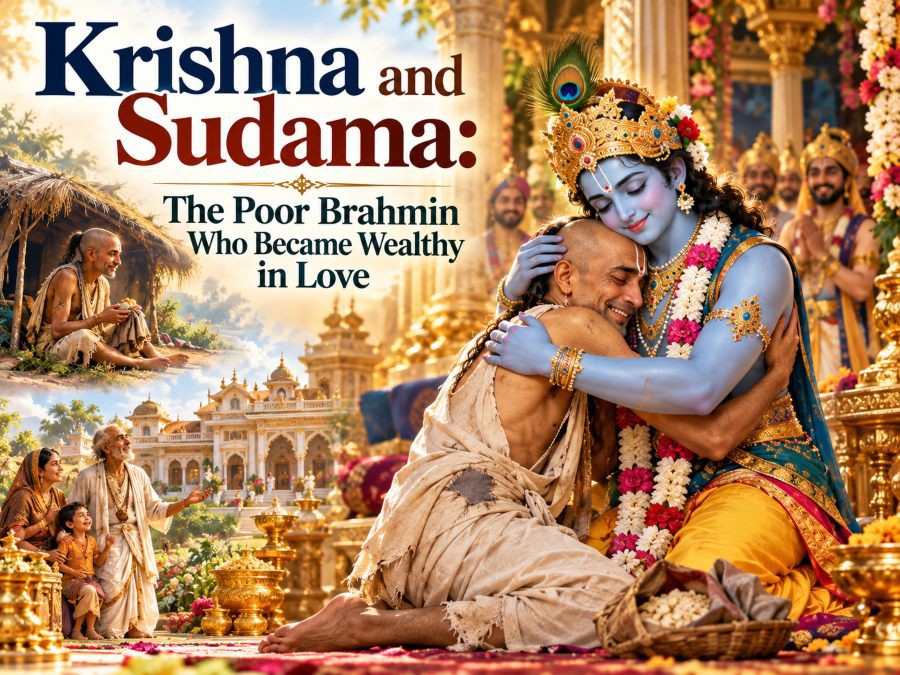 Krishna and Sudama: The Poor Brahmin Who Became Wealthy in LoveRead more
 -
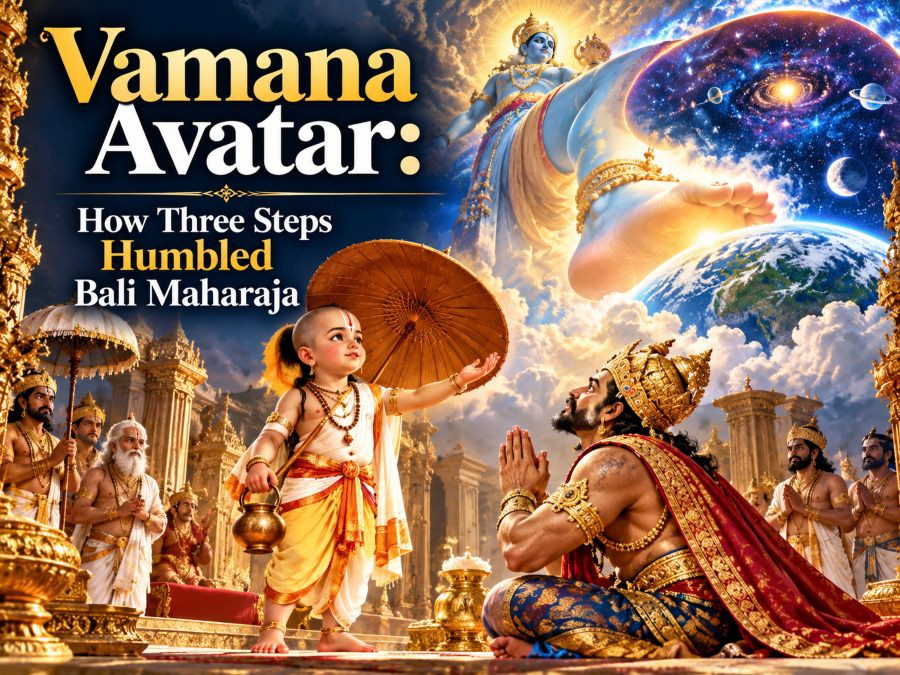 Vamana Avatar: How Three Steps Humbled Bali MaharajaRead more
Why did a powerful king give away three worlds to a boy asking for three steps? Learn the Vamana avatar story from...
-
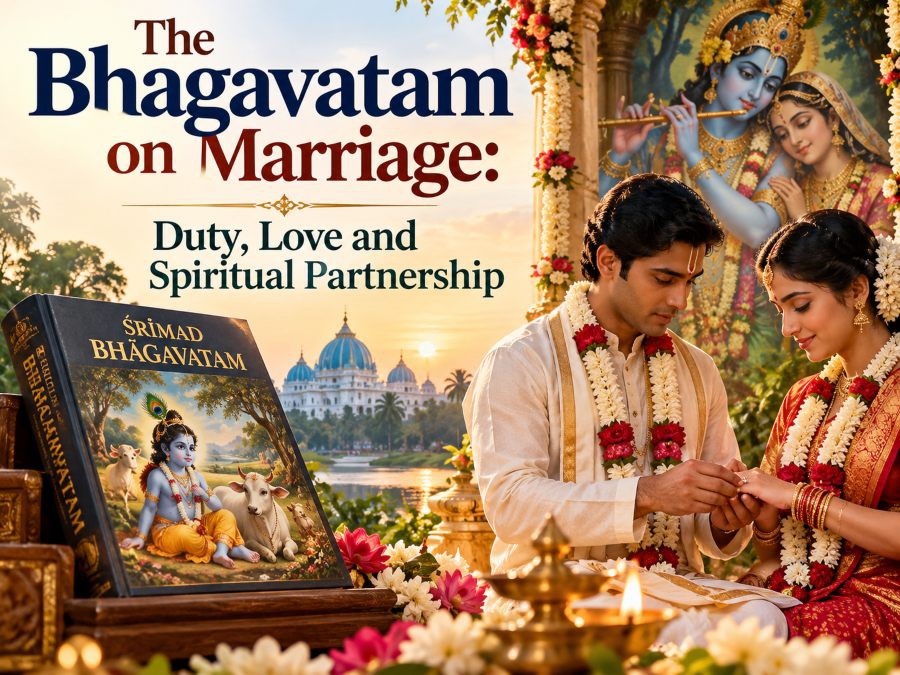 The Bhagavatam on Marriage: Duty, Love and Spiritual PartnershipRead more
What does the Bhagavatam say about marriage? Through the stories of Kardama and Devahuti, Rukmini's secret letter and...
-
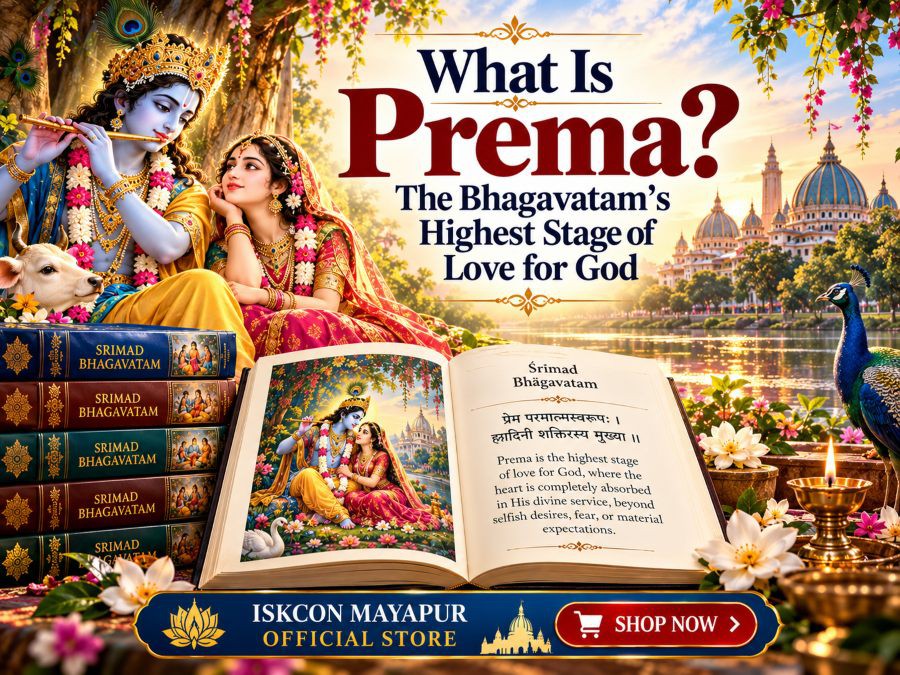 What Is Prema? The Bhagavatam's Highest Stage of Love for GodRead more
Prema is love for God with no "because" attached. Learn how the Bhagavatam describes it, the nine steps from faith to...
-
 Is Shiva Parvati Kalyana Mentioned in Srimad Bhagavatam? What the Scripture Really SaysRead more
Looking for Shiva and Parvati's wedding in the Srimad Bhagavatam? Find out what the scripture actually describes,...
-
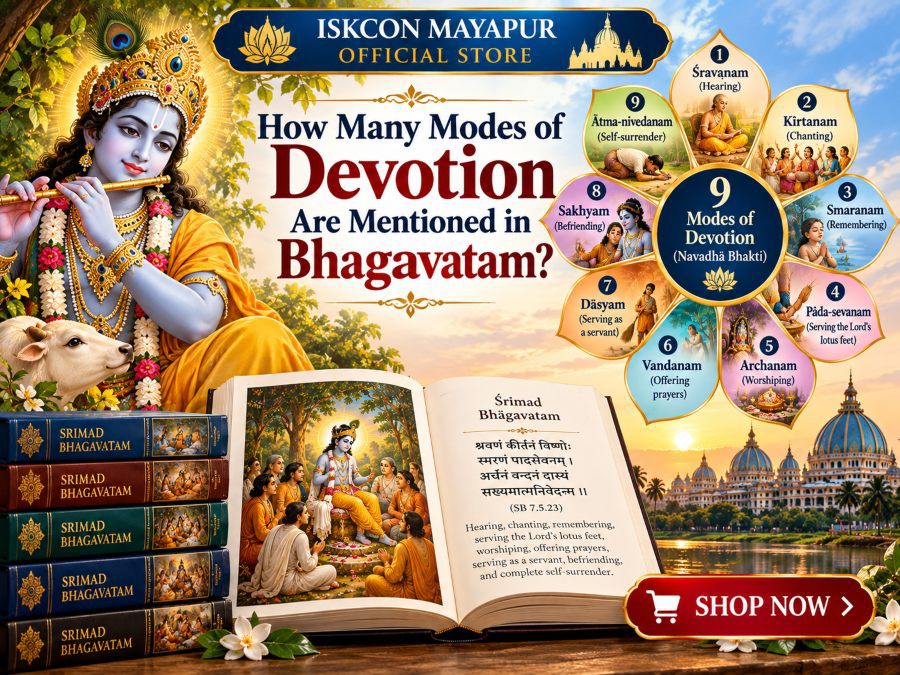 How Many Modes of Devotion Are Mentioned in Bhagavatam?Read more
A young boy named Prahlada listed nine ways to serve God, and the Bhagavatam keeps them as its answer. Learn what the...
-
 What Is Bhagavatam and Why Has It Been Read for 5,000 Years?Read more
A dying king asked one question, and the answer became the Bhagavatam. Learn what this Sanskrit scripture contains,...
-
 Who Is Lord Krishna? His Meaning, Teachings and Pastimes ExplainedRead more
Discover who Krishna is according to Srimad Bhagavatam, including His divine identity, childhood pastimes, teachings,...
-
 Incense in Islam: Bakhoor, Agarbatti and What Tradition SaysRead more
Is burning fragrance part of Muslim tradition? Explore incense in Islam, from the Prophetic practice of fumigating...
-
 History of Agarbatti: From Vedic Dhupa to Modern Incense SticksRead more
Where did agarbatti really come from? Follow the history of agarbatti from Vedic fire rituals and temple dhupa to...
Blog categories
- Default category (0)
- MUSICAL INSTRUMENT (1)
- BOOK (5)
- DEVOTIONAL GIFT (0)
- Blog (30) click
- CHANDAN (12)
- Bhagavatam Wisdom Series (68)
- Krishna Consciousness (14)
- Mridangam Musical Instrument (6)
- Bhagavad Gita for Beginners (13)
- Bhagavad Gita As It Is (37) click
- Bhagavad Gita As It Is Telugu (0)
- Bhagavad Gita As It Is Marathi (0)
- Bhagavad Gita As It Is In Hindi (0)
- Bhagavad Gita As It Is In English (0)
- Bhagavad Gita As It Is In Bengali (8)
- Bhagavad Gita As It Is In Kannada (0)
- Bhagavad Gita As It Is In Gujarati (0)
- Bhagavad Gita As It Is In Panjabi (0)
- Bhagavad Gita As It Is In Tamil (0)
- Bhagavad Gita As It Is Odia (0)
- BHAGAVAD GITA As It Is GERMAN (0)
- Bhagavad Gita As It Is In French (0)
- Bhagavad Gita As It Is In Nepali (0)
- Bhagavad Gita As It Is In Assamese (0)
- Incense or Agarbatti (38)
- Lord Chaitanya Mahaprabhu (3)
- Vedic Temple Mayapur (14)
- kalki (15)
- Mahabharata – Dharma & Destiny (27)
- Vaishnava Scriptures (4)
- healthy product (4)
- chaitanya mahaprabhu (5)
- Tulsi Mala Guide (17)
Search in blog
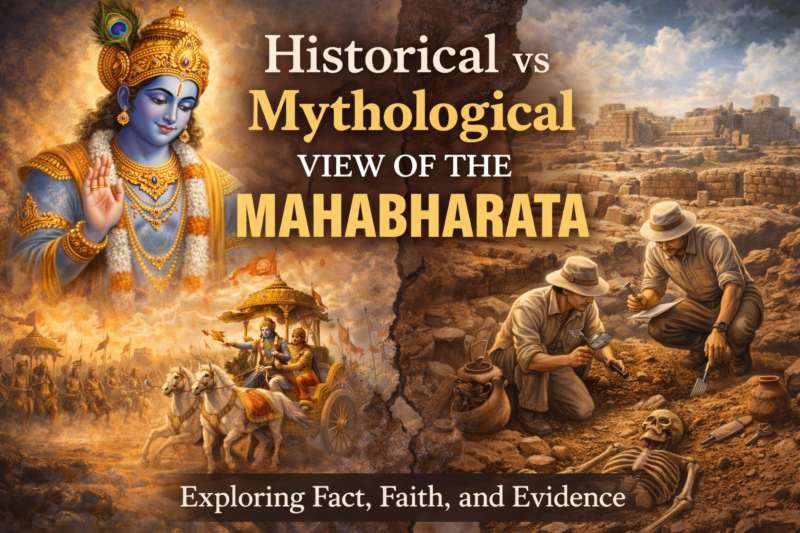
Historical vs Mythological View of the Mahabharata – Exploring Fact, Faith, and Evidence
Historical vs Mythological View of the Mahabharata – Exploring Fact, Faith, and Evidence
The Mahabharata is one of the greatest epics ever written, shaping Indian culture, spirituality, ethics, and philosophy for thousands of years. Yet one fundamental question continues to inspire debate among scholars, historians, spiritual teachers, and readers worldwide: Is the Mahabharata historical reality or divine mythology? Some view it as a literal record of an ancient civilization and a massive war, while others see it as a symbolic narrative conveying moral and spiritual truths rather than factual history.
For readers who wish to explore both perspectives deeply, studying authentic translations and commentaries is essential. Many seekers begin their journey with trusted editions such as Read the complete Mahabharata in Hindi, which preserve narrative clarity and philosophical depth. Understanding both historical and mythological viewpoints allows readers to appreciate the epic without limiting it to one rigid interpretation.
This article explores archaeological evidence, textual chronology, oral tradition, symbolism, scientific perspectives, and cultural continuity to present a balanced analysis of the Mahabharata’s dual identity.
Understanding the Mahabharata Beyond a Simple Story
The Mahabharata is not merely a war chronicle; it is a multi-layered literary universe containing politics, ethics, psychology, theology, sociology, and metaphysics. It contains over 100,000 verses, multiple subplots, hundreds of characters, and extensive philosophical discourse, including the Bhagavad Gita.
Unlike modern historical texts that prioritize dates and documentation, ancient Indian literature integrated philosophy with narrative. Events were often conveyed through poetic symbolism, moral allegory, and spiritual frameworks. This blending of history and metaphysics creates interpretational complexity.
Many civilizations preserved their collective memory through epic narratives rather than chronological archives. Therefore, evaluating the Mahabharata requires understanding ancient literary traditions rather than imposing modern academic standards alone.
What Scholars Mean by “Historical” and “Mythological”
The term historical implies verifiable events supported by archaeology, inscriptions, geography, and independent records. Mythological does not mean false—it refers to symbolic storytelling conveying universal truths through divine imagery and metaphors.
In ancient cultures, myths functioned as educational tools, moral frameworks, and spiritual transmission systems. A narrative could be spiritually true even if not scientifically verifiable.
The Mahabharata operates on both dimensions: physical locations and dynasties coexist with divine incarnations, cosmic timelines, and supernatural elements. This dual nature challenges strict classification.
Archaeological Evidence Supporting Historical Possibilities
Several archaeological discoveries align with descriptions found in the Mahabharata:
· Excavations in Hastinapur reveal flood layers consistent with textual accounts of city destruction.
· Dwarka underwater ruins match descriptions of Krishna’s coastal city.
· Painted Grey Ware pottery dating to 1200–800 BCE matches settlement timelines described in the epic.
· Ancient trade routes and river systems correspond to geographic references.
While archaeology cannot confirm specific individuals like Arjuna or Krishna with certainty, settlement patterns and cultural continuity support the possibility of a real historical framework behind the narrative.
Dating the Mahabharata: Chronological Debates
Scholars propose various timelines for the Mahabharata war:
· Traditional Indian chronology places it around 3102 BCE (start of Kali Yuga).
· Academic estimates range between 1500–1200 BCE based on linguistic and archaeological indicators.
· Astronomical references within the text describe planetary alignments that some researchers attempt to calculate.
Because the text evolved over centuries through oral transmission, pinpointing exact dates remains challenging. However, consistent astronomical references suggest deliberate preservation of time markers.
Oral Tradition and Transmission Accuracy
Before writing systems became widespread, knowledge was preserved orally using rhythmic structure, repetition, and memorization techniques. Vedic scholars maintained extraordinary accuracy through disciplined recitation traditions.
The Mahabharata was transmitted orally for generations before being compiled. While some embellishments naturally occur over time, the core narrative structure remained remarkably stable.
Oral preservation does not eliminate historical credibility—it reflects a different documentation methodology.
Mythological Elements and Symbolic Interpretation
Mythological components include divine incarnations, celestial weapons, curses, miracles, and cosmic events. These elements often symbolize deeper philosophical truths:
· Divine avatars represent higher consciousness guiding humanity.
· Supernatural weapons symbolize advanced knowledge or moral power.
· Curses reflect karmic consequences.
· Cosmic cycles symbolize time and impermanence.
Such symbolism does not invalidate historical possibility; it enriches interpretive depth.
Krishna: Historical Figure or Divine Symbol?
Krishna occupies a central role. Some historians argue Krishna may represent a powerful ancient leader later deified. Others view Krishna as a spiritual archetype symbolizing divine consciousness.
Textual consistency across centuries strongly preserves Krishna’s philosophical teachings. Whether historical or divine, his ethical framework remains culturally transformative.
Geographic Accuracy and Environmental Clues
Mahabharata references thousands of rivers, mountains, forests, and kingdoms that align closely with real Indian geography. Many place names still exist today.
Environmental descriptions such as monsoon patterns, agricultural cycles, and flora match ancient ecological conditions. Such consistency strengthens geographic credibility.
Cultural Continuity and Living Traditions
Indian rituals, festivals, temple practices, moral values, and social structures trace continuity to Mahabharata traditions. Oral storytelling, village dramas, and pilgrimages preserve geographic memory across millennia.
Such uninterrupted cultural continuity rarely exists for purely fictional narratives.
Scientific Limitations in Ancient Verification
Modern science requires material evidence. Ancient civilizations relied on oral preservation. The absence of inscriptions does not negate existence.
Many ancient global events lack archaeological proof yet remain accepted historically due to narrative consistency.
Comparative Global Epics and Historical Parallels
Epics like the Iliad, Odyssey, Epic of Gilgamesh, and Ramayana show similar blending of history and mythology. Troy was once considered mythical until excavations confirmed its existence.
Mahabharata may follow similar validation patterns over time.
Philosophical Truth vs Literal Truth
The Mahabharata emphasizes ethical truth over literal accuracy. Whether every event occurred exactly as described matters less than the wisdom transmitted.
Its enduring relevance lies in human psychology, leadership ethics, conflict resolution, and spiritual development.
Why the Debate Continues in Modern Times
Modern rationalism seeks empirical evidence, while spiritual traditions honor experiential truth. Both perspectives coexist.
Technological advances may reveal new evidence in the future. Until then, intellectual humility remains essential.
How Readers Should Approach the Mahabharata Today
Readers should adopt an open-minded perspective:
· Appreciate historical possibility without rigid certainty.
· Embrace symbolic depth without dismissing physical reality.
· Study multiple translations and commentaries.
· Allow personal interpretation to evolve.
This balanced approach enhances learning.
Educational, Spiritual, and Cultural Value Regardless of Classification
Whether historical or mythological, Mahabharata remains:
· A moral compass for ethical leadership.
· A psychological study of human behavior.
· A spiritual guide toward self-realization.
· A cultural bridge connecting generations.
Its influence transcends classification.
Final Conclusion
The Mahabharata exists at the intersection of history and mythology, fact and philosophy, memory and meaning. Archaeological findings, geographic accuracy, oral preservation, and cultural continuity support the possibility of a historical foundation, while divine narratives and symbolic depth elevate it into spiritual mythology.
Rather than forcing a binary classification, the Mahabharata invites readers to appreciate its multidimensional nature. Its greatest truth lies not in archaeological certainty alone, but in its ability to illuminate human consciousness, ethical responsibility, and spiritual purpose across centuries.
The Mahabharata remains timeless precisely because it speaks to both the rational mind and the spiritual soul.
Posted in: Mahabharata – Dharma & Destiny
Related posts
-
 Who Wrote the Mahabharata? The Complete Story of Sage VyasaA clear explanation of who wrote the Mahabharata, exploring Sage Vyasa’s authorship, the Ganesha narrative, and the...Read more
 -
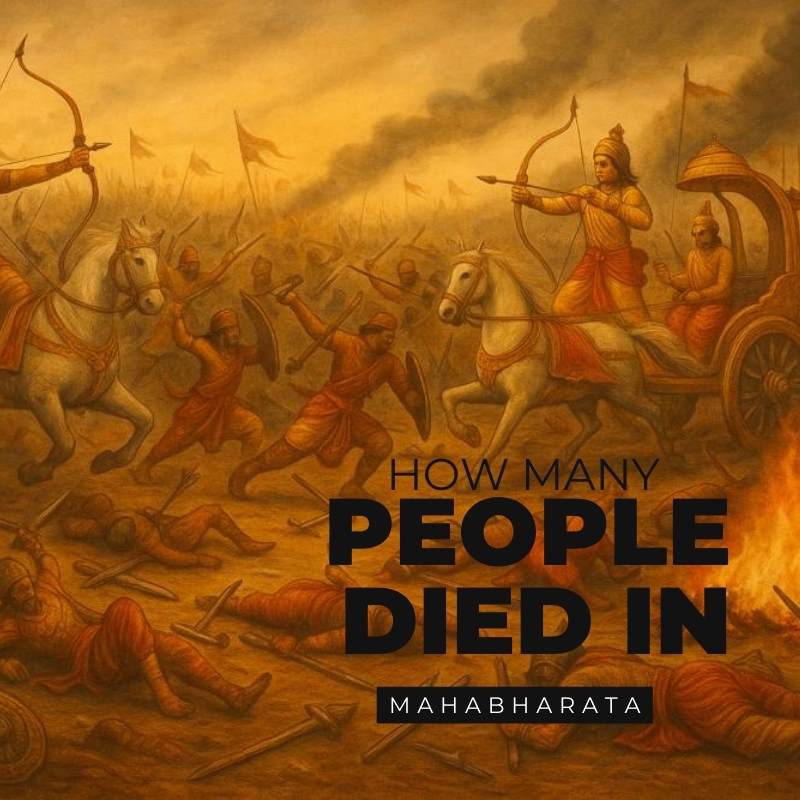 How Many People Died in the Mahabharata? Complete Death Count ExplainedA detailed explanation of how many people died in the Mahabharata, including the Kurukshetra War death count, major...Read more
 -
 Why the Mahabharata Happened: The True Causes Behind the Great WarDiscover the real causes of the Mahabharata war, from jealousy and power struggles to deep karmic destiny. This...Read more
 -
 How Many Days Mahabharata War Happened?The Mahabharata war lasted for 18 intense days, each filled with major battles, turning points, and historic events....Read more
 -
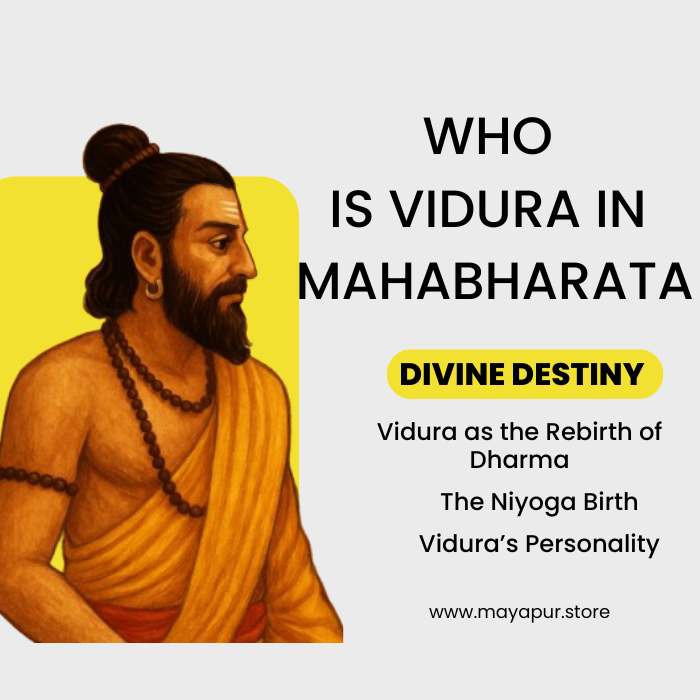 Who Is Vidura in the Mahabharata? Complete Story, Role & TeachingsDiscover who Vidura is in the Mahabharata—his origin, character, wisdom, loyalty, and unmatched adherence to dharma....Read more
Leave a comment