
Why did Krishna run to embrace a poor brahmin in rags? Read the Sudama story from the Bhagavatam and learn how a...
Latest posts
-
 Krishna and Sudama: The Poor Brahmin Who Became Wealthy in LoveRead more
 -
 Vamana Avatar: How Three Steps Humbled Bali MaharajaRead more
Why did a powerful king give away three worlds to a boy asking for three steps? Learn the Vamana avatar story from...
-
 The Bhagavatam on Marriage: Duty, Love and Spiritual PartnershipRead more
What does the Bhagavatam say about marriage? Through the stories of Kardama and Devahuti, Rukmini's secret letter and...
-
 What Is Prema? The Bhagavatam's Highest Stage of Love for GodRead more
Prema is love for God with no "because" attached. Learn how the Bhagavatam describes it, the nine steps from faith to...
-
 Is Shiva Parvati Kalyana Mentioned in Srimad Bhagavatam? What the Scripture Really SaysRead more
Looking for Shiva and Parvati's wedding in the Srimad Bhagavatam? Find out what the scripture actually describes,...
-
 How Many Modes of Devotion Are Mentioned in Bhagavatam?Read more
A young boy named Prahlada listed nine ways to serve God, and the Bhagavatam keeps them as its answer. Learn what the...
-
 What Is Bhagavatam and Why Has It Been Read for 5,000 Years?Read more
A dying king asked one question, and the answer became the Bhagavatam. Learn what this Sanskrit scripture contains,...
-
 Who Is Lord Krishna? His Meaning, Teachings and Pastimes ExplainedRead more
Discover who Krishna is according to Srimad Bhagavatam, including His divine identity, childhood pastimes, teachings,...
-
 Incense in Islam: Bakhoor, Agarbatti and What Tradition SaysRead more
Is burning fragrance part of Muslim tradition? Explore incense in Islam, from the Prophetic practice of fumigating...
-
 History of Agarbatti: From Vedic Dhupa to Modern Incense SticksRead more
Where did agarbatti really come from? Follow the history of agarbatti from Vedic fire rituals and temple dhupa to...
Blog categories
- Default category (0)
- MUSICAL INSTRUMENT (1)
- BOOK (5)
- DEVOTIONAL GIFT (0)
- Blog (30) click
- CHANDAN (12)
- Bhagavatam Wisdom Series (68)
- Krishna Consciousness (14)
- Mridangam Musical Instrument (6)
- Bhagavad Gita for Beginners (13)
- Bhagavad Gita As It Is (37) click
- Bhagavad Gita As It Is Telugu (0)
- Bhagavad Gita As It Is Marathi (0)
- Bhagavad Gita As It Is In Hindi (0)
- Bhagavad Gita As It Is In English (0)
- Bhagavad Gita As It Is In Bengali (8)
- Bhagavad Gita As It Is In Kannada (0)
- Bhagavad Gita As It Is In Gujarati (0)
- Bhagavad Gita As It Is In Panjabi (0)
- Bhagavad Gita As It Is In Tamil (0)
- Bhagavad Gita As It Is Odia (0)
- BHAGAVAD GITA As It Is GERMAN (0)
- Bhagavad Gita As It Is In French (0)
- Bhagavad Gita As It Is In Nepali (0)
- Bhagavad Gita As It Is In Assamese (0)
- Incense or Agarbatti (38)
- Lord Chaitanya Mahaprabhu (3)
- Vedic Temple Mayapur (14)
- kalki (15)
- Mahabharata – Dharma & Destiny (27)
- Vaishnava Scriptures (4)
- healthy product (4)
- chaitanya mahaprabhu (5)
- Tulsi Mala Guide (17)
Search in blog
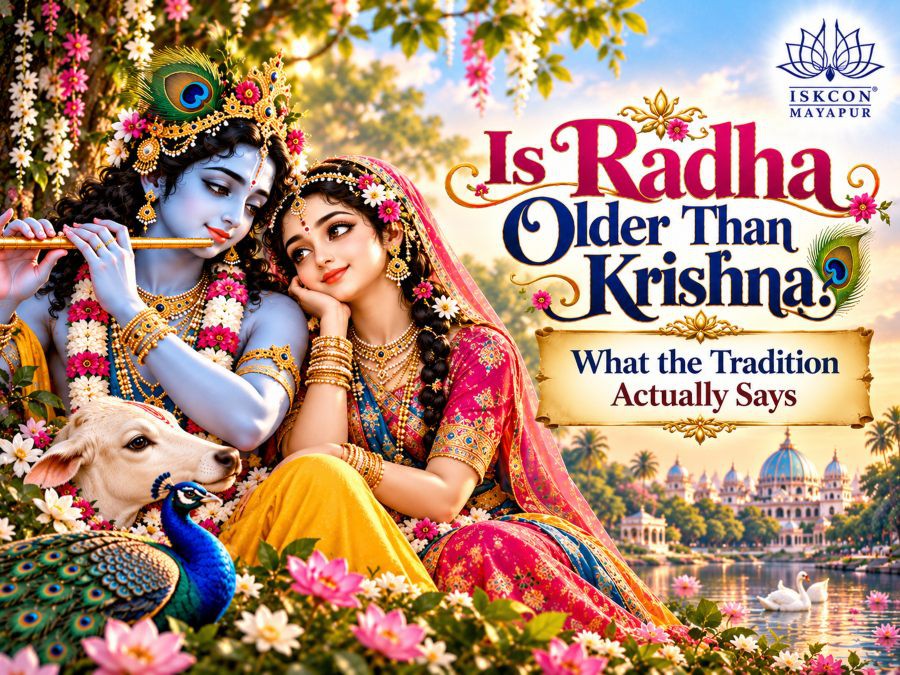
Is Radha Older Than Krishna? What the Tradition Actually Says
Is Radha Older Than Krishna? What the Tradition Actually Says
If Radha Krishna is supposed to be the most complete devotional pairing in the entire Vaishnava tradition, why does something as basic as who was born first still spark genuine disagreement among devotees, scholars, and regional traditions?
That's not a rhetorical setup. It's a real question, and the honest answer is more interesting than a simple yes-or-no, because it depends on which layer of the tradition you're asking — the folk chronology of Vrindavana, the Puranic origin stories, or the deeper theological framework that treats Radha and Krishna as existing beyond ordinary time altogether.
The Short, Popular Answer: Yes, Radha Is Generally Considered Older
Across most regional traditions and devotional folklore, particularly in Braj (the Vrindavana region) and Bengal, Radha is traditionally regarded as older than Krishna — usually described as being ahead of him by several months, though the exact figure shifts depending on which local tradition or text you consult.
This isn't a fringe or minor detail tucked into obscure commentary. It shows up consistently enough in oral tradition, folk songs, and regional retellings that it's treated as settled background knowledge in most Braj communities, even though it rarely gets addressed head-on in the way more famous episodes — the Rasa Lila, the butter theft stories, the Bhagavad Gita — do.
A few reasons this detail persists so widely despite getting relatively little formal textual attention:
- Oral and folk tradition in Braj carries an enormous amount of detail that never made it into the major Sanskrit Puranas, and age sequencing is exactly the kind of domestic, human-scale detail that oral tradition tends to preserve carefully.
- Several later devotional poets and commentators reference her seniority directly, treating it as an accepted premise rather than something requiring justification.
- It connects logically to other well-established parts of the story — including why Radha is sometimes shown taking a guiding, slightly senior role with young Krishna during their early Vrindavana years together.
How Much Older? The Numbers Actually Vary
Here's where honesty matters more than a tidy answer. Different regional and textual traditions don't converge on a single, agreed number of months or years. Some folk traditions place her as older by roughly eleven months. Others describe a gap closer to two or three years. Some retellings simplify the detail entirely, describing her only as "elder" without attaching a specific figure at all.
This kind of variation is actually normal for details that live primarily in oral and folk tradition rather than being anchored to a single canonical text with one specific verse everyone can point to. Compare it to how a well-known folk story might have three slightly different endings depending on which grandmother is telling it in which village — the core claim (Radha is older) stays remarkably consistent, while the specific number attached to it shifts by region and source.
What's worth taking away from this variation, rather than getting stuck on it:
- The consistency of the direction (Radha older, not Krishna) across traditions matters more than agreement on the exact gap.
- Regional folk tradition in Braj and Gaudiya Bengal both preserve this detail independently, which suggests it isn't a late invention specific to one lineage.
- Precise numerical claims about ages in devotional folklore are rarely meant to be read with the same literalism you'd apply to a modern birth certificate.
Why This Age Gap Actually Shaped the Story, Not Just a Trivia Detail
This is the part that gets skipped most often, and it's worth slowing down for, because the age difference isn't just a random biographical footnote — it does real narrative work in explaining several other well-known features of the Radha Krishna story.
It helps explain why they're never shown as formally married in the earliest core texts. Several folk and regional tellings describe Radha as already married to another figure, often named Ayan Ghosh (sometimes called Abhimanyu in certain tellings), by the time her relationship with Krishna develops — a detail that only makes narrative sense if she's already at an age suitable for marriage while Krishna, as the younger figure, is still a child or adolescent cowherd during much of their early Vrindavana story together.
It accounts for the slightly maternal or guiding quality some early episodes give her. In several folk retellings, an older Radha is shown gently supervising, teasing, or guiding a younger Krishna during the earliest stages of their acquaintance in Vrindavana — a dynamic that later shifts, as Krishna matures, into the more mutual, complex romantic and devotional relationship depicted in the Rasa Lila and later poetry like Jayadeva's Gita Govinda.
It adds weight to her role as the more established, senior figure among the gopis. Radha isn't portrayed as one gopi among equals who happens to catch Krishna's attention. She's consistently described as their leader, the one the other gopis defer to — a position that an age advantage helps reinforce, alongside her described spiritual seniority as Krishna's hladini-shakti.
Where the Origin Stories Actually Place Her Birth
The Garga Samhita and later Brahma Vaivarta Purana give slightly different accounts of Radha's appearance, and both are worth knowing, because they approach the age question from different angles entirely.
The Brahma Vaivarta Purana version leans theological rather than chronological: it describes Radha appearing from Krishna's own left side, born essentially simultaneously with him, as his direct feminine counterpart rather than a separately timed birth. Read this way, the question "who was born first" barely applies, since the text is describing a single origin event with two resulting forms, not two independent births separated by time.
The Garga Samhita, by contrast, gives Radha a more grounded, earthly birth story — she's described as the daughter of King Vrishabhanu and Queen Kirtida of Barsana, discovered under unusual circumstances, already radiant and extraordinary from the start. This version sits more comfortably alongside the folk tradition's claim of an earthly age gap, since it treats her birth as a discrete event in Barsana that can, at least in principle, be placed before or after Krishna's own birth in Mathura.
Neither account was designed to settle a precise chronological debate the way a modern biography would. They're doing different theological and narrative work, and the tension between them is part of why this question doesn't have one single textually enforced answer.
Krishna's Birth, for Comparison
Krishna's own birth story is comparatively well-documented and specific: born in a Mathura prison cell to Devaki and Vasudeva, on Ashtami tithi during Krishna Paksha (the waning lunar fortnight) in the month of Bhadrapada, under Rohini nakshatra, at midnight — details covered at length in the Bhagavata Purana with far more textual consistency than Radha's own origin gets across different sources.
That asymmetry itself is worth noting. Krishna's birth details are treated with a level of textual precision that Radha's simply doesn't receive in the same measure across the core Puranic literature — which is part of why questions about her exact age relative to his end up relying more heavily on folk tradition and regional retellings than on a single, universally cited scriptural verse.
The Deeper Answer: Why "Older" Might Be the Wrong Frame Entirely
Here's where the question shifts from historical trivia into something genuinely philosophical, and it's worth taking seriously rather than treating as a technicality dodge.
Gaudiya Vaishnava theology describes Radha as Krishna's hladini-shakti — his internal potency of pleasure, inseparable from him in essence even though she's expressed as a distinct form. Both are described as eternal, existing before the material universe itself, present together in Goloka Vrindavana beyond the reach of ordinary time. If that framework is taken at face value, asking whether one is older than the other runs into the same category error as asking whether heat is older than fire — they're not sequential events in a timeline; they're two aspects of a single, eternally existing reality.
.jpg)
This doesn't cancel out the folk tradition's claim about an earthly age gap during their specific incarnated pastimes in Vrindavana. Both claims can be true simultaneously, operating at different levels: within the specific earthly lila — the sequence of events unfolding in ancient Braj — Radha is older by some months, and that age gap shapes several details of how their relationship develops. At the eternal, theological level, the question of "older" doesn't meaningfully apply at all, since both are described as co-eternal expressions of a single divine reality rather than two separately timed beings.
Why Devotees Still Discuss This Detail Seriously
It would be easy to file this under harmless trivia, but the ongoing interest in this question reflects something more substantive about how devotees actually engage with this story. Getting the details of Radha and Krishna's relationship right — including something as specific as their relative ages — matters to people who take the devotional and narrative texture of Vrindavana seriously, because these details shape how the entire relationship gets understood emotionally, not just chronologically.
An older Radha guiding a younger Krishna in their earliest years together reads differently than two same-age childhood companions falling into romance simultaneously. It changes the emotional shape of the story — who's teaching whom, who's more socially established, whose perspective anchors the early episodes — even if it doesn't change the eventual depth of devotion the tradition attributes to their bond.
So, Is Radha Older Than Krishna?
According to the overwhelming majority of regional folk tradition in Braj and Bengal: yes, generally by several months to a few years, depending on which specific local tradition you're following, with the exact figure varying rather than fixed by a single universally cited text.
According to the deeper Gaudiya theological framework built around the Brahma Vaivarta Purana's account of her origin: the question itself may not fully apply, since Radha and Krishna are described as co-eternal expressions of a single divine reality, existing together beyond the ordinary sequencing of birth order that the question assumes.
Both answers are worth holding at once, rather than picking one and discarding the other. The folk tradition's age gap explains real narrative details about how their Vrindavana story unfolds. The theological framework explains why, at a deeper level, Radha Krishna was never really two separate people whose ages needed comparing in the first place.
Posted in: Bhagavatam Wisdom Series
Related posts
-
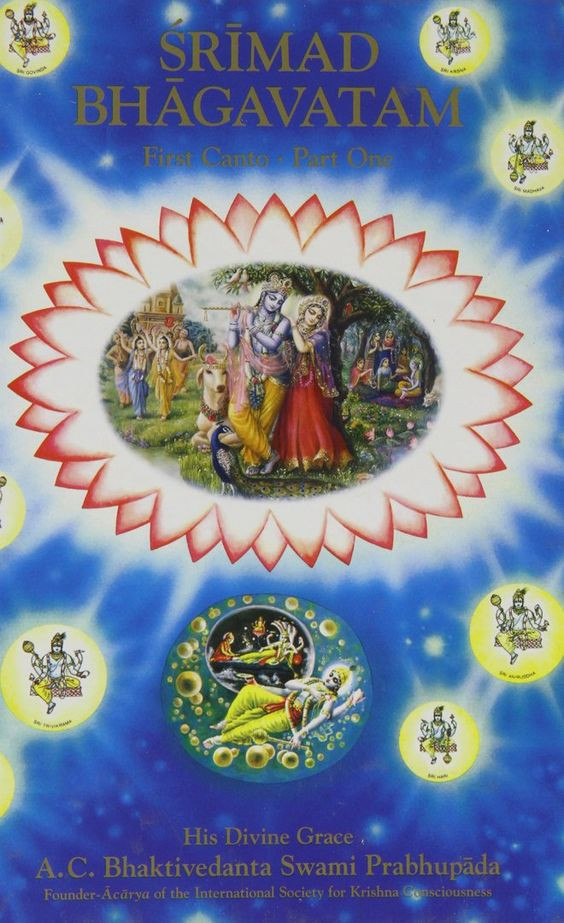 Why to read srimad bhagavatamReading the Srimad Bhagavatam fosters deep spiritual growth by narrating the life and teachings of Lord Krishna,...Read more
 -
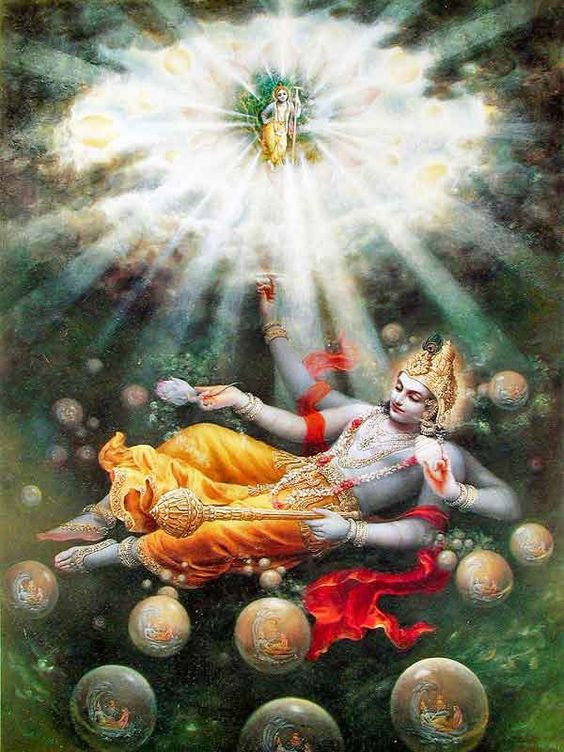 When was srimad bhagavatam written?The Srimad Bhagavatam is believed to have been written around 9th-10th century CE, though its oral traditions date...Read more
 -
 How many chapters are there in srimad bhagavatam?The Srimad Bhagavatam consists of 12 cantos (books) containing 335 chapters in total. Each canto covers various...Read more
 -
 How many skandhas are there in srimad bhagavatamThe Srimad Bhagavatam is divided into 12 skandhas (cantos or books). Each skandha explores different themes,...Read more
 -
 How many slokas in srimad bhagavatamThe Srimad Bhagavatam contains approximately 18,000 shlokas (verses). These verses are spread across its 12 skandhas...Read more
Leave a comment