
Explore Srimad Bhagavatam Canto 11, where Lord Krishna shares His final and most profound teachings with Uddhava on...
Latest posts
-
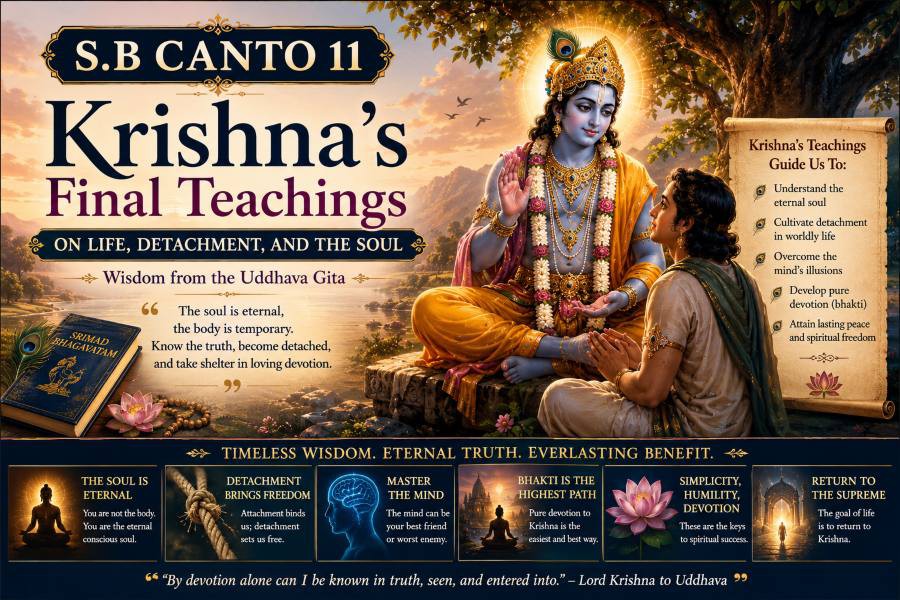 S.B Canto 11 — Krishna’s Final Teachings on Life, Detachment, and the SoulRead more
 -
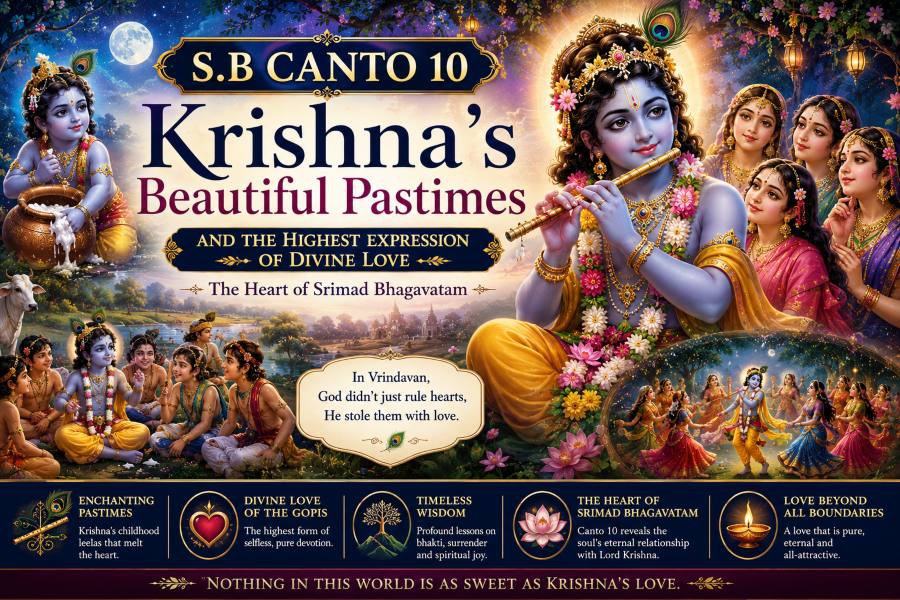 S.B Canto 10 — Krishna’s Beautiful Pastimes and the Highest Expression of Divine LoveRead more
Explore Srimad Bhagavatam Canto 10, the heart of the Bhagavatam, where Lord Krishna's enchanting childhood pastimes,...
-
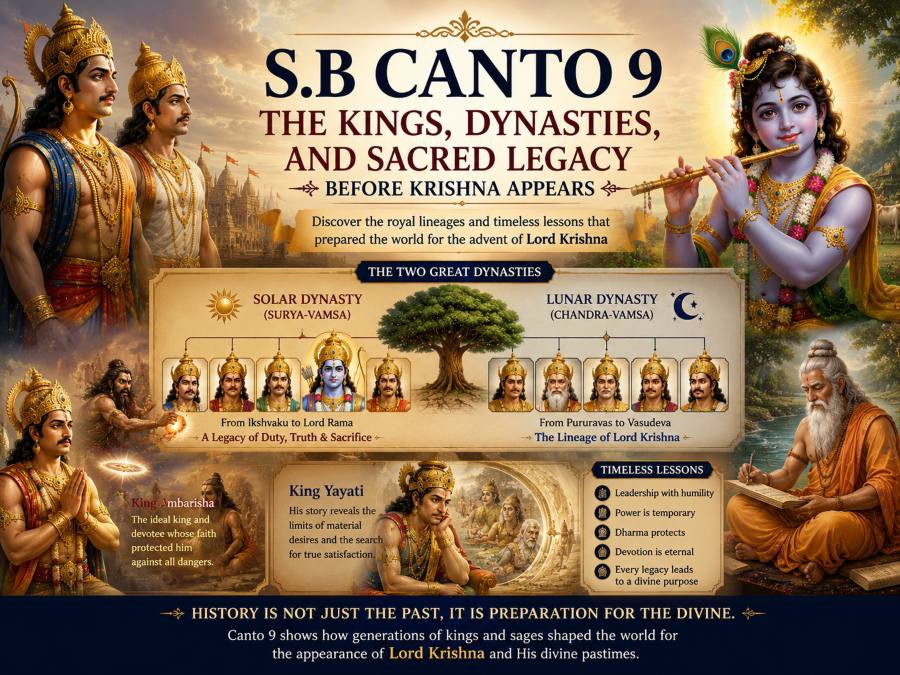 S.B Canto 9: The Kings, Dynasties, and Sacred Legacy Before Krishna AppearsRead more
Explore Srimad Bhagavatam Canto 9 and uncover the remarkable stories of ancient kings, royal dynasties, and sacred...
-
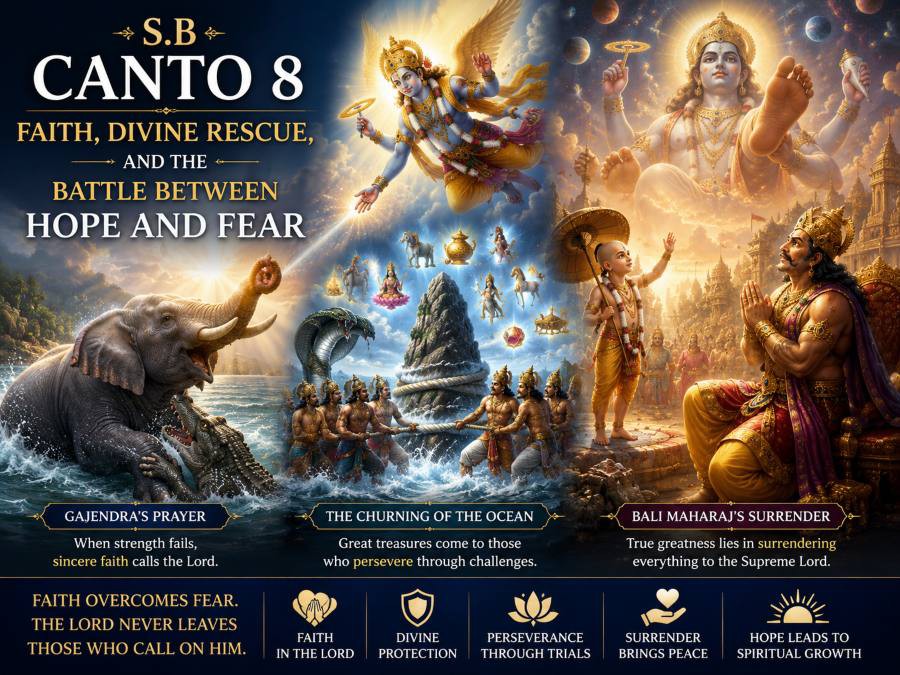 Srimad Bhagavatam Canto 8: How Faith Triumphs Over FearRead more
Explore Srimad Bhagavatam Canto 8, where the inspiring stories of Gajendra, the churning of the Milk Ocean, and Bali...
-
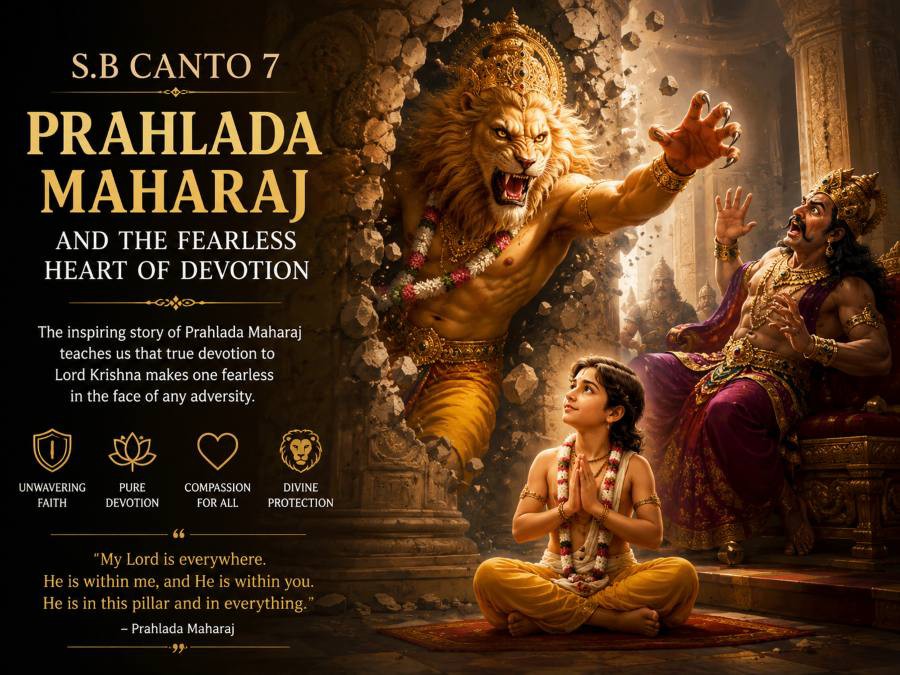 S.B Canto 7: Prahlada Maharaj and the Fearless Heart of DevotionRead more
Explore Srimad Bhagavatam Canto 7 and discover the inspiring story of Prahlada Maharaj, whose unwavering devotion to...
-
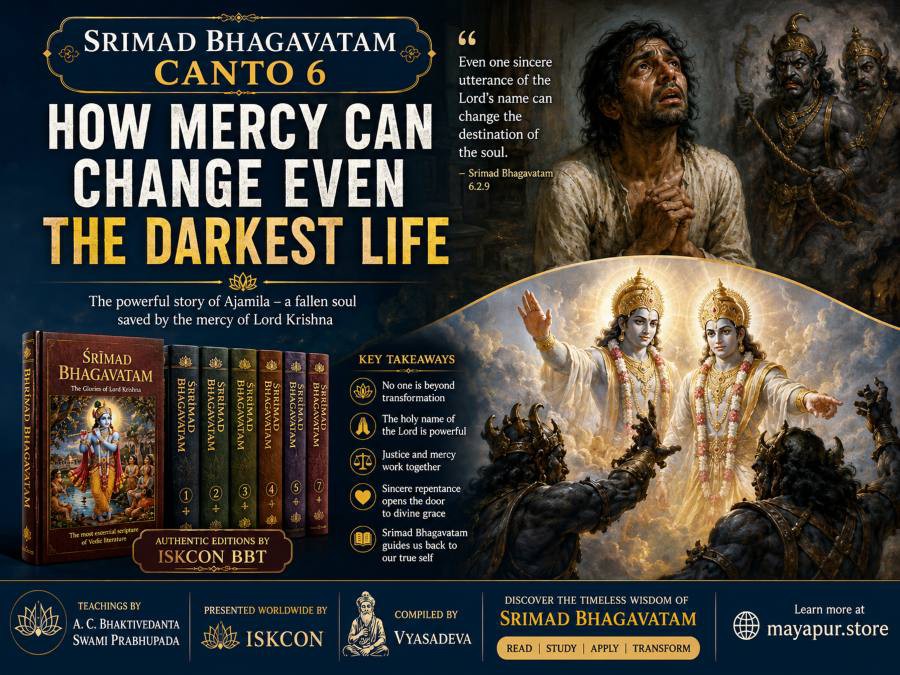 S.B Canto 6: How Mercy Can Change Even the Darkest LifeRead more
Discover the inspiring lessons of Srimad Bhagavatam Canto 6, where the story of Ajamila reveals how divine mercy,...
-
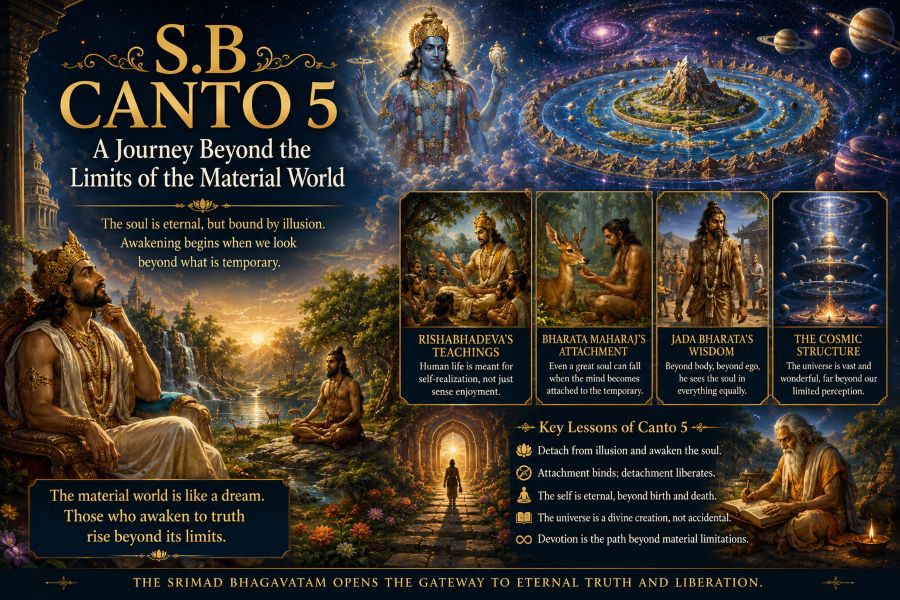 Srimad Bhagavatam Canto 5: A Journey Beyond the Limits of the Material WorldRead more
Discover how Srimad Bhagavatam Canto 5 explores cosmic creation, spiritual awakening, material illusion, and the...
-
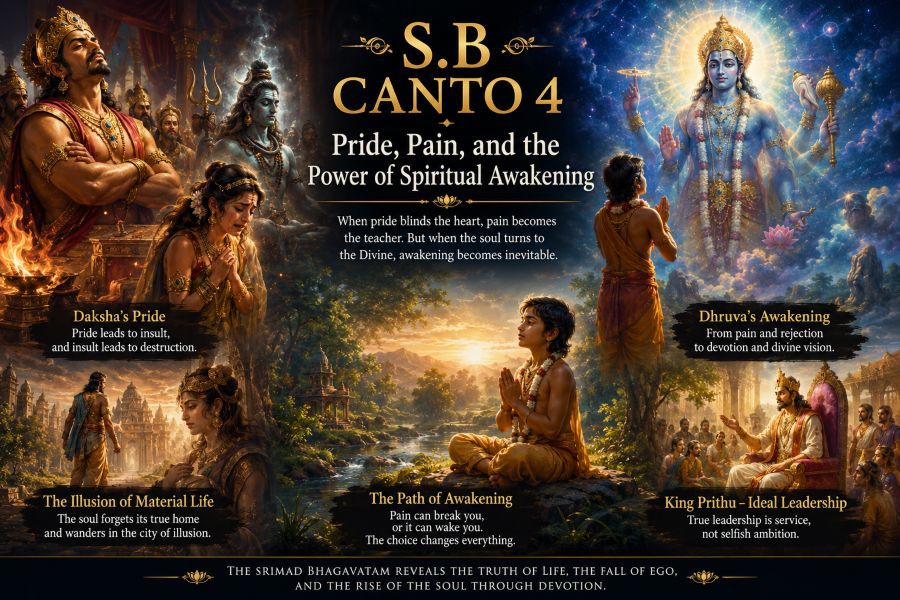 Srimad Bhagavatam Canto 4: The Pain of Pride and the Journey Back to the SoulRead more
Discover how Srimad Bhagavatam Canto 4 explores pride, rejection, devotion, spiritual awakening, and the emotional...
-
 Srimad Bhagavatam Canto 3: The Soul, Creation, and the Forgotten Truth of LifeRead more
Discover how Srimad Bhagavatam Canto 3 explains the soul, creation, consciousness, and the forgotten spiritual truth...
-
 Srimad Bhagavatam Canto 2: Seeing the Universe Through Divine EyesRead more
Discover how Srimad Bhagavatam Canto 2 explains the cosmic form of the Lord, spiritual vision, meditation, creation,...
Blog categories
- Default category (0)
- MUSICAL INSTRUMENT (1)
- BOOK (5)
- DEVOTIONAL GIFT (0)
- Blog (30) click
- CHANDAN (12)
- Bhagavatam Wisdom Series (43)
- Krishna Consciousness (5)
- Mridangam Musical Instrument (6)
- Bhagavad Gita for Beginners (13)
- Bhagavad Gita As It Is (13) click
- Bhagavad Gita As It Is Telugu (0)
- Bhagavad Gita As It Is Marathi (0)
- Bhagavad Gita As It Is In Hindi (0)
- Bhagavad Gita As It Is In English (0)
- Bhagavad Gita As It Is In Bengali (8)
- Bhagavad Gita As It Is In Kannada (0)
- Bhagavad Gita As It Is In Gujarati (0)
- Bhagavad Gita As It Is In Panjabi (0)
- Bhagavad Gita As It Is In Tamil (0)
- Bhagavad Gita As It Is Odia (0)
- BHAGAVAD GITA As It Is GERMAN (0)
- Bhagavad Gita As It Is In French (0)
- Bhagavad Gita As It Is In Nepali (0)
- Bhagavad Gita As It Is In Assamese (0)
- Incense or Agarbatti (6)
- Lord Chaitanya Mahaprabhu (3)
- Vedic Temple Mayapur (16)
- kalki (15)
- Mahabharata – Dharma & Destiny (27)
- Vaishnava Scriptures (4)
- healthy product (4)
- chaitanya mahaprabhu (5)
Search in blog
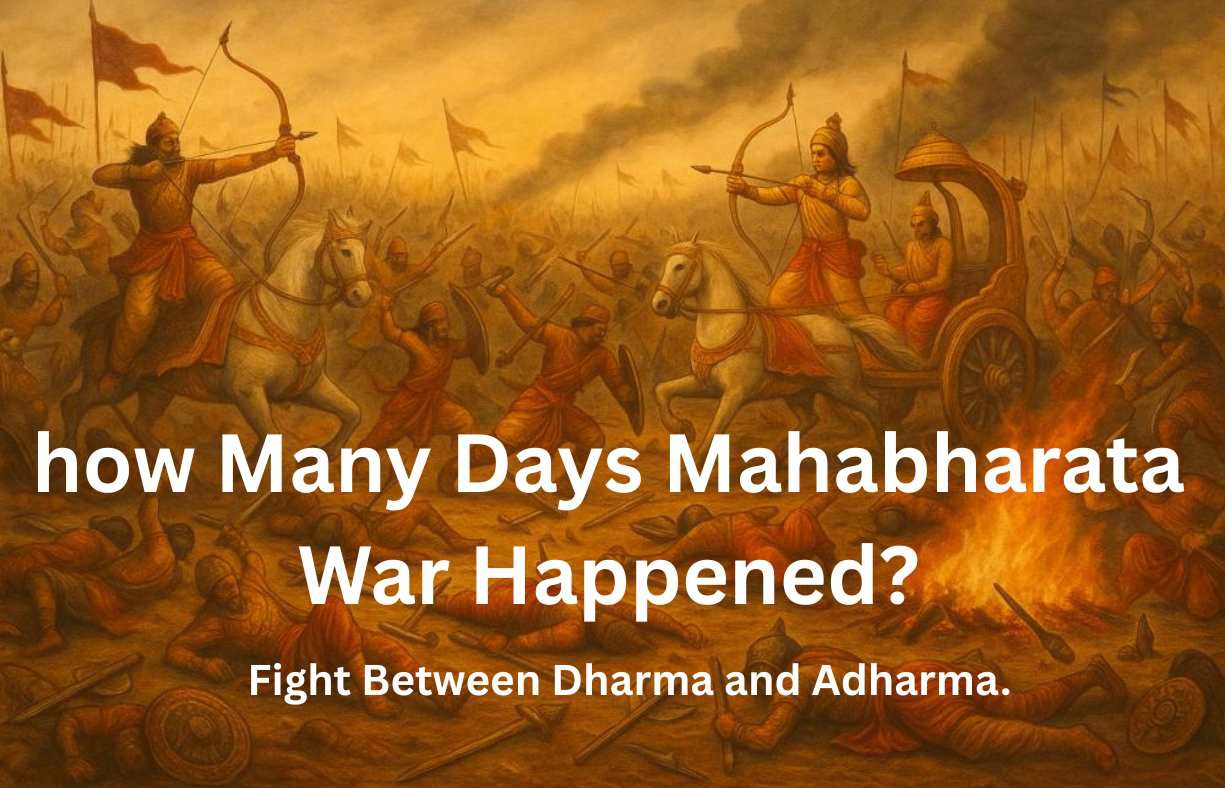
How Many Days Mahabharata War Happened?
How Many Days the Mahabharata War Happened
The Mahabharata is one of the most significant epics in human civilization. The Kurukshetra War, the climax of the Mahabharata, is not just a physical battle—it is a spiritual, political, moral, and cosmic event that shaped the destiny of ancient India and symbolized the eternal fight between dharma and adharma.
One of the most asked questions is:
“How many days did the Mahabharata war last?”
The direct answer is:
The Mahabharata war lasted for 18 days.
But the deeper truth lies in understanding why 18 days, what happened on each day, what made the war so intense, and how these 18 days changed the fate of the world forever.
This article explores:
- The significance of the number 18
- A day-by-day breakdown of the war
- Important deaths and turning points
- Strategies used by both sides
- The spiritual and karmic meaning behind the 18-day duration
Let us dive into a complete, detailed.
Introduction: The Mahabharata War – The Greatest Battle Ever Fought
The Kurukshetra War was the final resolution of decades of rivalry between the Pandavas and the Kauravas. More than 4 million warriors were involved. Kings from across Bharatvarsha joined the battle, making it one of the largest wars ever recorded.
The war was not merely a fight for the throne—it was a cosmic cleansing, a reset to restore dharma.
The war lasted 18 days, but the preparation, politics, and emotions behind it had built up for generations.
Buy the Mahabharata Book from ISKCON Mayapur Store
Why the Mahabharata War Lasted for 18 Days
The number 18 is extremely significant in the Mahabharata:
- The epic has 18 parvas (sections)
- The war lasted 18 days
- There were 18 akshauhinis (army divisions)
- The Bhagavad Gita has 18 chapters
This is not a coincidence.
The number 18 represents the finality of karma, completion of cycles, and the transition between eras. In Vedic numerology:
1 symbolizes the individual soul
8 symbolizes infinity, karma, and cosmic order
Together, 18 = the journey of the soul through karma.
Thus the war lasted 18 days to signify the cleansing of accumulated karma of mankind.
The Armies: 18 Akshauhinis on the Battlefield
The war involved:
- 11 Akshauhinis on the Kaurava side
- 7 Akshauhinis on the Pandava side
Each Akshauhini included:
- 21,870 chariots
- 21,870 elephants
- 65,610 horses
- 109,350 foot soldiers
This created a massive confrontation.
The imbalance—11 vs. 7—shows that quantity does not defeat quality or dharma.
Though the Kauravas had superior numbers, they lacked righteousness.
READ ALSO:-who wrote Mahabharata
Day-by-Day Breakdown of the 18-Day Mahabharata War
Below is the complete detailed analysis of what happened on each of the 18 days.
Day 1: The War Begins
- Bhishma leads the Kaurava army.
- Pandavas suffer heavy losses.
- Arjuna hesitates seeing relatives and teachers — Krishna delivers the Bhagavad Gita.
Day 2: Pandavas Strike Back
- Arjuna and Bhima overpower the Kaurava formations.
- The war becomes more intense.
Day 3: Bhima Begins His Vengeance
- Bhima kills many Kaurava brothers.
- The battlefield becomes frighteningly brutal.
Day 4: Yudhishthira Takes Charge
- The Pandava prince shows leadership.
- Bhishma destroys several Pandava forces.
Day 5: Equal Losses on Both Sides
- The war continues with no clear advantage.
- The ground turns red with blood.
Day 6: Bhishma’s Full Power
- Bhishma uses divine weapons.
- Arjuna suffers under Bhishma’s attack.
Day 7: Kauravas Dominate
- Pandava army weakens.
- Krishna motivates Arjuna to fight with full strength.
Day 8: Bhima’s Rampage
- Bhima kills eight Kaurava brothers in a single day.
- Duryodhana feels insecure.
Day 9: Bhishma’s Indestructible Defense
- Bhishma unleashes terrible destruction.
- Krishna realizes Bhishma must be stopped.
Day 10: Bhishma Falls
- Arjuna, guided by Shikhandi, defeats Bhishma.
- This is a major turning point.
Day 11: Drona Becomes Commander
- Drona takes charge.
- His strategy is sharper and more dangerous.
Day 12: Chakravyuha Attack
- Drona forms the deadly Chakravyuha.
- Arjuna is misled away from the formation.
Day 13: Abhimanyu’s Martyrdom
- Abhimanyu breaks into the Chakravyuha.
- He is trapped and killed brutally by multiple warriors.
- Arjuna vows to kill Jayadratha the next day.
Day 14: Arjuna’s Vow Fulfilled
- The longest day of the war.
- Arjuna kills Jayadratha.
- The Pandavas regain momentum.
Day 15: Drona’s Death
- Drona kills countless warriors.
- Pandavas use strategic deception (“Ashwatthama is dead”).
- Drona loses will and dies.
Day 16: Karna Becomes Commander-in-Chief
- Karna defeats many mighty warriors.
- The rivalry between Arjuna and Karna intensifies.
Day 17: Arjuna Kills Karna
- The most emotional day of the war.
- Karna’s chariot gets stuck due to curse.
- Krishna instructs Arjuna to shoot.
- Karna dies.
Day 18: The Final Destruction
- Shalya becomes commander, but is defeated.
- Bhima kills Duryodhana by breaking his thigh.
- Ashwatthama kills the Pandava sons at night.
- The war ends.
Thus, in 18 days, nearly the entire warrior class of ancient India was destroyed.
Order Mahabharata Directly from ISKCON Mayapur Store
The Significance of the 18 Days
Why did such a massive war end so quickly? Because:
Warriors had divine weapons
Astras and shastras (celestial weapons) caused destruction beyond ordinary battles.
The war was destined to be decisive
Krishna ensured the Pandavas won to restore dharma.
Karma had to be settled rapidly
Generations of karmic debts were burned in these 18 days.
The age (Yuga) was transitioning
The Dvapara Yuga needed to end for Kali Yuga to begin.
Important Deaths During the 18 Days
The war witnessed the fall of:
- Bhishma
- Drona
- Karna
- Abhimanyu
- Ghatotkacha
- Duryodhana
- 100 Kaurava brothers
- Shalya
- Shakuni
- Jayadratha
Nearly all major heroes died.
Aftermath of the 18-Day War
The war left:
- The Kuru dynasty destroyed
- Millions dead
- Civilizations wiped out
- The Pandavas emotionally shattered
Yudhishthira, though victorious, did not celebrate — he was filled with sorrow.
Krishna guided him to rule based on dharma, ensuring the future stability of the kingdom.
READ ALSO:-how many people died in mahabharata
Spiritual Meaning Behind the 18-Day Battle
The war symbolizes the inner conflict of every human:
- Arjuna represents the confused soul
- Krishna represents divine guidance
- The battlefield represents life
- The 18 days represent the battle of karma
- The Pandavas symbolize righteous qualities
- The Kauravas symbolize negative tendencies
Thus the 18-day war is also the battle of the mind and soul.
Why Understanding the 18 Days Matters Today
Studying the Mahabharata war teaches us:
- Dharma always wins
- Ego and greed destroy families
- Silence toward injustice is sinful
- Right guidance (Krishna) can save us
- Life is a battlefield — choices matter
- Destiny unfolds through human action
These lessons remain relevant in modern life.
Conclusion: The Mahabharata War Was an 18-Day Cosmic Turning Point
To summarize:
✔ The Mahabharata war lasted exactly 18 days.
✔ Each day was filled with major events that shaped history.
✔ The number 18 symbolizes the completion of karma.
✔ The war ended the Dvapara Yuga and began the Kali Yuga.
The Kurukshetra War was not just a battle — it was the reset button of humanity, ensuring that dharma would survive even amid chaos.

Posted in: Mahabharata – Dharma & Destiny
Related posts
-
 Who Wrote the Mahabharata? The Complete Story of Sage VyasaA clear explanation of who wrote the Mahabharata, exploring Sage Vyasa’s authorship, the Ganesha narrative, and the...Read more
 -
 How Many People Died in the Mahabharata? Complete Death Count ExplainedA detailed explanation of how many people died in the Mahabharata, including the Kurukshetra War death count, major...Read more
 -
 Why the Mahabharata Happened: The True Causes Behind the Great WarDiscover the real causes of the Mahabharata war, from jealousy and power struggles to deep karmic destiny. This...Read more
 -
 Who Is Vidura in the Mahabharata? Complete Story, Role & TeachingsDiscover who Vidura is in the Mahabharata—his origin, character, wisdom, loyalty, and unmatched adherence to dharma....Read more
 -
 Who Is Subhadra in the Mahabharata? Complete Story, Role & ImportanceThis article explains who Subhadra is in the Mahabharata—her lineage, virtues, role as Krishna’s sister, her...Read more
Leave a comment