
Explore Srimad Bhagavatam Canto 11, where Lord Krishna shares His final and most profound teachings with Uddhava on...
Latest posts
-
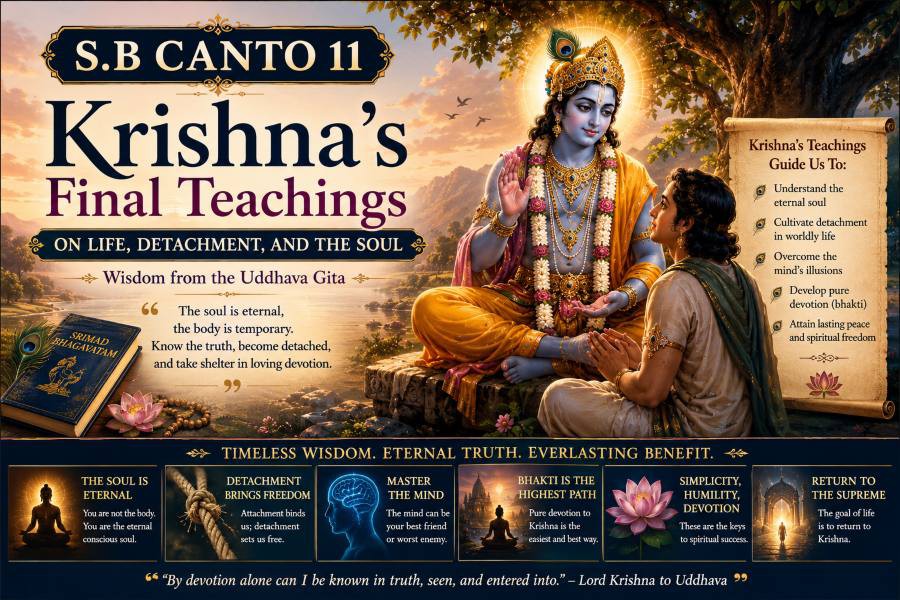 S.B Canto 11 — Krishna’s Final Teachings on Life, Detachment, and the SoulRead more
 -
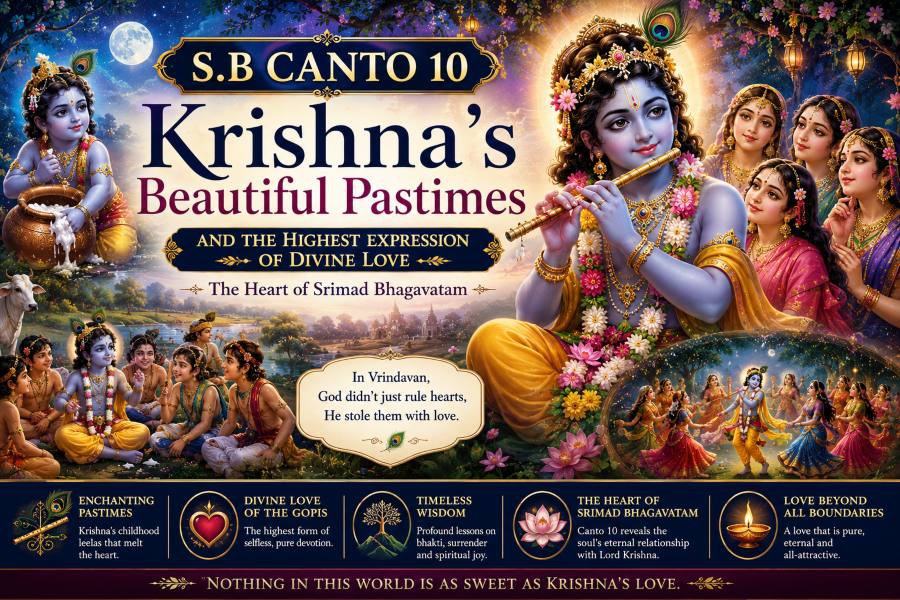 S.B Canto 10 — Krishna’s Beautiful Pastimes and the Highest Expression of Divine LoveRead more
Explore Srimad Bhagavatam Canto 10, the heart of the Bhagavatam, where Lord Krishna's enchanting childhood pastimes,...
-
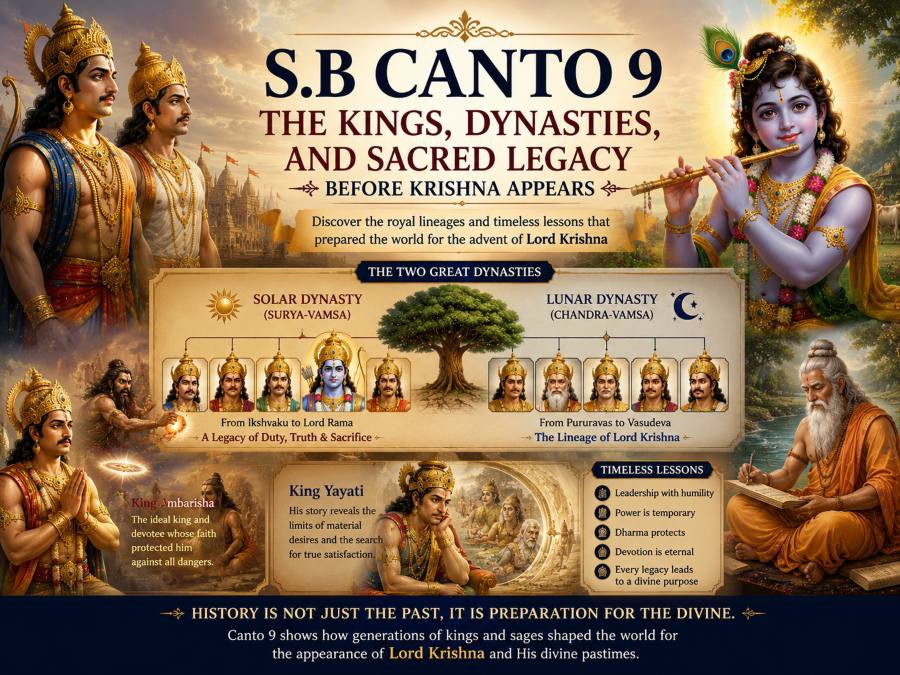 S.B Canto 9: The Kings, Dynasties, and Sacred Legacy Before Krishna AppearsRead more
Explore Srimad Bhagavatam Canto 9 and uncover the remarkable stories of ancient kings, royal dynasties, and sacred...
-
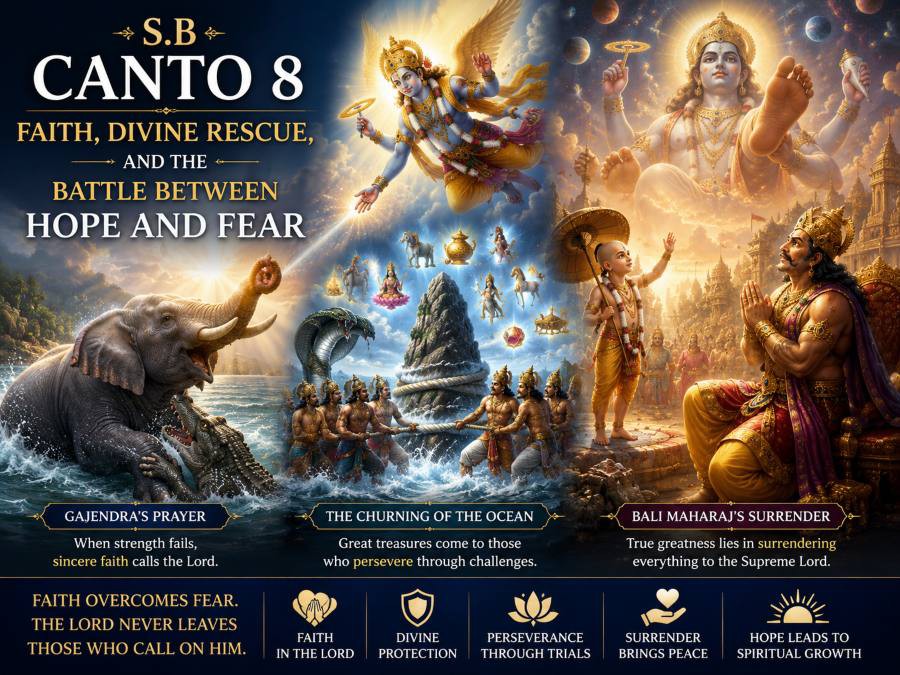 Srimad Bhagavatam Canto 8: How Faith Triumphs Over FearRead more
Explore Srimad Bhagavatam Canto 8, where the inspiring stories of Gajendra, the churning of the Milk Ocean, and Bali...
-
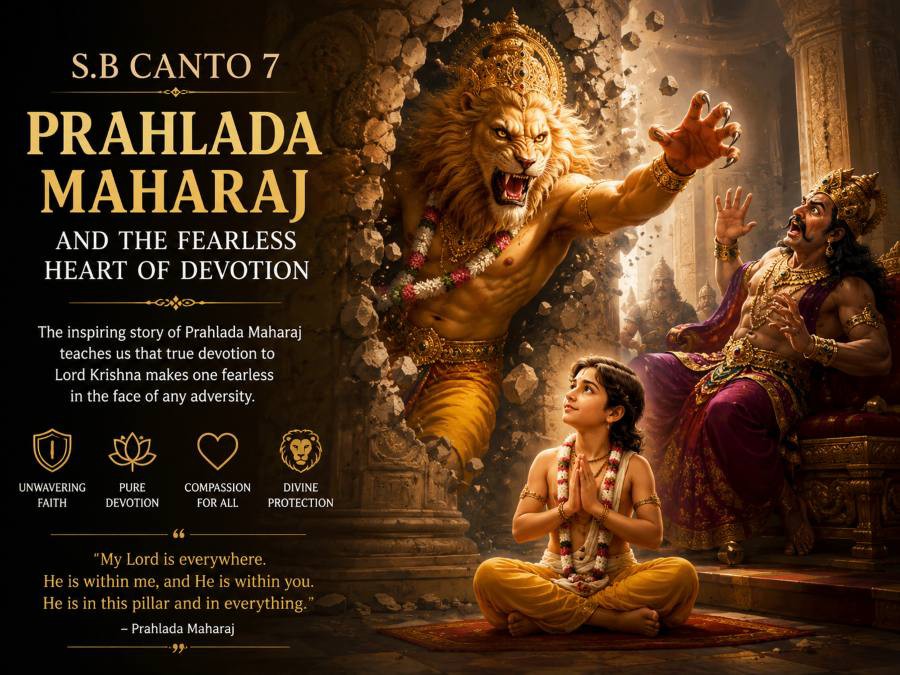 S.B Canto 7: Prahlada Maharaj and the Fearless Heart of DevotionRead more
Explore Srimad Bhagavatam Canto 7 and discover the inspiring story of Prahlada Maharaj, whose unwavering devotion to...
-
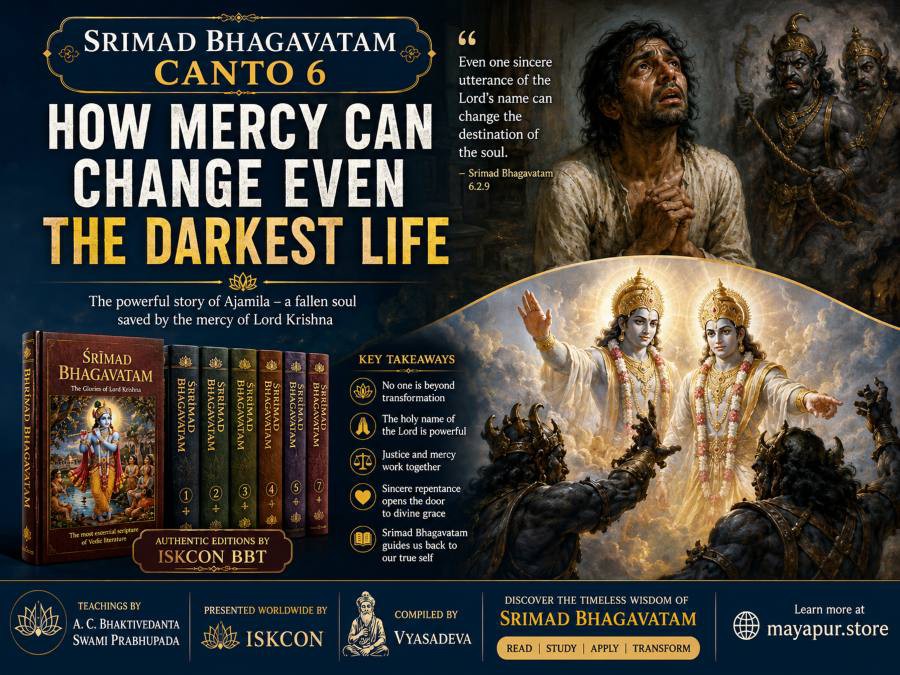 S.B Canto 6: How Mercy Can Change Even the Darkest LifeRead more
Discover the inspiring lessons of Srimad Bhagavatam Canto 6, where the story of Ajamila reveals how divine mercy,...
-
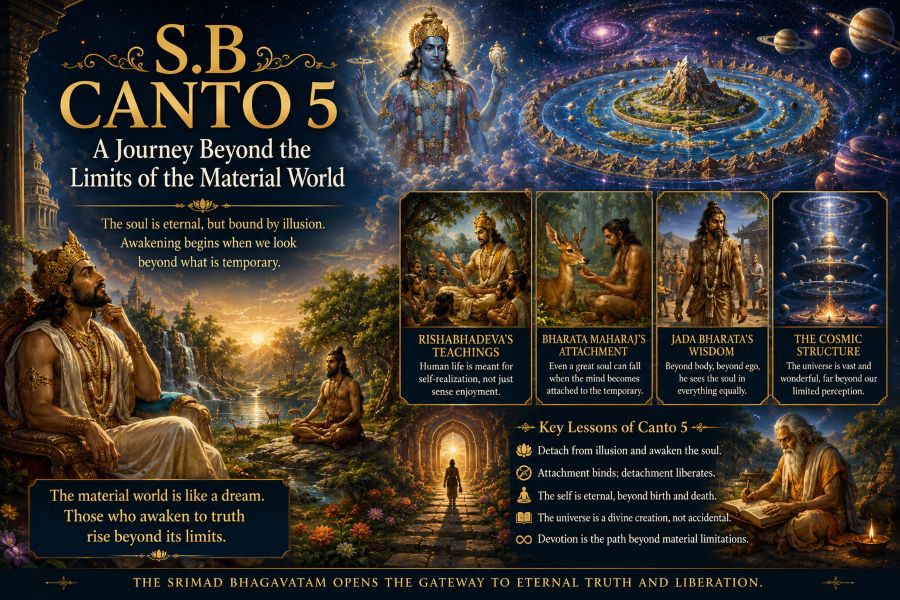 Srimad Bhagavatam Canto 5: A Journey Beyond the Limits of the Material WorldRead more
Discover how Srimad Bhagavatam Canto 5 explores cosmic creation, spiritual awakening, material illusion, and the...
-
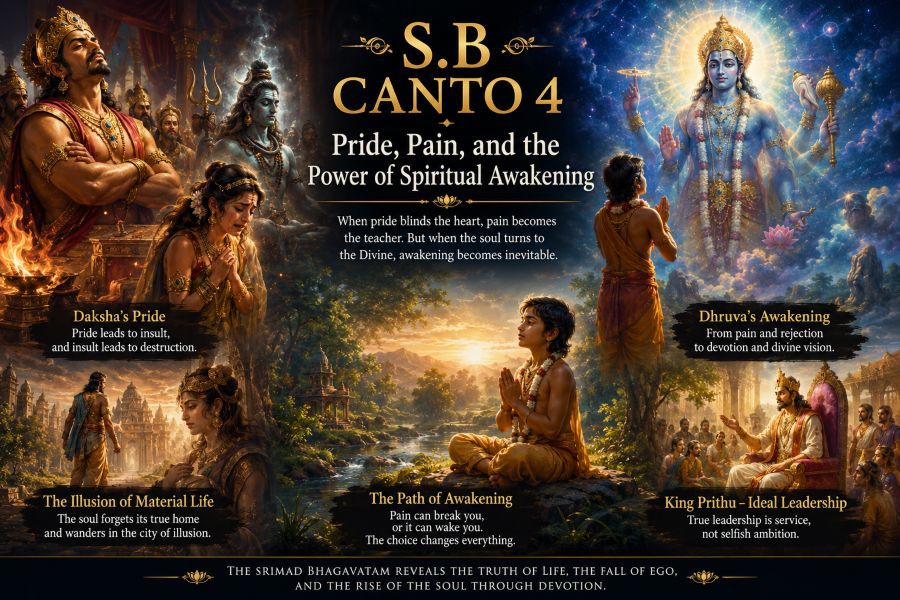 Srimad Bhagavatam Canto 4: The Pain of Pride and the Journey Back to the SoulRead more
Discover how Srimad Bhagavatam Canto 4 explores pride, rejection, devotion, spiritual awakening, and the emotional...
-
 Srimad Bhagavatam Canto 3: The Soul, Creation, and the Forgotten Truth of LifeRead more
Discover how Srimad Bhagavatam Canto 3 explains the soul, creation, consciousness, and the forgotten spiritual truth...
-
 Srimad Bhagavatam Canto 2: Seeing the Universe Through Divine EyesRead more
Discover how Srimad Bhagavatam Canto 2 explains the cosmic form of the Lord, spiritual vision, meditation, creation,...
Blog categories
- Default category (0)
- MUSICAL INSTRUMENT (1)
- BOOK (5)
- DEVOTIONAL GIFT (0)
- Blog (30) click
- CHANDAN (12)
- Bhagavatam Wisdom Series (43)
- Krishna Consciousness (5)
- Mridangam Musical Instrument (6)
- Bhagavad Gita for Beginners (13)
- Bhagavad Gita As It Is (13) click
- Bhagavad Gita As It Is Telugu (0)
- Bhagavad Gita As It Is Marathi (0)
- Bhagavad Gita As It Is In Hindi (0)
- Bhagavad Gita As It Is In English (0)
- Bhagavad Gita As It Is In Bengali (8)
- Bhagavad Gita As It Is In Kannada (0)
- Bhagavad Gita As It Is In Gujarati (0)
- Bhagavad Gita As It Is In Panjabi (0)
- Bhagavad Gita As It Is In Tamil (0)
- Bhagavad Gita As It Is Odia (0)
- BHAGAVAD GITA As It Is GERMAN (0)
- Bhagavad Gita As It Is In French (0)
- Bhagavad Gita As It Is In Nepali (0)
- Bhagavad Gita As It Is In Assamese (0)
- Incense or Agarbatti (6)
- Lord Chaitanya Mahaprabhu (3)
- Vedic Temple Mayapur (16)
- kalki (15)
- Mahabharata – Dharma & Destiny (27)
- Vaishnava Scriptures (4)
- healthy product (4)
- chaitanya mahaprabhu (5)
Search in blog
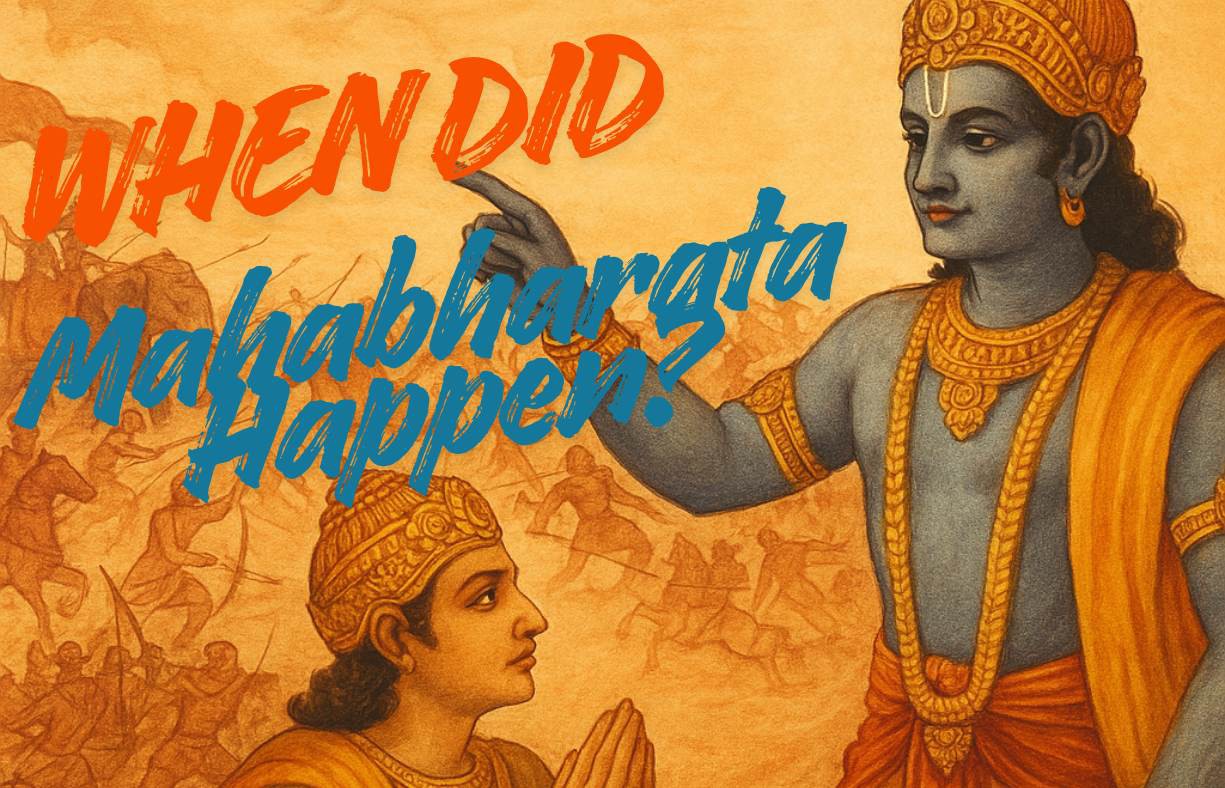
When Did the Mahabharata Happen? Exact Timeline, Evidence & Historical Analysis
When Did the Mahabharata Happen? A Comprehensive Historical, Astronomical & Archaeological Analysis
Introduction
Few questions in Indian history have sparked as much curiosity, debate, and scholarly investigation as “When did the Mahabharata happen?” The Mahabharata is not only a sacred epic but also a monumental cultural text that shaped Indian civilization, ethics, politics, and spiritual perspectives. While modern historians often categorize it as mythology, thousands of traditional scholars, astronomers, and archaeologists have put forth compelling evidence that the events described in the Mahabharata may indeed have a historical foundation.
Determining the exact date of the Mahabharata is challenging because the epic has been transmitted through oral tradition for centuries before being written down. However, astronomical references, genealogical records, archaeological findings, linguistic studies, and cultural anthropology together form a fascinating timeline that allows scholars to approximate when the Mahabharata war took place.
This article provides a complete, research-based, SEO-optimized exploration of the possible dates of the Mahabharata war, analyzing evidence from multiple disciplines while presenting the information in a simple, reader-friendly format.
READ ALSO:-Who wrote mahabharata
Chapter 1: Why Dating the Mahabharata Is Difficult
Dating the Mahabharata is not a straightforward process for several reasons:
Oral Transmission
For thousands of years, the Mahabharata was passed down through oral storytelling traditions. It evolved gradually as sages, poets, and rishis added philosophical expansions such as the Bhagavad Gita and Shanti Parva.
Lack of Contemporary Written Records
Unlike modern histories, there were no timestamped documents during the epic era. Ancient Indian calendars differed from region to region, making conversion into modern dates complicated.
Mythological & Symbolic Layers
The Mahabharata mixes:
- Historical events
- Spiritual symbolism
- Cosmic allegories
- Moral teachings
This blend often confuses traditional historians who seek strictly factual records.
Multiple Astronomical Interpretations
Different researchers interpret the astronomical verses differently, resulting in varied dates.
Despite these challenges, the Mahabharata contains enough genealogical, astronomical, and geographical markers to attempt a scientific dating.
Shop Authentic Mahabharata Book – ISKCON Mayapur Store
Chapter 2: Genealogical Evidence of the Mahabharata Timeline
Ancient Indian texts like the Puranas mention royal lineages in great detail. If we count the generations from the Kurukshetra war to historical kings such as Mahapadma Nanda, we get an approximate timeline.
- On average, traditional genealogies suggest about 90–120 generations from the Kurukshetra war to the Mauryan period (around 320 BCE).
- Using an average of 25 years per generation, this places the Mahabharata war between 3100 BCE and 1500 BCE.
Many historians dismiss extremely ancient dates (before 3000 BCE), but genealogical records consistently point toward a time far earlier than the commonly assumed 1000 BCE.
Chapter 3: Astronomical Evidence — The Most Powerful Dating Tool
The Mahabharata contains over 150 astronomical references, including planetary alignments, eclipses, and star positions. Modern astronomy allows us to calculate when such configurations occurred.
Here are some key astronomical clues from the text:
Krishna leaving Mathura & planetary alignments
Several verses describe Saturn, Jupiter, Mars, and lunar eclipses occurring simultaneously or in close succession.
Bhishma’s death timing
Bhishma waited for Uttarayana, the sun’s northward movement, which occurs around January 14 every year.
The position of planets during the war
The text describes:
- Saturn in Rohini
- Mars retrograde near Jyeshta
- Solar eclipse followed by a lunar eclipse within 13 days
Astronomers have used these markers to calculate possible dates:
Researcher
| Proposed Date
| Method
|
Dr. P.V. Vartak | 5561 BCE | Astronomical references |
Dr. Narahari Achar | 3067 BCE | Planetarium software |
S.R. Rao (Marine archaeologist) | 1500–1700 BCE | Archaeology of Dwarka |
B.G. Tilak | 3100 BCE | Astronomical calculations |
ISRO scientist Achar | 1478 BCE | Revised alignments |
Among these, the most widely accepted dates fall between 3100 BCE and 1500 BCE, with 3067 BCE and 5561 BCE attracting the most attention.
Chapter 4: Archaeological Evidence — What Excavations Tell Us
Archaeology plays a crucial role in dating the Mahabharata events. Some major discoveries include:
Ruins of Dwarka
Marine archaeology off the coast of Gujarat by the National Institute of Oceanography uncovered submerged cities with:
- Stone structures
- Anchors
- Pillars
- Harbors
These structures date back to between 1500 BCE and 3000 BCE, matching descriptions of Krishna’s Dwarka.
Hastinapura Excavation
Excavations at present-day Hastinapur found:
- Layers of settlement destruction caused by floods
- Signs of abandonment
This aligns with the Puranic story of Ganga flooding Hastinapura after the war.
Kurukshetra Region Finds
Archaeologists discovered:
- Painted Grey Ware (PGW) pottery
- Weapons
- Settlement patterns matching descriptions
PGW culture dates between 1200–800 BCE, but many scholars argue that the war itself may have happened earlier, with pottery cultures representing later habitation.
Order Mahabharata Books Today – ISKCON Mayapur Store
Chapter 5: Linguistic Evidence
The language used in the earliest layers of the Mahabharata resembles Vedic Sanskrit, which is older than classical Sanskrit. Linguists agree that:
- The earliest parts of the Mahabharata were composed between 1500 BCE and 1000 BCE.
- However, these compositions may reflect memories of events that took place centuries earlier.
This supports the idea that the war predates the written text.
Chapter 6: Cultural & Anthropological Evidence
The Mahabharata describes:
- Chariots, not horses on saddles
- Iron weapons, but limited usage
- Social systems of kings, rishis, and Vedic rituals
Anthropologists associate these features with societies between 2000–1400 BCE.
Chapter 7: Possible Dates of the Mahabharata War (All Theories)
THEORY 1: Around 5561 BCE
Based on extensive astronomical events described in the epic.
THEORY 2: Around 3139–3067 BCE
One of the most widely supported timelines among traditional scholars and many astronomers.
THEORY 3: Around 2000–1500 BCE
Supported by archaeological and anthropological findings (Dwarka, PGW, iron usage).
THEORY 4: Around 1000–900 BCE
Favored by modern historians who treat the epic as mostly mythological.
Chapter 8: Which Date Is Most Accurate?
Combining astronomy, archaeology, and genealogy, the most balanced conclusion places the Mahabharata around:
3000–1500 BCE
With the strongest support for 3067 BCE (astronomy) and 1700–1500 BCE (archaeology).
The earlier date (3067 BCE) aligns perfectly with:
- Eclipses
- Planetary alignments
- Seasonal references
- Generational timelines
Hence, many scholars believe the war happened more than 5,000 years ago, around 3100–3000 BCE.
READ ALSO:-how many people died in mahabharata
Chapter 9: Impact of the Mahabharata Regardless of Its Date
Even if the exact date is debated, the Mahabharata’s influence is undeniable:
- It shaped Indian philosophy, ethics, and governance.
- It introduced timeless teachings like the Bhagavad Gita.
- It established core concepts of dharma, karma, and duty.
- It provided historical geography of ancient India through places like Kurukshetra, Dwarka, Hastinapur, and Indraprastha.
Its relevance continues across:
- Politics
- Spirituality
- Literature
- Psychology
- Warfare studies
The epic is therefore both timeless literature and valuable historical memory.
Conclusion
So, when did the Mahabharata happen?
While there is no single universally accepted date, strong multidisciplinary evidence suggests that the Mahabharata war occurred:
Between 3000 BCE and 1500 BCE
With 3067 BCE being one of the most compelling dates based on astronomy.
Whether viewed as history, mythology, or a blend of both, the Mahabharata remains one of humanity’s greatest epics—rich with wisdom, cultural heritage, and a grand narrative of dharma versus adharma. Dating the Mahabharata is not just a search for chronology; it is a quest to understand India’s ancient worldview and civilizational roots.

Posted in: Mahabharata – Dharma & Destiny
Related posts
-
 Who Wrote the Mahabharata? The Complete Story of Sage VyasaA clear explanation of who wrote the Mahabharata, exploring Sage Vyasa’s authorship, the Ganesha narrative, and the...Read more
 -
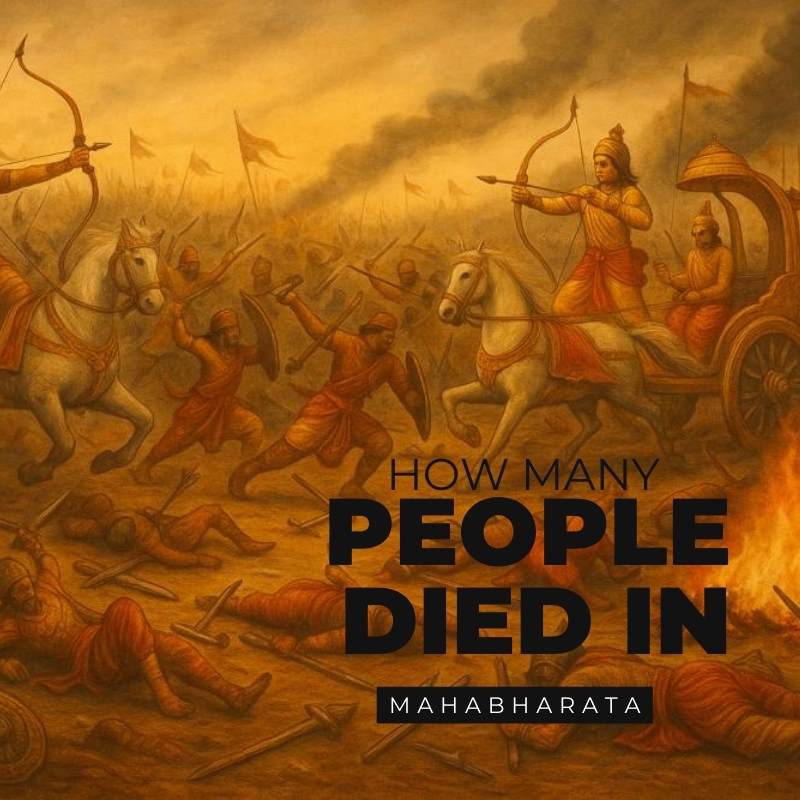 How Many People Died in the Mahabharata? Complete Death Count ExplainedA detailed explanation of how many people died in the Mahabharata, including the Kurukshetra War death count, major...Read more
 -
 Why the Mahabharata Happened: The True Causes Behind the Great WarDiscover the real causes of the Mahabharata war, from jealousy and power struggles to deep karmic destiny. This...Read more
 -
 How Many Days Mahabharata War Happened?The Mahabharata war lasted for 18 intense days, each filled with major battles, turning points, and historic events....Read more
 -
 Who Is Vidura in the Mahabharata? Complete Story, Role & TeachingsDiscover who Vidura is in the Mahabharata—his origin, character, wisdom, loyalty, and unmatched adherence to dharma....Read more
Leave a comment