
Why did Krishna run to embrace a poor brahmin in rags? Read the Sudama story from the Bhagavatam and learn how a...
Latest posts
-
 Krishna and Sudama: The Poor Brahmin Who Became Wealthy in LoveRead more
 -
 Vamana Avatar: How Three Steps Humbled Bali MaharajaRead more
Why did a powerful king give away three worlds to a boy asking for three steps? Learn the Vamana avatar story from...
-
 The Bhagavatam on Marriage: Duty, Love and Spiritual PartnershipRead more
What does the Bhagavatam say about marriage? Through the stories of Kardama and Devahuti, Rukmini's secret letter and...
-
 What Is Prema? The Bhagavatam's Highest Stage of Love for GodRead more
Prema is love for God with no "because" attached. Learn how the Bhagavatam describes it, the nine steps from faith to...
-
 Is Shiva Parvati Kalyana Mentioned in Srimad Bhagavatam? What the Scripture Really SaysRead more
Looking for Shiva and Parvati's wedding in the Srimad Bhagavatam? Find out what the scripture actually describes,...
-
 How Many Modes of Devotion Are Mentioned in Bhagavatam?Read more
A young boy named Prahlada listed nine ways to serve God, and the Bhagavatam keeps them as its answer. Learn what the...
-
 What Is Bhagavatam and Why Has It Been Read for 5,000 Years?Read more
A dying king asked one question, and the answer became the Bhagavatam. Learn what this Sanskrit scripture contains,...
-
 Who Is Lord Krishna? His Meaning, Teachings and Pastimes ExplainedRead more
Discover who Krishna is according to Srimad Bhagavatam, including His divine identity, childhood pastimes, teachings,...
-
 Incense in Islam: Bakhoor, Agarbatti and What Tradition SaysRead more
Is burning fragrance part of Muslim tradition? Explore incense in Islam, from the Prophetic practice of fumigating...
-
 History of Agarbatti: From Vedic Dhupa to Modern Incense SticksRead more
Where did agarbatti really come from? Follow the history of agarbatti from Vedic fire rituals and temple dhupa to...
Blog categories
- Default category (0)
- MUSICAL INSTRUMENT (1)
- BOOK (5)
- DEVOTIONAL GIFT (0)
- Blog (30) click
- CHANDAN (12)
- Bhagavatam Wisdom Series (68)
- Krishna Consciousness (14)
- Mridangam Musical Instrument (6)
- Bhagavad Gita for Beginners (13)
- Bhagavad Gita As It Is (37) click
- Bhagavad Gita As It Is Telugu (0)
- Bhagavad Gita As It Is Marathi (0)
- Bhagavad Gita As It Is In Hindi (0)
- Bhagavad Gita As It Is In English (0)
- Bhagavad Gita As It Is In Bengali (8)
- Bhagavad Gita As It Is In Kannada (0)
- Bhagavad Gita As It Is In Gujarati (0)
- Bhagavad Gita As It Is In Panjabi (0)
- Bhagavad Gita As It Is In Tamil (0)
- Bhagavad Gita As It Is Odia (0)
- BHAGAVAD GITA As It Is GERMAN (0)
- Bhagavad Gita As It Is In French (0)
- Bhagavad Gita As It Is In Nepali (0)
- Bhagavad Gita As It Is In Assamese (0)
- Incense or Agarbatti (38)
- Lord Chaitanya Mahaprabhu (3)
- Vedic Temple Mayapur (14)
- kalki (15)
- Mahabharata – Dharma & Destiny (27)
- Vaishnava Scriptures (4)
- healthy product (4)
- chaitanya mahaprabhu (5)
- Tulsi Mala Guide (17)
Search in blog
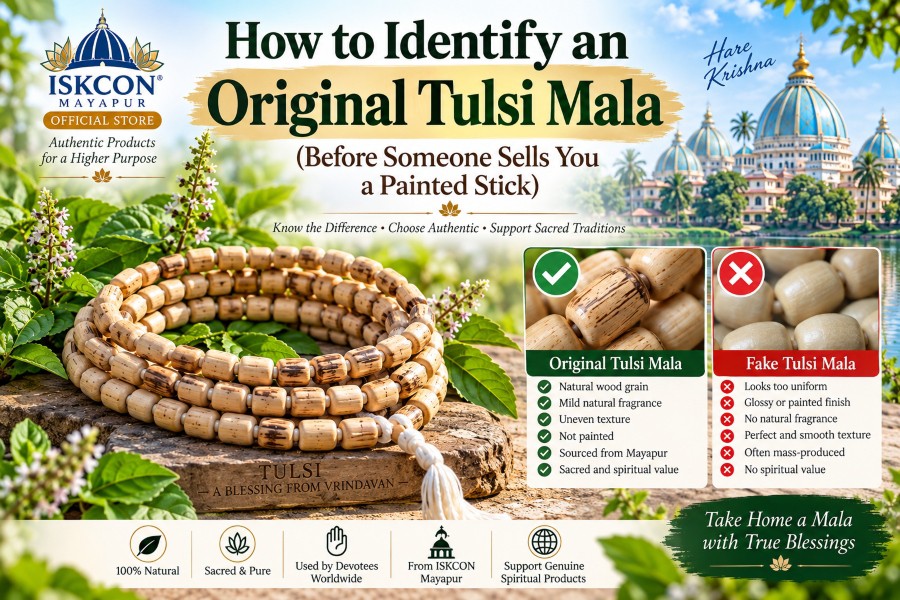
How to Identify an Original Tulsi Mala (Before Someone Sells You a Painted Stick)
How to Tell a Real Tulsi Mala From a Fake One
Hold two malas side by side—one genuine tulsi wood, one a clever fake—and most people genuinely can't tell the difference. Not because they're careless. Because the fakes have gotten good, and the sellers pushing them have gotten better at sounding confident.
That confidence is the problem. A seller who's never held real tulsi wood will still tell you, with a completely straight face, that what's in their hand is "100% pure." They're not necessarily lying. They might just not know either. Somewhere down a long, murky supply chain, a batch of dyed wood or resin beads got labeled tulsi, and nobody along the way had the knowledge to catch it.
If you're shopping for a Tulsi Mala, especially online, you're not just choosing a product. You're trying to verify a claim; you have no easy way to check. This article walks through the actual physical tests that work—the ones devotees and temple communities have used for generations, long before online shopping existed. Once you know what to look for, spotting a fake gets a lot easier, whether you're buying from ISKCON Mayapur's Tulsi Mala collection or anywhere else.
Why This Even Needs to Be Said
Tulsi wood has a problem that most fake goods don't: it looks unremarkable. There's no obvious sparkle, no dramatic grain pattern, and nothing that jumps out and says "this is special." It's pale, plain, and light. Which, ironically, makes it easy to fake—a manufacturer doesn't need to replicate something visually complex. They just need something roughly the same color and shape, and most buyers will never know the difference.
Compare that to something like rudraksha, where the mukhi lines (the natural ridges on the seed) are hard to convincingly fake at scale. Tulsi beads don't have that kind of built-in security feature. What they have instead is a set of subtler physical characteristics—weight, smell, grain, and how the material behaves over time. None of these show up in a product photo. All of them show up the moment you hold the real thing.
The Weight Test: The One Thing Fakes Almost Always Get Wrong
Pick up a genuine tulsi mala, and the first thing you'll notice is how little it weighs. Tulsi wood is one of the lightest materials used in devotional bead-making—genuinely, almost startlingly light, especially for something that looks solid.
Fakes usually fail here first. Resin, plastic, and dyed hardwoods are all denser than tulsi. A mala that feels even slightly substantial in your palm, heavier than you'd expect from its size, is probably not what it claims to be. This is one of the easiest tests to do, and it's also one sellers can't fake in a photo—weight only reveals itself in your hand.
A quick way to calibrate this: if you've ever held a genuine one, even briefly, your hand remembers. If you haven't, ask anyone at a temple or a Vaishnava community to let you hold theirs for ten seconds. That's often enough to recognize the difference the next time.
What Your Nose Knows That Your Eyes Don't
Rub a tulsi bead between your palms for a few seconds, generating a little warmth and friction, then smell it. Genuine tulsi wood gives off a faint, dry, slightly herbal scent—not sweet, not perfumed, just a subtle woody note that's distinctly plant-based.
Dyed or synthetic beads tend to go one of two ways. Either they smell like nothing at all, or they carry a chemical, slightly sweet, artificial scent—sometimes a giveaway perfume added specifically to make fakes smell "natural." A strong, overpowering fragrance on a mala is almost always a red flag, not a feature. Real tulsi doesn't need help smelling like tulsi.
The Colour Story: Read the Bead Like a Weather Pattern
Genuine tulsi wood isn't uniform. That's actually the whole point.
Look closely at a real strand, and you'll see:
- Pale cream to light tan base color, sometimes drifting toward a soft grey
- Occasional darker streaks or patches, where the grain runs differently
- Small natural imperfections—a slightly rough patch, a faint knot, an edge that isn't perfectly smooth
Now compare that to a uniformly dark brown mala, where every single bead is the exact same shade with a slight shine to it. That consistency is the tell. Wood doesn't naturally come out that clean across dozens of beads cut from the same plant. When you see that kind of factory-perfect uniformity, you're very likely looking at a dyed or stained substitute, not tulsi.
A simple physical test: rub a slightly damp white cloth firmly along a few beads. If any color transfers onto the cloth, the beads have been dyed. Real tulsi wood's natural color won't rub off, because it isn't sitting on the surface—it's the wood itself.
Grain, Texture, and the Beauty of Imperfection
Real tulsi beads are hand-cut, almost always, and that shows. Run your finger along a genuine strand, and you'll feel:
- Slight size variation from bead to bead—no two are perfectly identical
- Fine natural grain lines running along each bead's surface
- Occasional small nicks or rough spots near where beads were cut or drilled
None of this is a flaw. It's evidence. A strand where every bead is mechanically identical in size, shape, and surface—glossy, smooth, machine-perfect—is a strand that almost certainly wasn't made from tulsi wood at all, since tulsi isn't commonly processed that way at a commercial scale.
This is counterintuitive for a lot of first-time buyers, who assume "perfect" means "high quality." With tulsi, it's often the opposite. The mala that looks a little rough around the edges is usually the honest one.
The Water Test (For When You're Genuinely Unsure)
If you've already got the mala in hand and still aren't confident, there's one more test worth trying, though it requires a little patience.
Soak a single bead—ideally one that isn't part of a mala you're currently wearing or a spare from a strand—in water for several hours. Genuine tulsi wood, being porous and light, will absorb some water and may soften very slightly at the surface, occasionally releasing a faint earthy scent as it does.
Dense synthetic or resin beads won't absorb water in any meaningful way. Dyed hardwood beads may start to release color into the water, turning it faintly tinted. This test isn't something you'd do before buying—it's more useful after the fact if you're trying to confirm what you already have or settle a dispute with a seller.
Where the Fakes Actually Come From
It helps to understand why this problem exists at all. Nobody wakes up planning to sell fake tulsi beads specifically—usually, it's one of a few things happening:
- Wholesale mislabeling. A supplier buys generic pale wood beads in bulk from a general craft manufacturer and rebrands them as tulsi, either through ignorance or convenience.
- Deliberate dyeing. Cheaper, darker woods get stained to approximate tulsi's pale color, since the raw material costs less.
- Resin casting. Some fakes aren't wood at all—they're molded resin, shaped and colored to mimic the look of hand-cut beads, then sold at a price point that should honestly raise suspicion on its own.
None of these sellers are necessarily malicious in every case. Some genuinely believe their supplier's claims. But that doesn't help you, the buyer, who's stuck holding something that isn't what it was sold as, sometimes for religious use where authenticity genuinely matters.
A Fast Checklist for When You're Standing at a Market Stall
If you don't have time for a full inspection, run through this shortlist:
1. Pick it up. Does it feel almost weightless? Good sign.
2. Rub it between your palms and smell it. Faint, dry, herbal? Good sign. Sweet or chemical? Bad sign.
3. Look closely at color consistency. Natural variation across beads? Good sign. Uniform glossy brown? Bad sign.
4. Feel the surface. Slight roughness, visible grain, minor size differences? Good sign. Machine-smooth and identical? Bad sign.
5. Check the price against the effort. A hand-cut, small-batch material shouldn't be priced like a mass-produced trinket.
No single point here is a guaranteed verdict on its own. But if a mala fails three or four of these at once, trust that pattern over any verbal reassurance from the person selling it.
Why This Actually Matters (Beyond Just Not Getting Ripped Off)
There's a reasonable question buried in all of this: does it really matter if the beads are technically real wood, as long as they look right and mean something to the wearer?
For a lot of casual buyers, maybe not. But for devotees who wear a kanthi mala as part of a daily spiritual discipline, the material isn't incidental—it's the entire reason the mala exists in that tradition. Tulsi holds a specific devotional significance in Gaudiya Vaishnavism that a piece of stained beech or a resin substitute simply doesn't carry, regardless of how convincing it looks. Wearing a fake, unknowingly, doesn't ruin anyone's practice. But knowingly choosing a source you can trust, rather than gambling on a stranger's word, is part of taking the practice seriously in the first place.
The Bottom Line
None of these tests require special equipment or expert training. A working nose, a decent sense of touch, and a willingness to actually handle the beads before trusting a listing photo will catch the overwhelming majority of fakes on the market.
What you're really doing, at the end of all this, isn't running a lab analysis. You're building a baseline—a sense, developed through touch and smell and a bit of attention, of what the real thing feels like. Once you have that baseline, spotting a fake stops being guesswork and starts being obvious, almost immediately, the moment it's in your hand.
Posted in: Tulsi Mala Guide
Related posts
-
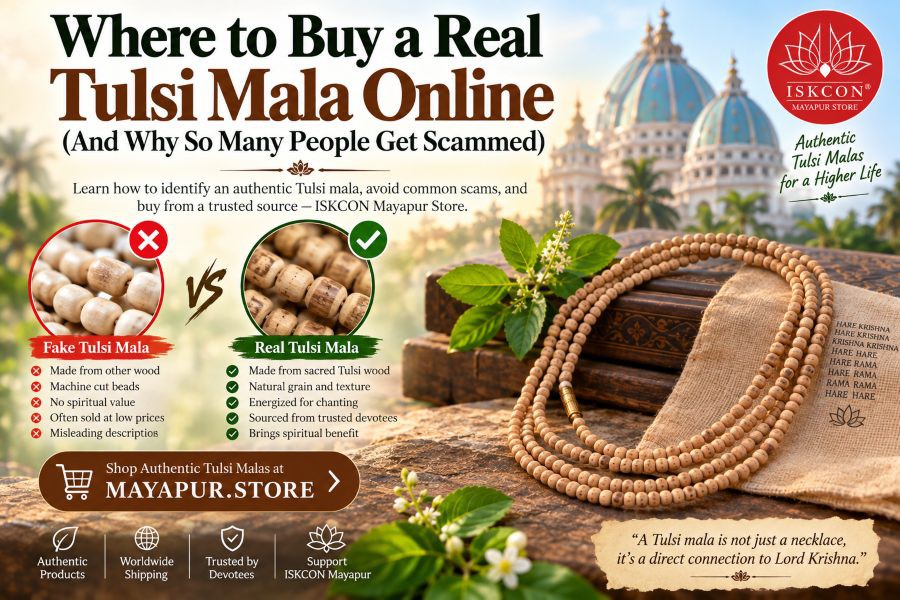 Where to Buy a Real Tulsi Mala Online Most tulsi malas sold online are fake, dyed, or mislabeled. Here's how to spot genuine tulsi wood, why traceability...Read more
 -
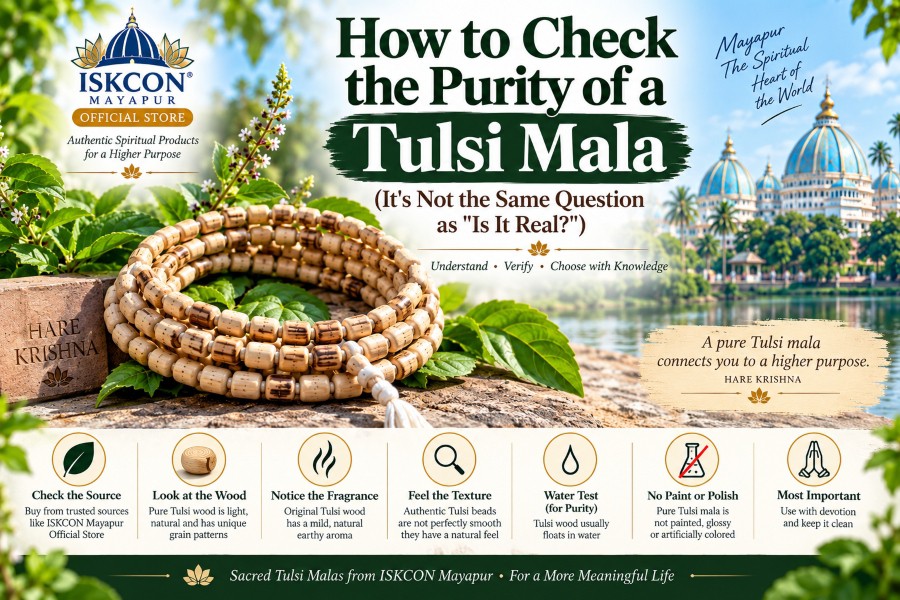 How to Check the Purity of a Tulsi Mala (It's Not the Same Question as "Is It Real?")Purity isn't the same as authenticity. Here's how to check both — whether the beads are genuinely tulsi wood, and...Read more
 -
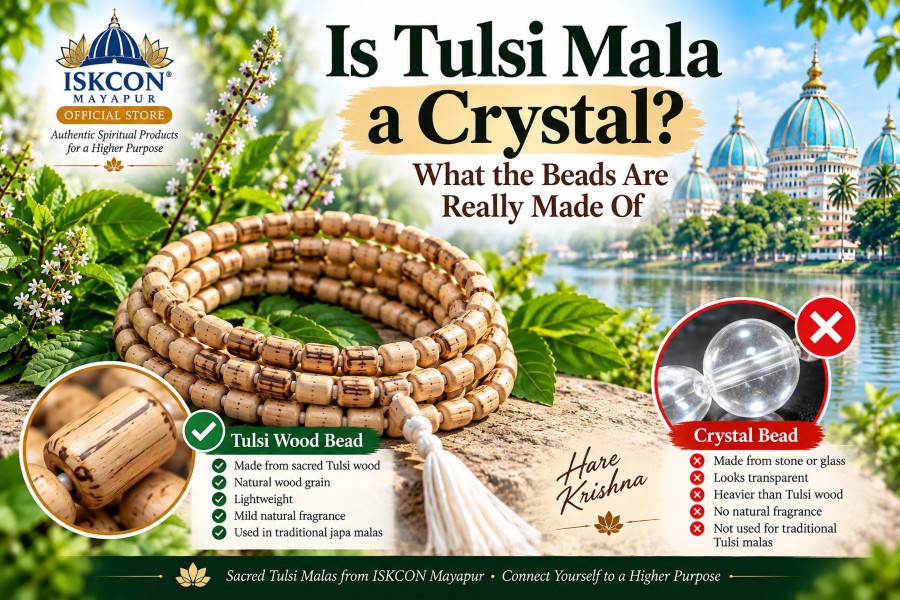 Is Tulsi Mala a Crystal? What the Beads Are Really Made OfTulsi malas often get mistaken for crystal jewellery online. Here's what tulsi beads are actually made of, why the...Read more
 -
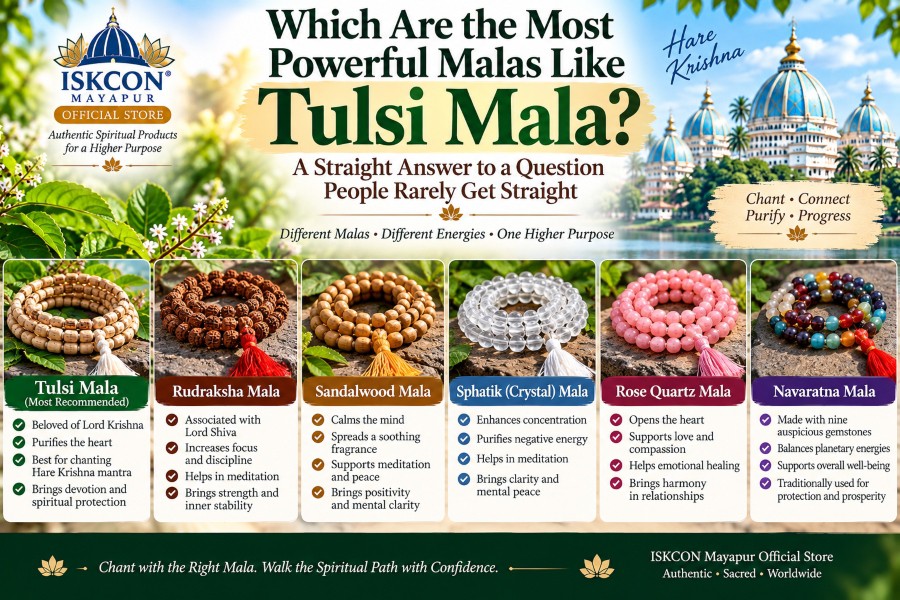 Which Are the Most Powerful Malas Like Tulsi Mala? A Straight Answer to a Question People Rarely Get StraightTulsi, rudraksha, sphatik, sandalwood, and navratna are all called "powerful" — but each belongs to a different...Read more
 -
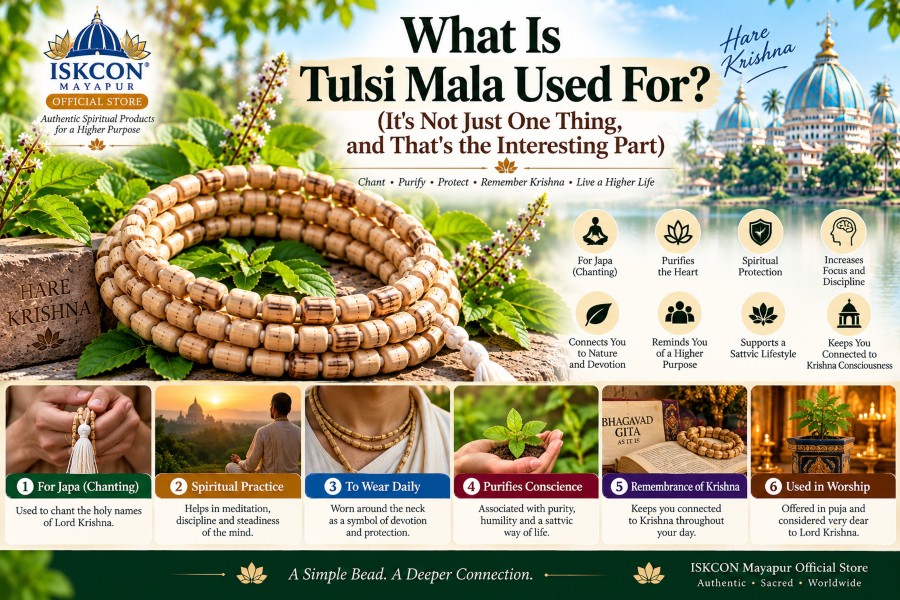 What Is Tulsi Mala Used For? (It's Not Just One Thing, and That's the Interesting Part)A Tulsi Mala isn't just one thing — it's worn daily, used to count mantras, given as a spiritual milestone gift, and...Read more
Leave a comment